The Argentine political scene is undergoing a silent mutation. It is not manifested solely in Congress, nor in official offices, nor even in traditional party disputes. It occurs in a more diffuse, more emotional territory, and for that reason, more effective: the intersection of religion, territory, and political power. In this space, evangelical churches—especially those of Pentecostal roots—have ceased to be peripheral actors to become devices of legitimization, mobilization, and political support in a context of structural crisis of the State and the parties.
This is not a budding theocracy or a clerical conspiracy. The phenomenon is more complex, and thus more unsettling: faith as informal political infrastructure, capable of filling state absences, organizing meanings, and providing symbolic refuge to crisis-ridden leaderships.
From the margin to the center: political visibility and opportunity
A recent data point encapsulates the change of era. In the Argentine Parliament, there are nine legislators who profess evangelical faith or maintain direct ties with churches of that creed, all currently within La Libertad Avanza. They do not have their own legislative agenda or organic coordination. Their priority, for now, is to unconditionally support the program of President Javier Milei.
This growth does not respond to a strategy planned by the churches, but to an accelerated process of visibility, catalyzed by the emergence of a political space willing to absorb religious identities as political capital. In Gramscian terms, we are not facing a consolidated historical bloc, but rather a tactical convergence between actors who share cultural enemies, moral languages, and a common understanding of the social order.
The soft power of media evangelism
Figures like Dante Gebel represent a distinct and particularly sophisticated modality of political intervention, that of religious soft power. Without engaging in party militancy, his discourse articulates conservative values, charismatic leadership, and a narrative of self-improvement that resonates with contemporary political imaginaries, both in Argentina and worldwide.
This type of leadership shapes cultural climates, legitimizes worldviews, and produces common sense. In politics, this capacity to organize collective emotions is often more determinant than a slogan or a ballot.
Milei, the pastors, and the logic of refuge
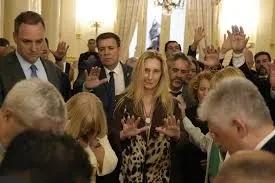
The relationship between President Milei and certain evangelical leaders starkly exposed this logic. In a moment of extreme political fragility—with governors and legislators advancing initiatives that eroded presidential power—Milei chose to present himself alongside pastors with remarkable capacity for mobilization, in packed temples and carefully ritualized settings.
Recent history offers clear parallels: Donald Trump in the United States, Jair Bolsonaro in Brazil, and much of the global far-right found in evangelism an invaluable intermediary. As researcher Ariel Goldstein points out, Pentecostal churches function as support political structures for leaders who lack backing from traditional actors. In exchange, they receive proximity to power, recognition, and state benefits.
Faith, thus, operates as a substitute for governability.
Money, prosperity, and opacity
The most sensitive—and least honestly discussed—issue is financing. The so-called Prosperity Theology, dominant in wide sectors of contemporary evangelism, redefines the relationship between religion and wealth; money ceases to be suspicious and becomes proof of divine blessing.
Accounts of financial miracles, temples built with million-dollar budgets, and foundations that receive public resources without the same controls as other social actors reveal a concerning gray area. Not because there is an automatic illegality, but because opacity becomes structural.
Churches, unlike political parties, do not account systematically, but they influence public policies, manage social assistance, and articulate territorially with the State.
The myth of the “evangelical vote”
It is advisable to dismantle a frequent simplification. In Argentina, there is no homogeneous “evangelical vote.” The evangelical field is plural, fragmented, and marked by internal disputes. The tensions between religious federations in light of Milei's rise clearly demonstrated this.
However, this diversity does not neutralize their influence. On the contrary: it makes it more flexible and adaptable. Where there is no party discipline, there is territorial capillarity. Where there is no rigid electoral structure, there are active community networks in neighborhoods, prisons, and areas where the State is slow to respond or does not arrive at all.
Deep affinities: morality, merit, and order
The tacit alliance between evangelism and new right-wing movements can be explained by the moral agenda (abortion, gender, family) and by an ethic of individual effort, a distrust of the collective, and a moralized reading of poverty.
While traditional Catholicism could conceive of poverty as a virtue or destiny, evangelism proposes overcoming it as a spiritual mandate. This logic dialogues without friction with contemporary economic liberalism: if you are poor, it is because you have not yet done enough.
Faith, power, and the future of democracy
The influence of the evangelical church in Argentine politics is not an imported trend. It is the result of structural transformations: a crisis of representation, the withdrawal of the State, the delegitimization of traditional politics, and a desperate search for meaning in contexts of uncertainty.
The challenge is not to prevent religious participation in the public sphere—that would be as naïve as authoritarian—but to establish limits, rules, and transparency mechanisms. When faith becomes unchecked power, it ceases to be a private belief and transforms into an informal political architecture, difficult to audit and even harder to dismantle.
What kind of democracy will emerge when prayers, territorial networks, and political power are definitively intertwined?

Comments