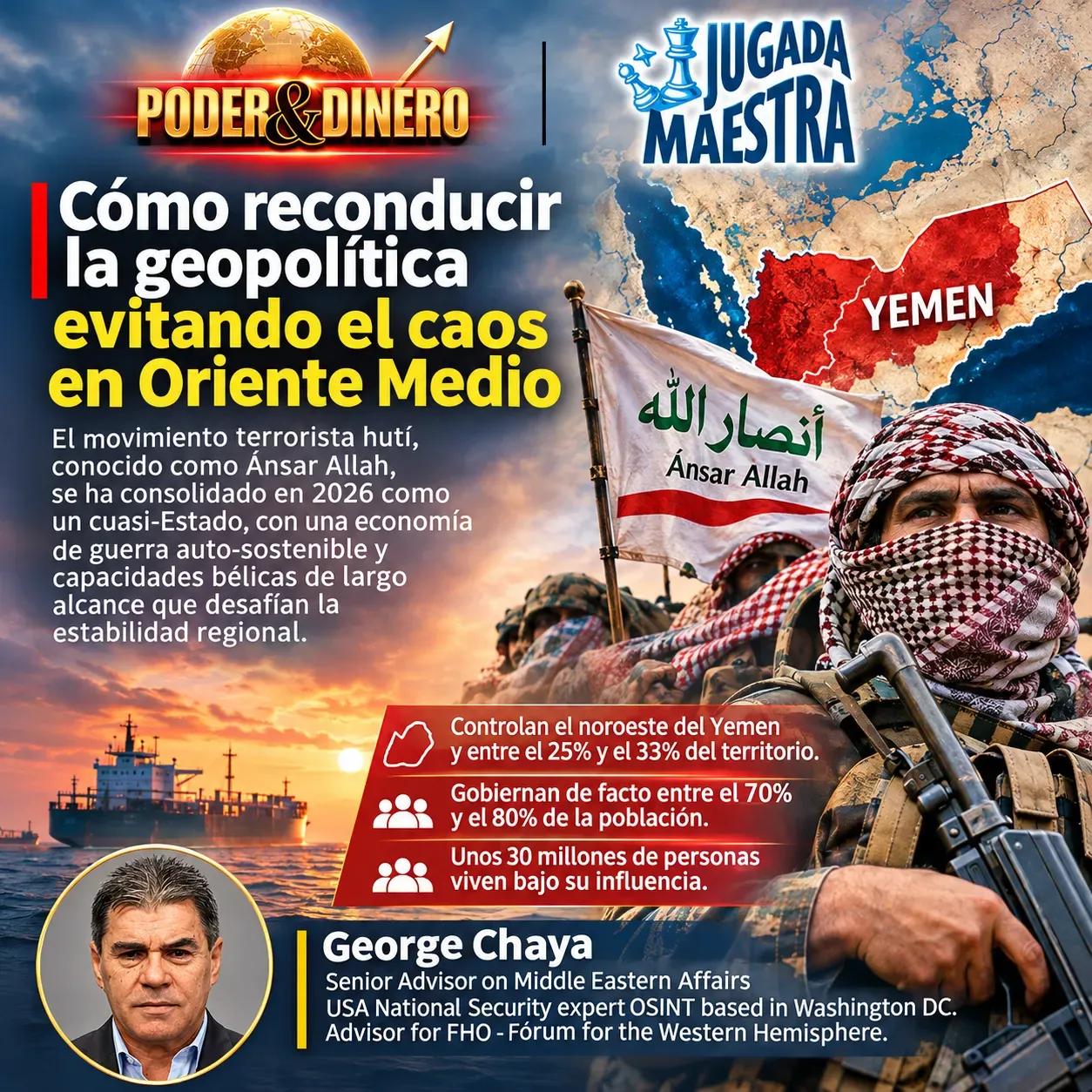
The Houthi terrorist movement, whose military force is known as “Ansar Allah” (soldiers or protectors of God, in Spanish) has consolidated itself in 2026 not as a simple rebel militia, but as a quasi-state, with a war economy, yet sustainable and with advanced long-range military capabilities that has managed to operate to generate serious problems for regional geopolitics.
The group controls the northwestern region of Yemen and manages between 25% and 33% of the geography of its country. However, it effectively governs between 70% and 80% of the total population of the country. Thus, about 30 million people are under its influence.
Many in the West wonder how it is possible that the group has thrived and still maintains combat capacity after receiving severe US airstrikes in recent months. The answer is simple: “This has been made possible through the smuggling of technology provided by the Quds Force, the armed branch of the Iranian IRGC, and through an aggressive reconfiguration of the Yemeni private sector. The Houthis have also had the freedom to transform the Bab el-Mandeb Strait (“the gate of pain or crying” in Spanish, this name originates from the number of shipwrecks recorded there for hundreds of years).
The strait is the largest bottleneck for global maritime trade, and today the Houthis openly challenge Western military coalitions, primarily the administration of US President Donald Trump and Israel.
The strengthening of this group is recent and occurs in late September 2026, as the military dynamics in Yemen undergoes a profound metamorphosis. After the collapse and formal dissolution in early 2026 of the Southern Transitional Council, historically backed by the United Arab Emirates, the forces of the Presidential Leadership Government based in Aden remained as the only ground rival of the Houthis under the direct protection of Saudi Arabia.
In a maneuver politically backed by the Saudi Coalition, (the Yemenis confronting the Houthis) mobilized nearly 100,000 troops in an ambitious ground campaign aimed at regaining control of the entire Red Sea coastline and surrounding -to later isolate- the historical capital, Sana'a.
However, far from yielding ground, reports of recent fighting indicate that the Houthis launched fierce and successful counterattacks in the significant province of Taiz. Through these operations, they not only contained the advance of government forces but captured new geographical enclaves and tactical heights that optimize and favor their line of fire against the Bab al-Mandeb strait, thereby reaffirming and expanding their control over the capital Sana'a and the provinces that have been in military dispute since mid-2025, such as Sa’dah, Amran, and Dhamar. They have also returned and dominate the strategic ports of Hodeida and Salif, which configure fundamental objectives for deploying their asymmetric military operations.
To sustain a war effort of such magnitude against global powers, Ansar Allah dismantled “the traditional business ecosystem of Yemen.” OSINT reports (open-source intelligence) reveal that the militia revoked over 4,000 traditional business licenses to transfer logistical, food, and energy control to monopolies managed by capital and front men affiliated with its leadership. Through this parallel institutionality, they manage to evade Western financial sanctions and global terrorism designations issued by the international community, and their monthly revenues continue to accumulate interesting sums of money to finance their military efforts, while public salaries in the civil sector in northern Yemen remain frozen.
The country faces a humanitarian catastrophe with 21 to 22 million people dependent on international assistance. This crisis has worsened after the World Food Program (WFP) was forced to partially suspend aid in the north due to a lack of safety guarantees for its operatives (several were kidnapped and killed there).
The technological arsenal of the terrorist group consists of precision missiles and drones that they did not possess before August of this year. The transformation of the Houthis from a tribal guerrilla with Soviet Kalashnikov rifles into an asymmetric precision attack force responds to systematic technological transfer from the Iranian Revolutionary Guard (IRGC) and, according to recent reports from Western intelligence, to logistical support from financial networks linked to Russia.
Their current strategic arsenal is divided into three lethal vectors: long-range ballistic and cruise missiles of the Quds-3 and Quds-4 series. Ground-attack cruise missiles with an actual operational range of 1,300 to 2,000 km. These weapon systems have proven their effectiveness by hitting critical Aramco infrastructure in Saudi Arabia, causing significant material damage and losses of millions of dollars to the House of Saud. They also have the Zulfiqar and Toufan, which are liquid-fueled ballistic missiles with estimated ranges between 1,400 km and 1,700 km, designed to carry conventional explosive warheads of high destructive power.
The terrorist group has also recently acquired anti-ship systems (ASBM and ASCM) advanced variants like Aseef and Tankil, equipped with electro-optical infrared guidance systems, capable of attacking moving merchant vessels. This arsenal is complemented by Unmanned Aerial Vehicles (UAVs) capable of changing the landscape of geopolitics in the region and any diplomatic agreements that may be attempted to resolve various regional crises. For this purpose, the Houthis have received kamikaze drones (Wahid / Shahed-136) with delta-wing platforms and a range exceeding 2,000 km., these drones are highly dangerous given their ability to fly at very low altitudes, allowing them to evade conventional radar using the complex Yemeni coastal geography. To this, asymmetric naval capabilities must be added.
Such as the use of contact naval mines, unmanned high-speed surface boats that carry substantial amounts of explosives (WBIED or suicide boats) directed by GPS and real-time video signals. These very low-cost manufacturing tools can neutralize billions of dollars invested in high-tech frigates by the West.
This scenario allows projecting future short-term scenarios (2026-2030), where the crisis provoked by the Houthis has ceased to be a temporary disruption and has become a structural variable of maritime trade and global geopolitics. In response, the international coalitions (such as the US operation Prosperity Guardian or the naval missions of the European Union) achieve tactical successes by intercepting projectiles in the air. However, total military deterrence is unfeasible. Due to the ease of hiding and resupplying drones and missiles in the rugged geography of northern Yemen, the Houthis maintain a constant asymmetric capability, and the reality is that the Red Sea remains semi-blocked for merchant fleets linked to the West.
This scenario will lead to Western/Israeli reprisals against Iranian and Yemeni territory, Tehran and Sana'a coordinating actions to activate simultaneous blockade threats of the Strait of Hormuz and the Strait of Bab el-Mandeb in a coordinated manner, aiming to strangle the flows of crude oil to Asia and Europe, in an attempt to paralyze a large part of the global industrial economy.
The Houthis are unlikely to agree to definitively suspend their maritime attacks in exchange for international official recognition of their government in Sana'a, the lifting of customs sanctions, and the provision of funds for reconstruction. Iran will not allow it. However, by retaining their armament infrastructure intact, the stability of transit through the Red Sea will perpetually depend on a political thread. The persistence of the Houthi crisis completely redefines the costs of international supply chains.
The solution to the Houthi conflict is not foreseen through a conventional military victory by the West. The resilience demonstrated by the leadership of Ansar Allah against bombing campaigns indicates a high capacity for damage absorption, interpreting the conflict not as a transitory friction but as a fundamental element of its internal political legitimization and its strategic role, even surpassing the reputation of a diminished Hezbollah within the Axis of Resistance led by Iran. Any sustainable resolution, according to analyses from international foreign ministries, will demand a multifaceted approach: effectively strangling the ghost financial networks of cryptocurrencies and smuggling Iranian crude that feed the group, and directly strengthening the institutional capacities of legitimate Yemeni naval forces based in Aden to take effective control of their territorial waters. Until this occurs, shipping companies will operate under a “new normal” where the Red Sea will continue to be a zone of latent danger.
George Chaya.
Prof. George Chaya, is a Senior Advisor on Middle Eastern Affairs USA National Security expert OSINT based in Washington DC. Advisor for FHO -Fórum for the Western Hemisphere.

Comments