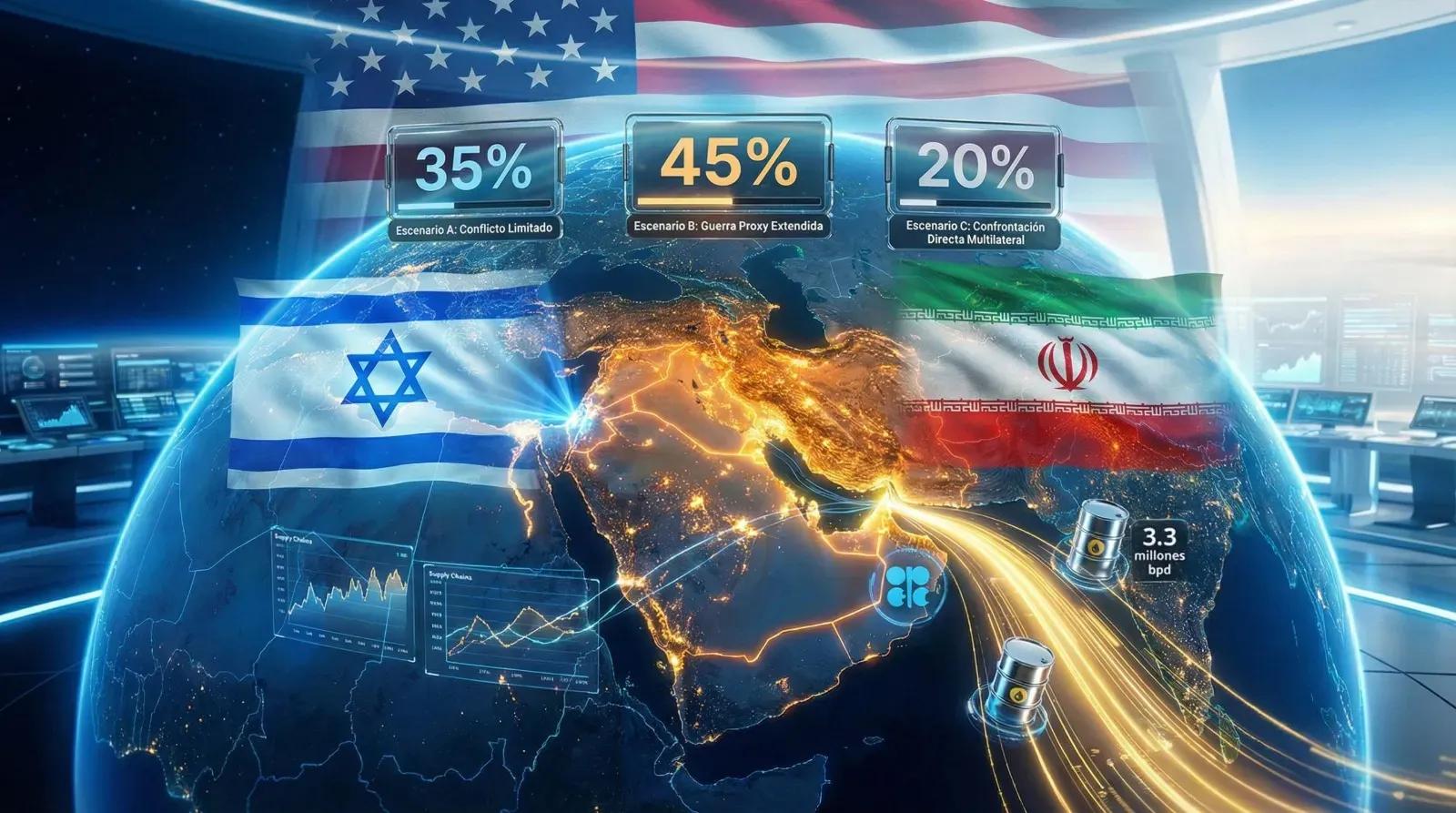
The apparent calm that followed the last truce in the indirect confrontation —and increasingly less covert— between the United States, Israel, and Iran is far from being interpreted as a step toward détente. On the contrary, multiple signs suggest that the involved actors are using this period of waiting to bolster their military capabilities and redefine their strategic objectives. The region, far from stabilizing, may be entering a preparatory phase of greater military intensity, in a context marked by the fragility of the informal ceasefire that ended the twelve-day war in June 2025 and the fear of a resumption of large-scale hostilities.
The most alarming signals come from the ground itself. According to information collected by Defence Review, at least six cargo planes from China have landed in Iranian territory in recent days with their transponders turned off, suggesting operations to transfer sensitive material. Suspicions point to air defense systems and missiles at a time when Tehran seeks to bolster its vulnerability to potential airstrikes. This activity fits into a broader pattern of growing military cooperation between Iran, Russia, and China, solidified since the war in Ukraine and Moscow's international isolation, and has been recently confirmed by Iran's Foreign Minister, Abbas Araghchi, who admitted in an interview that his country receives “military cooperation” from both strategic partners, without going into details but emphasizing the depth of political, economic, and defensive ties.
Additionally, there has been the documented appearance, by OSINT sources, of a Russian MANPADS Igla-S at a public event in Ahvaz, an armament not previously registered in Iranian arsenals. Although the evidence is still fragmentary, it fits a broader pattern of growing military cooperation among Iran, Russia, and China, which includes not only transfers of drone and missile technology but also Russian satellite intelligence to improve the precision of Iranian attacks and Chinese supplies of dual-use components that enhance Tehran's defense and counterattack capabilities.
In parallel, Iranian official rhetoric has hardened. A spokesman for the Islamic Revolutionary Guard Corps warned that any attack on energy infrastructure will be responded to “in kind”, including the possibility of mining the Strait of Hormuz or closing Bab el-Mandeb, two key arteries of global energy trade. This threat is not empty rhetoric: recent U.S. intelligence reports, collected by media such as Axios and CBS News, indicate that Iran may have already placed new naval mines in Hormuz in recent weeks —at least a dozen according to Washington estimates— increasing the risk of incidents that could trigger an immediate and disruptive escalation for global energy markets. Maritime security experts warn that these actions, combined with the possible loss of control over some of the mines by the Iranian Navy itself, could prolong the effective blockade of the Strait and generate a global economic shock with unpredictable consequences for oil prices and the stability of trade routes.
On the Israeli side, statements from Defense Minister Israel Katz leave no room for ambiguity. In a recorded message, Katz stated that his country is awaiting the “green light” from Washington to resume military operations against Iran, anticipating a strategy centered on attacking critical energy infrastructure. “Things will be different now,” he warned, promising to take Iran “to the dark ages” if necessary. These statements reflect a significant doctrinal shift and align with recent announcements from Katz himself, who has insisted that joint Israeli and U.S. attacks against the Iranian regime and its infrastructure “will significantly increase” in the coming days, emphasizing symbolic targets of state power and internal repression mechanisms. Israel seems to consider that the previous phase of the conflict did not achieve its strategic objectives and that a new campaign should focus on weakening the Iranian regime's economic base rather than limiting itself to conventional military targets or shadow warfare.
Meanwhile, the United States has visibly intensified its military deployment in the region. The arrival of the USS George H.W. Bush (CVN-77) aircraft carrier in the Central Command operational area raises to three the number of deployed strike groups, alongside the USS Abraham Lincoln and the USS Gerald R. Ford. This naval concentration has no recent precedents outside of open warfare contexts and represents an unparalleled demonstration of strength, aimed both at deterring and preparing for possible sustained operations of air superiority and maritime control. Moreover, the interception of a supertanker linked to Iranian exports —the M/T Majestic X— in the Indian Ocean suggests that Washington is rehearsing maritime control doctrines intended not only for Tehran but also to send a strategic message to Beijing. The global dimension of the conflict is thus becoming increasingly evident, with implications that transcend the region and directly affect global energy security and the balance of power in the Indo-Pacific.
On the regional level, non-state actors aligned with Iran have also stepped up their rhetoric. Hezbollah, through its leader Mahmoud Qamati, warned that any resumption of Israeli attacks will be met without time limits, anticipating a prolonged war. This positioning reinforces the idea that the conflict could quickly expand to multiple fronts, from Lebanon to Iraq and Yemen, reactivating proxy networks that, although weakened after previous confrontations, still represent a significant asymmetric threat.
International analysts agree that the current truce has classic characteristics of an “operational pause”. Former U.S. diplomat Dennis Ross has pointed out on several occasions that “truces in the Middle East are rarely preludes to peace; they are often intervals to rearm”. In a similar vein, International Crisis Group expert Ellie Geranmayeh has warned that the current balance is “extremely fragile” and that any incident in the Gulf could trigger a large-scale escalation, with risks of a prolonged conflict leading to global economic shocks and altering the security landscape throughout the region.
One of the most alarming scenarios emerging in this context is the still remote but increasingly discussed possibility that the United States may consider the use of tactical nuclear weapons in the event of an open conflict with Iran. Although no senior official has publicly raised this option, U.S. military doctrines foresee their use in high-intensity situations against hardened or deeply buried targets, such as Iranian nuclear facilities. However, experts like Lawrence Freedman emphasize that the use of such weaponry would have “incalculable” geopolitical consequences, not only due to the Iranian response but also because of the impact on the global non-proliferation architecture. In Freedman’s words, “crossing that threshold would transform a regional conflict into a first-order international crisis”.
For now, deterrence remains the dominant language. But the accumulation of forces, the hardening of rhetoric, signs of rearmament, and confirmation of external support for Iran suggest that the truce may merely be a fleeting illusion. In the Middle East, where recent history is marked by sudden escalations after periods of apparent calm, the question is not so much whether hostilities will resume, but when and with what intensity, on a board where each move by the main actors —and their allies— redefines the delicate balance between containment and total confrontation.

Adalberto Agozino is a PhD in Political Science, International Analyst, and Professor at the University of Buenos Aires

Comments