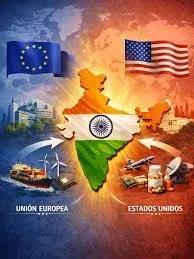
In less than two decades, India has transitioned from being considered an emerging power to establishing itself as one of the vertices of the new multipolar landscape. With over 1.4 billion inhabitants and growth that has hovered around 7% in recent years, the Asian country has not only surpassed the United Kingdom in economic size but aspires to redefine the rules of international order.
Prime Minister Narendra Modi has made this ambition a pillar of his foreign policy. “This is not the time for war”, he stated in 2022 regarding the conflict in Ukraine, a phrase that encapsulates India's strategy: strategic autonomy, rejection of bloc logic, and a claim for reformed multilateralism.
This vision was clearly articulated by Indian diplomat T. S. Tirumurti, former ambassador to Spain, who advocated for the need for a “reformed multilateralism” that provides greater representation for the Global South. In his assessment, the international system that emerged after World War II does not reflect the realities of the 21st century and marginalizes emerging powers.
India holds that it can no longer remain a secondary actor in global governance when it is the most populous nation in the world and one of the largest economies.
Foreign Trade: Between the United States, China, and the Gulf
India has become an essential node in global trade. Its main trading partners are the United States, China, and the United Arab Emirates, followed by Saudi Arabia and the European Union.
The United States has solidified its position as its primary individual trading partner, with an exchange exceeding $190 billion annually. India exports technological services, pharmaceuticals, textiles, and manufactured goods, while importing advanced technology, hydrocarbons, and military equipment. The link with Washington has acquired unprecedented strategic density, driven by the shared rivalry with China.
However, the relationship with Beijing is more ambiguous. China is one of the largest suppliers of intermediate goods and industrial technology for India, but at the same time, it is its main strategic rival in Asia. Border tensions in the Himalayas and competition for influence in the Indian Ocean and South Asia coexist with bilateral trade exceeding $130 billion.
In the Gulf, India finds not only energy suppliers but also key financial partners. Millions of Indian workers in the UAE and Saudi Arabia maintain a steady flow of remittances, while New Delhi secures its oil and gas supply.
BRICS and Global South Diplomacy
India is a founding member of the BRICS, a forum it shares with Brazil, Russia, China, and South Africa, and which has expanded its membership in recent years. At the Johannesburg summit in 2018, Modi first proposed the idea of a reformed multilateral order that is more representative and less dominated by powers.
During its G20 presidency in 2023, India pushed for the African Union's inclusion as a permanent member, a gesture aimed at reinforcing its leadership among developing countries. New Delhi also organized the Global South Voice Summit, with the participation of over a hundred countries, to convey their demands to the forum of major economies.
In the United Nations Security Council, where it held a non-permanent seat from 2021 to 2022, India advocated for reform of the body and the expansion of its permanent members. “The days of a small group of countries deciding what the world should do are over”, Tirumurti emphasized.
The Military and Industrial Muscle
Strategic autonomy does not mean isolation. India actively participates in the Quadrilateral Security Dialogue (Quad) alongside the United States, Japan, and Australia, a mechanism designed to counter China's expansion in the Indo-Pacific. It also maintains a historic military cooperation with Russia, the main arms supplier for decades, although in recent years it has diversified its purchases towards France and Israel.
At the same time, New Delhi is promoting an ambitious domestic production policy in defense. Companies such as Tata Advanced Systems have expanded their international presence, including agreements to manufacture military vehicles in Morocco, in a strategy that combines economic diplomacy and security projection in Africa.
Retired General V. G. Pantakar recently emphasized that the Indian Army produces “affordable and reliable” equipment, in an effort to position the country as a competitive exporter of technology.
Strategic Rivalries: China and Pakistan
India's international projection cannot be divorced from its immediate environment. It maintains a historic rivalry with Pakistan centered on Kashmir, a region that has been the stage for wars and recurrent clashes. With China, the territorial dispute in Aksai Chin and Ladakh has triggered military clashes in recent years.
Despite these tensions, India avoids automatic alignment with the West. It has continued to purchase Russian oil despite sanctions due to the war in Ukraine and defends a position of balance that allows it to maximize its maneuvering space.
Internal Challenges, Global Ambitions
The international ascent coexists with domestic tensions. Analysts like Shibu Thomas warn that population growth, youth unemployment, and inequality could erode the demographic dividend if not managed.
India aspires to achieve carbon neutrality by 2070 and faces enormous environmental and social challenges.
However, the country has a structural advantage: a young population, a robust technology industry, and an expanding middle class. In a world marked by geopolitical fragmentation, India presents itself as an alternative partner, a counterweight, and at times, a mediator.
Conclusion
India is no longer a peripheral actor or a future promise. It is an indispensable power in contemporary international architecture. Between commercial pragmatism and the advocacy of the Global South, between cooperation with Washington and competition with Beijing, New Delhi has charted its own path.
The question is no longer whether India will be a protagonist in the 21st century, but how it will exercise that protagonism: whether as an arbiter between blocs, as a leader of the Global South, or as a power that, from its strategic autonomy, seeks to redefine the rules of the international system. In any case, the world will have to count on it.
Adalberto Agozino. PhD in Political Science, International Analyst, and Lecturer at the University of Buenos Aires

Comments