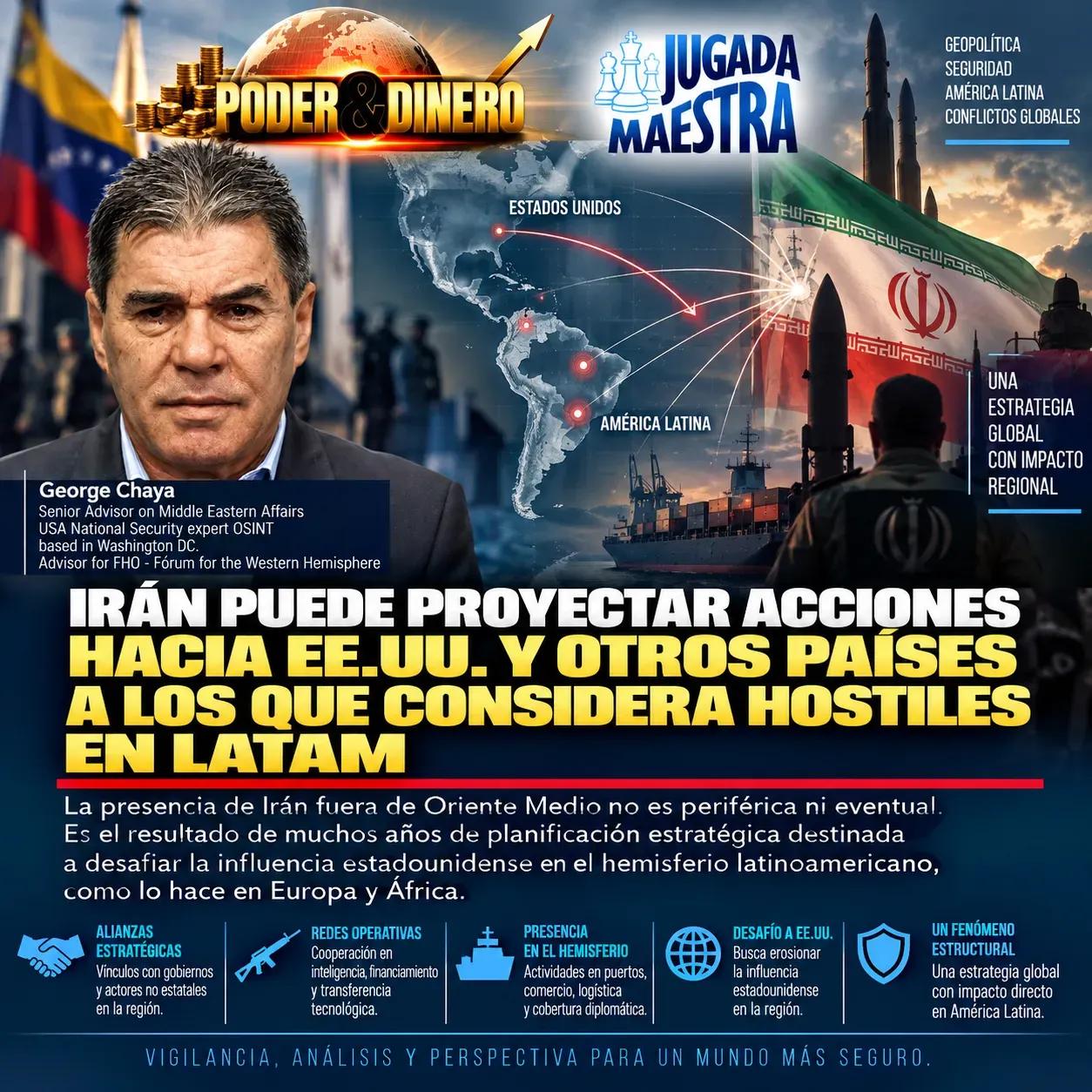
The presence of Iran outside of the Middle East is neither peripheral nor eventual. It is the result of many years of strategic planning aimed at challenging U.S. influence in the Latin American hemisphere, just as it does in Europe and Africa.
Since 1980, especially during the presidency of Mahmmud Ahmadinejad, Tehran methodically cultivated ideological, secret diplomatic, and criminal alliances throughout the region. At the center of this projection is Hezbollah, Iran's most operationally capable and flexible agent. The Tehran regime has fused political indoctrination with illicit finances and paramilitary operations to create a resilient and multifaceted presence in Latin America and has done well in fulfilling that objective on the South American continent.
In the view of specialists and prominent analysts in Washington DC, the alliance with populist and authoritarian regimes, particularly the remnants of Chavista Venezuela, Evo Morales' Bolivia, Nicaragua, Cuba, Brazil, and with the recent change of government, Uruguay, can provide Iran not only with capacity for diplomatic and institutional action but also with platforms for asymmetric warfare alongside a logistical infrastructure capable of supporting covert actions in LATAM.
The escalation of conflict in the Middle East must always be a warning that the Western Hemisphere should not lose sight of. Iran considers its greatest enemy (the United States) very close to LATAM, and it is also in that region where Hezbollah's presence has its most extensive network, far surpassing the organization's networks and presence abroad.
In Latin America, Hezbollah far surpasses its own presence in Africa and Europe. In recent years, to mention just one country, its operations have amplified in Brazil, first with what became known as “Operation Trapiche” and recently with legal and police actions known as “Operation Hawala.”
On the other hand, the precise military action executed by the U.S. on Iranian nuclear facilities resulted in the destruction of key nuclear installations and severely degraded Iran's missile system capabilities. However, ongoing military operations should not be interpreted as a provocation aimed at deepening the war by Washington. Rather, they represent a deterrent measure aimed at promoting a peaceful solution to curb Iran’s attacks against U.S. military bases and its Sunni allies in the Gulf. The measured and precise attack against Iran's nuclear facilities has been a tactic of the strategy that forms the doctrine of pacification through force of the administration of President Donald Trump.
The U.S. administration does not desire war, and if the Iranian regime wants to survive, it should not drag the U.S. into a deepening of the ongoing war. The relevant question in this context is: what can we expect from Iran?
Rationally, its leaders should initiate and maintain a responsible and serious dialogue with the U.S. to find a way to avoid direct and sustained military confrontation, which Tehran cannot win. However, it is most likely that the Iranian regime will resort to the tactic it has mastered since its rise to power from the early days of the Islamic revolution, namely asymmetric warfare through its allies such as Hezbollah and its ideologically satellite militias in Iraq, Yemen, Lebanon, Africa, and also with its networks in LATAM.
The impact of a defeat and the eventual collapse of its regime would cause significant damage in Latin America, primarily divided into severe inflationary economic shocks and a latent threat of asymmetric security through its networks of illicit financing and operational cells present in the LATAM region that perfectly offer options for attacks that Iran can carry out beyond conventional warfare through terrorist attacks, as has already happened in the 1990s in Argentina and Panama against Jewish/Israeli targets and could add opportunity targets on U.S. interests. It is also in LATAM where Iran has the capacity to launch misinformation campaigns to generate regional instability. According to analyses and reports from U.S. think tanks, militant immigration could be one of the ways to operate those campaigns. Although geographically the epicenter is in the Middle East, the global interconnection and the networks Tehran has woven for decades expose the region to severe repercussions in terms of terrorist threats to security given its asymmetric networks with capacities for terrorist actions.
Unlike Western powers, Iran does not project its power in Latin America through conventional armies but through hybrid warfare using proxy forces, mainly Hezbollah and the Revolutionary Guard (IRGC). If the Iranian regime were to collapse or enter a phase of extreme desperation, the security damage would manifest in these ways, so retaliatory attacks should not be ruled out. Historically, the region has been the scene of attacks (such as the attacks on the Israeli Embassy and AMIA in Argentina in the 1990s). In a scenario of regime collapse, the embassies of Israel or the United States on Latin American soil, as well as local Jewish communities, would become primary targets for “sleeper cells” ready to hit where the West presents greater vulnerabilities.
In conclusion, and as a regional summary: The “collapse” of Iran will not bring immediate peace to Latin America. Economically, the initial impact will likely be an inflationary wave that will weaken local currencies against the dollar, followed by a potential activation of terrorist or criminal contingencies by criminal franchises aligned with the regime that operate autonomously in the shadows of the continent.
Another card Tehran holds through its adherents and militants in Mexico is to generate a humanitarian crisis at the Southern border of the United States by attempting to introduce hundreds of people through a new caravan of immigrants that could trigger not only a serious immigration-humanitarian-border issue but also a new conflict in the region.
Despite the plausible denial and alarming intellectual deficiency in the responses of those who call themselves specialists or worse still: “independent analysts,” but who surreptitiously support everything that confronts their own culture and the West in particular, striving to provide a support scenario while not hiding their deep desire to see the destruction of the Jewish state is an undeniable reality.
The Islamic Republic of Iran can harm the United States and more easily LATAM primarily through global economic warfare, tactical military saturation, and the activation of extremist cells or regional influence networks. Although militarily it will not be able to defeat U.S. forces in direct combat, the Iranian strategy is designed to wear down Western resources, destabilize the global economy, and exploit geopolitical alliances in the Western Hemisphere.
Iran's plan does not seek a conventional military victory but rather to make the conflict difficult to sustain for Washington through mechanisms of blockade and disruption, for example, at the Strait of Hormuz. Iran also has the capacity to utilize drones, missiles, and sea mines to obstruct passage through that most critical oil maritime route in the world. This, as has been periodically seen, drives global crude prices up, pushing the normal economy of the American taxpayer towards discontent.
Tehran also bets on the “fantasy of its propaganda” about the exhaustion of U.S. military inventory (typical failed and attrition strategies in asymmetric wars) through the mass and constant launch of very low-cost drones and ballistic missiles, Iran will consistently seek -and while permitted- to saturate allied defensive systems. This compels Washington to consume considerable-cost interceptor projectile reserves (like Patriot missiles), which are absolutely replaceable under U.S. war protocol, which can be done without inconvenience for its military industry.
Finally, always focusing on the operational theater of the Middle East, asymmetrical attacks on U.S. regional bases and those of its partners using allied militias from that region, Iran attacks U.S. military bases and logistical chains attempting to force (unsuccessfully) an overextension of its troops and resources. However, returning to the analysis on LATAM, that is where the danger is much more serious; the threats of terrorist attacks against opportunity targets and vulnerabilities are undeniable in the presence of terrorist cells, several military experts warn (to which I adhere) that Iran has influence networks and indirect historical ties in the region, such as through Hezbollah in the Triple Frontier between Argentina, Brazil, and Paraguay, and also now in Uruguay, and under military pressure, asymmetric attacks against Western, U.S. or Israeli targets located on Latin American soil should not be ruled out.
Iran has strengthened political, economic, and military ties with countries aligned with the anti-Washington axis. This can be used not only for the triangulation of money laundering and illicit resources that facilitate the evasion of international sanctions or the establishment of intelligence operations centers that politically destabilize the region. It is not about witch hunts, nor about fanciful counterintelligence measures and controls, or excesses in immigration and border enforcement. It is about implementing, strengthening, and deepening serious National Security policies in a hemisphere that has already experienced devastating terrorist blows outside the Middle East, such as the cases of AMIA in Argentina and flight 901 of Alas Chiricanas Airlines in Panama just one day after the coup in Buenos Aires.
*The Prof. George Chaya, is a Senior Advisor on Middle Eastern Affairs USA National Security expert OSINT based in Washington DC. Advisor for FHO -Fórum for the Western Hemisphere-

Comments