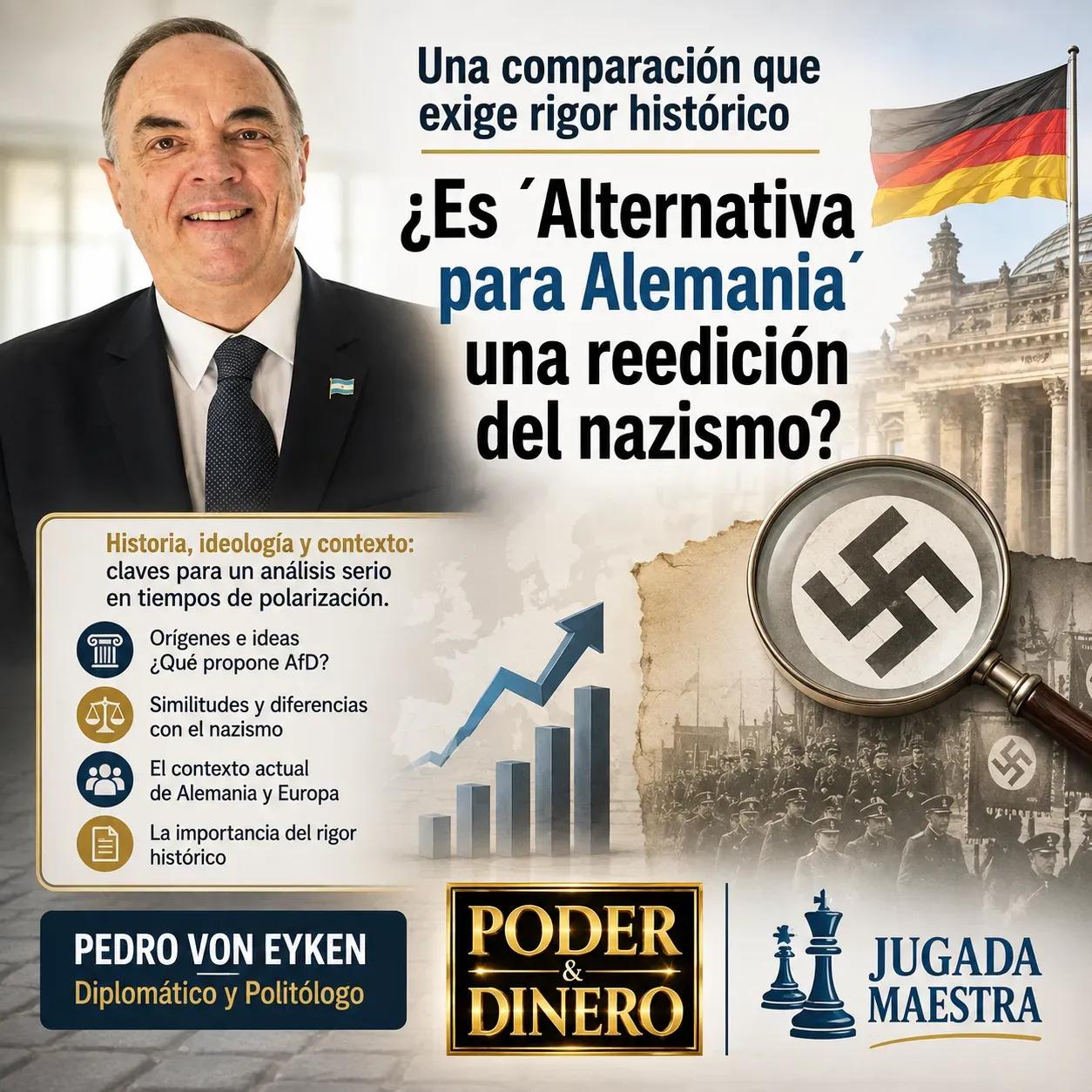
In the German public debate, which I follow as a political scientist and diplomat having lived in the Federal Republic for several years between 1986 and 1998, it is common to compare the party “Alternative for Germany” or “AfD,” for its initials in German, with the Nazi Party. However, from a historical and political science perspective, both organizations present substantial differences in their ideology, objectives, methods, and context. Recognizing these differences does not imply ignoring the controversies surrounding “AfD” nor the criticisms it receives, but rather distinguishing between different political phenomena.
In our country, it is common to label political leaders based on generalizations lacking historical rigor, with the sole intent of disqualifying. For example, is it correct to call every leader or party situated to the right of the political spectrum a fascist -or “facho”-? If fascism is used as a historical and political category, it should be reserved for movements that share the essential features of classic fascism: a strong state, subordination of the individual to the nation or the state, charismatic leadership, rejection of political liberalism, and above all, violent persecution of any opposition or criticism. If all right-wing movements end up being fascist and all nationalism is Nazi, we are no longer describing reality but renouncing the distinction between different political phenomena.
In the case of the “Alternative for Germany” and Nazism, conceptual rigor must be maintained in the political debate and relevant aspects must be differentiated. I choose six aspects for reasons of space: 1) Relationship with democracy, 2) Antisemitism, 3) Racial conception, 4) Political violence, 5) Economy, and 6) Foreign policy.
1)- Relationship with democracy: the NSDAP (German initials of the National Socialist German Workers' Party) explicitly sought the elimination of parliamentary democracy to establish a totalitarian state led by an absolute leader. The AfD participates in elections, holds seats in federal and regional parliaments, and operates within the framework of the German constitution. It is closely monitored by the Federal Office for the Protection of the Constitution, which strictly prohibits the emergence of parties that contradict the free democratic order. After 1949, the democratic state is not obliged to tolerate those who seek to destroy the constitutional order itself. While some leaders have made statements considered undemocratic and the party is under surveillance by intelligence services for alleged extremism, its political activity unfolds through electoral procedures.
2)- Antisemitism: was a central and non-negotiable element of Nazi ideology. Jews were defined as a biological enemy whose elimination became state policy and ended in the Holocaust. In contrast, the AfD does not officially hold an anti-Semitic program. The party recognizes Israel's right to exist and several of its leaders have expressed support for the Israeli state. In fact, part of its rhetoric presents that support as a consequence of its opposition to Islamism. This does not mean that the AfD is free from controversies, as some individual members have been accused of using anti-Semitic stereotypes or relativizing aspects of German historical memory. But those positions do not constitute the official core of its political program, as anti-Semitism defined Nazism.
3)- Racial conception: Nazism defended a biological theory of races, with the supposed Aryan superiority and the inferiority of other peoples. Meanwhile, the AfD centers much of its discourse on issues of immigration, integration, and national identity. Although critics believe that some positions promote xenophobia or ethnic nationalism, the party does not officially propose a biological hierarchy of races comparable to Nazi doctrine.
4)- Political violence: The Nazi movement used, even before it became a government, paramilitary organizations like the Sturmabteilung (SA, Assault Troops) to intimidate and eliminate its adversaries, sabotage revolutionary movements, interrupt other parties' public rallies, and participate in street fights. The Schutzstaffel (SS, Protective Squads) served as personal guards for the party's top leaders. The AfD, on the other hand, lacks paramilitary structures and participates in political competition through campaigns, elections, and parliamentary procedures.
5)- The economy: The Nazi regime established an economy directed towards rearmament and war, with strong state intervention and total subordination of economic activity to the state's objectives. The AfD, on the other hand, proposes a market economy, tax reductions in various areas, and less state intervention in many economic policies.
6)- Foreign policy. Nazism pursued territorial expansion through war and the concept of Lebensraum or living space. The AfD does not advocate for an expansionist policy nor proposes to modify borders through the use of force.
The war between Russia and Ukraine constitutes an area in which the AfD clearly distinguishes itself from the German political consensus. While most major parties support providing military aid to Ukraine and maintaining sanctions against Russia, the AfD advocates for ending arms shipments, opening peace negotiations, and gradually restoring diplomatic and economic relations with Moscow.
This position responds to pacifist, realist arguments and a defense of German economic interests, especially in energy matters. This position does not imply explicit support for the Russian invasion, which the AfD has described as a violation of international law. Analysts and political opponents argue that some statements by AfD leaders have tended to minimize the Kremlin's responsibility and reproduce narratives favorable to Moscow. The AfD rejects that characterization and maintains that its priority is to prevent a military escalation and defend Germany's national interests.
CONCLUSION
In my opinion, the AfD does not propose an expansionist policy or a German hegemony over Europe comparable to past imperial projects, although its conception of European integration differs significantly from that defended by Helmut Kohl for German reunification -which I witnessed closely since 1990-, as it demands a return of powers to national states and a profound reform of the European Union. Nevertheless, criticizing the current process of European integration or advocating for greater national sovereignty does not, in itself, equate to advocating for an expansionist nationalist project like that of the Third Reich.
Pedro von Eyken holds a PhD in Political Science from the Catholic University of Argentina. Former Consul in Finland and Germany, where he also served as Economic Counselor at the Argentine Embassy. Former Ambassador to Haiti and also in charge of Argentina's diplomatic representation in Cuba, serving as Chargé d'Affaires. Author of "Witness of a Betrayed Revolution," a first-person account of his experiences in Cuba, and "Haiti, between Silence and Hunger," a narrative about the violence and chaos that plagues this country.

Comments