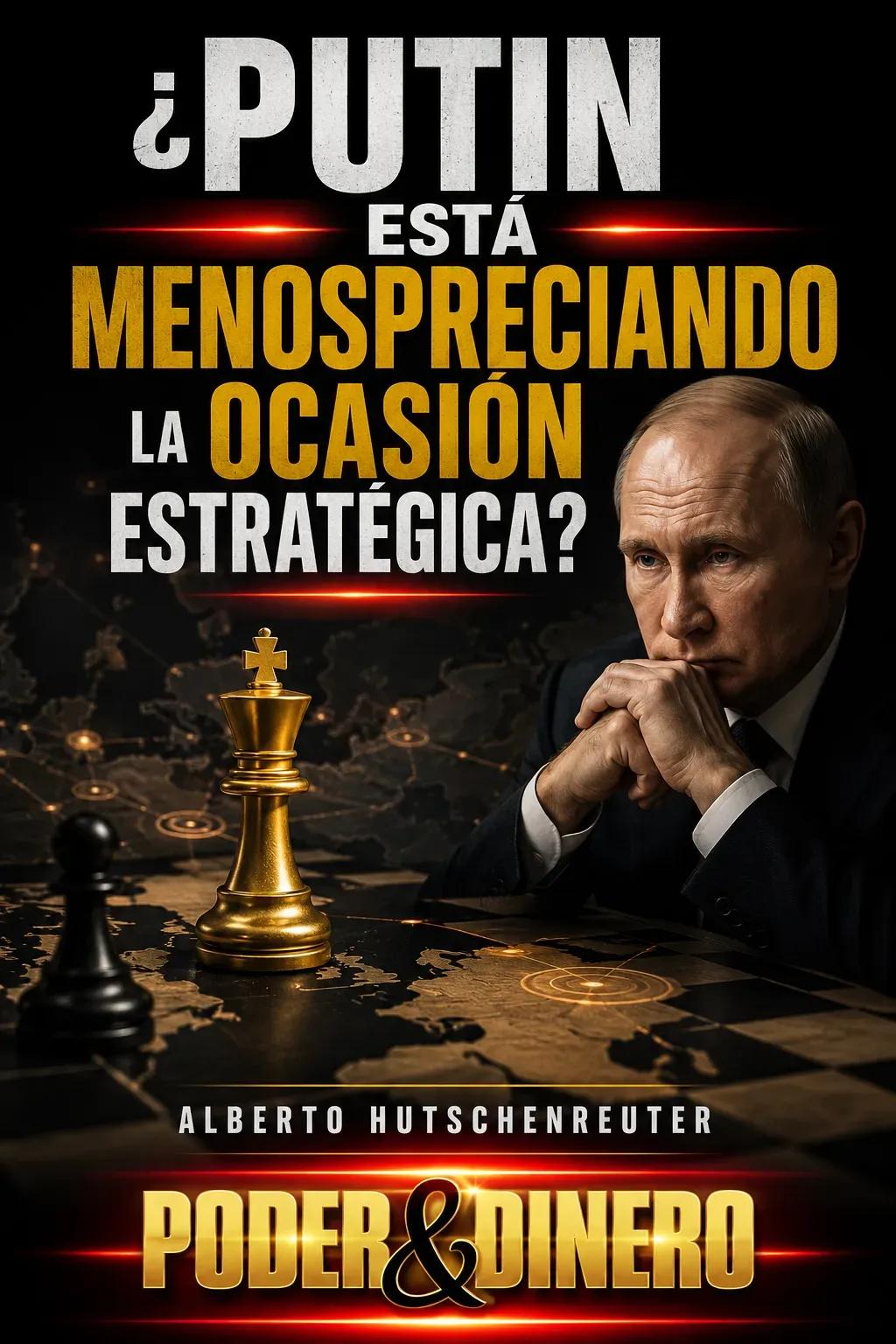
The war in Ukraine has entered its fifth year without either of the warring parties achieving decisive advantages. Neither has Russia managed to go beyond that 20 percent of territorial control captured in the east and south of Ukraine, nor has Kiev succeeded in pushing back the Russian expeditionary forces.
As a result, the scenario of a stagnant war has consolidated. In this context, the actions of both sides tend to increase wear through indiscriminate attacks (particularly with drones) aimed at demoralizing the front in the theater, as well as affecting the key nerve in any war: the political-social cohesion of the parties.
The margin of time, which until not too long ago was a more favorable asset for Russia than for Ukraine, may have shrunk, beginning to erode President Putin, whose approval ratings and trust from society, as an initial indication, have declined for the first time since 2022.
Regarding possible cracks within the power structure in Russia, namely the Security Council, the Ministry of Defense, the Federal Security Service, and the External Intelligence of the Armed Forces, there is no data on this; and what has emerged relates to calls for harsher action in the war.
The concerning aspect is situated in the Russian economy, as, beyond the issue of Russia's reorientation of its oil and gas sales towards the demanding economies of the Asia-Pacific-Indian region, thus moderating the effects of sanctions, the revenues have been used to sustain the war, increasingly "militarizing" the national economy.
Although this had a favorable effect on Russia's economic growth in the years following 2022, since last year this "model" has been showing its limits, even with the high price of crude oil due to the turbulent situation in the sensitive geopolitical plate of the Persian Gulf.
The consequences are evident: unemployment, shortages of consumer goods, inflation, external dependency (mainly on China). The model could only sustain itself if the price of crude remains high, but the international situation is temporary and volatile. Furthermore, Russia continues to delay its economic modernization, the great challenge for the country in the current century if it truly aspires to become a complete power like the United States and China.
To put it in very practical terms: Russian society has begun to pay the high price of a "quiet" war that has cost hundreds of thousands of lives.
Therefore, it is pertinent to ask whether Putin is underestimating the times of war, missing the opportunity to reach an agreement that would grant Russia geopolitical gains concerning its classic concerns, namely having buffer zones or territorial shelter against foreign neocontainment purposes at its borders, and achieving a reinforced neutrality status for Ukraine.
It is true that virtually no scenarios are being assessed in which Russian forces are expelled from eastern and southern Ukraine. Paraphrasing an American general, one might say that "the Russian presence in those territories admits no substitutes." But it is also practically impossible to imagine the scenario of "Ukraine does not exist," meaning one involving a large Russian military offensive resulting in the capture of Kiev, the takeover of the government, and the establishment of a pro-Russian government, which was the goal of the "Special Military Operation" launched on February 24, 2022.
In addition to this situation, Ukraine has shown that it not only withstands fatigue but can also sustain Russian offensives. Of course, this is only possible with the assistance of a Europe that decided not to persuade Kiev to agree with Moscow, while also focusing on developing capacities for a potential confrontation with Russia over the next decade, as, although not all, many in Europe (almost obsessively) consider that Russia's "assertive geopolitical activity" (what the American Stephen Kotkin calls “perpetual geopolitics”) will continue beyond Ukraine.
In other words, Europe previously did not prevent (in fact, made no attempt to) with its “institutional power” diplomacy to dissuade Kiev from "adopting the decision" to move towards NATO membership, knowing (presumably) that this would trigger a forceful response from Moscow, but today it also does not attempt to persuade Ukraine to accept the consequences of that challenging decision made shortly after Zelensky came to power, and to acknowledge the price involved in geopolitically and geographically challenging Russia, a predominantly terrestrial power.
Therefore, perhaps Putin, pursuing objectives in Ukraine that are difficult to achieve, is missing the strategic moment. Just as the West attempted to go beyond victory in the Cold War by pushing NATO further west of Russia, Putin is attempting an absolute victory by pushing Russia into a situation that could compromise it.
This brings us to Carl von Clausewitz, who in his famous work "On War" warns against the pursuit of absolute military victory at the expense of seeking a sustainable political victory or outcome in war. Because let us not forget that for this influential Prussian, war was not an end but a means.
Finally, and here we enter the realm of hypotheses, if the situation in Ukraine ends up compromising Russia, the issue of nuclear weapon use could resurface. To date, Russian nuclear deterrence has not stopped Ukraine and its Western backers. But let us not forget that the revised Russian nuclear doctrine in 2024 would eventually allow for its use.
It is complex to know what Putin would consider doing in a compromised scenario. It is difficult to know what Russia would do in such a situation, as the great writer Nikolai Gogol stated, Russia does not provide answers about its future.
Alberto Hutschenreuter is a Doctor in International Relations. Postgraduate in Control and Management of Public Policies. Former full professor of Geopolitics (ESGA). Former professor at UBA and ISEN. Contributor to national and international specialized magazines and websites. Author of "Russian Foreign Policy After the Cold War: Humiliation and Reparation" and "Geopolitics Never Went Away: Major World Events Through Political, Territorial, and Power Lenses."

Comments