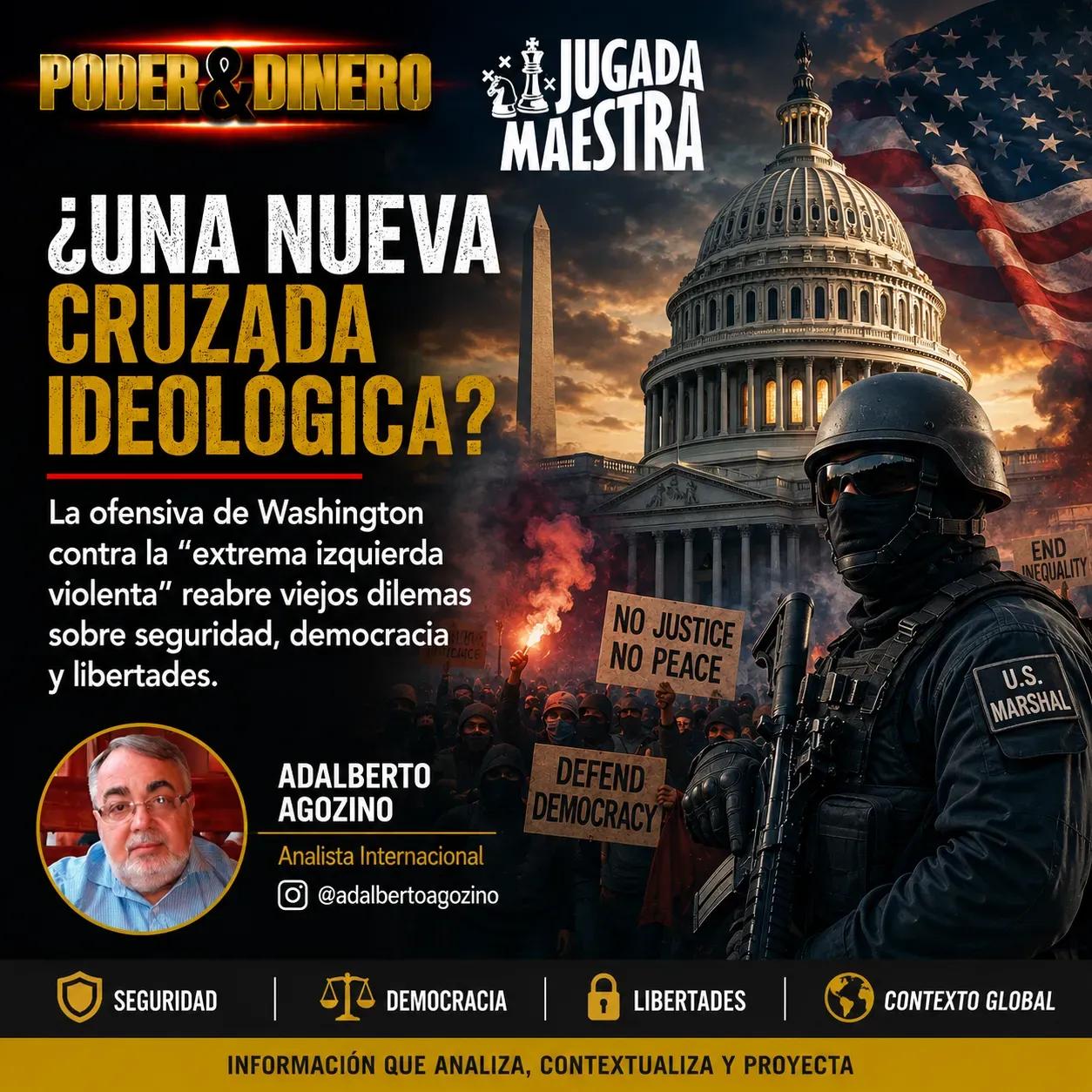
Presented by Secretary of State Marco Rubio as the beginning of a new global architecture for anti-terrorist cooperation, the initiative against the far left aims to identify, pursue, and dismantle violent revolutionary, anarchist, and antifascist networks. However, it has also sparked an intense debate about the conceptual limits of terrorism, the risk of criminalizing political dissent, and the possibility that the United States is inaugurating a new stage of ideological confrontation whose logic, according to numerous specialists, recalls some of the most disturbing traits of McCarthyism.
For decades, Washington's international agenda was dominated by clearly identifiable threats. First came the bipolar confrontation with the Soviet Union; subsequently, Islamist terrorism monopolized the attention of intelligence agencies and national security bodies following the attacks of September 11, 2001. Now, the Trump Administration contends that a different, long-ignored threat has regained transnational dimensions: politically motivated terrorism inspired by revolutionary left ideologies.
In the inaugural speech at the ministerial meeting held at the State Department, Marco Rubio stated that revolutionary violence inspired by Marxist, communist, anarchist, or antifascist ideas never completely disappeared and is currently undergoing a process of international reorganization. According to the Secretary of State, attacks on critical infrastructures, laboratories, electric grids, pipelines, and other strategic targets would be part of a renewed offensive against Western democracies.
The meeting brought together delegations from around sixty-seven countries—primarily European, but also American and Asian—although in numerous cases, the representations were led by ambassadors or technical officials rather than foreign ministers. Israel was the only Middle Eastern country officially present.
Beyond the operational content of the initiative, the true significance of the meeting lies in the doctrinal shift it represents. Rubio emphasized the need to rebuild the international counter-terrorism architecture through intensive intelligence sharing, judicial cooperation, financial tracking, and police coordination to identify networks that, according to Washington, have evaded international scrutiny for decades.
However, barely had the first official interventions begun when criticisms also arose. Numerous former officials from the State Department itself, counter-terrorism specialists, and academics questioned both the diagnosis and the priorities set by the new strategy. For them, the threat of far-left terrorism exists, but its current magnitude is considerably lower than that of jihadist extremism or various forms of far-right violence.
This debate relates to an extraordinarily complex question: what should be understood exactly by "violent far left"?
The difficulty is not minor. In practice, organizations that are clearly terrorist—such as Shining Path, the Italian Red Brigades, the German Red Army Fraction, Weather Underground, or former Latin American guerrilla organizations—coexist under that designation with anarchist collectives, decentralized antifascist movements, anti-system groups, direct action organizations, and even activists whose actions are limited to radicalized protests protected by constitutional rights to assembly.
The very case of Antifa illustrates this ambiguity. Various American agencies, including the FBI during Trump's first term, have repeatedly pointed out that Antifa constitutes more of an ideological current or a decentralized network of collectives than a hierarchical organization with an identifiable command structure. This characteristic poses enormous legal challenges when attempting to apply categories typical of international terrorism to an extremely diffuse phenomenon.
Precisely here lies one of the main fears expressed by jurists and organizations dedicated to defending civil liberties. The absence of an objective and universally accepted definition of "violent far left" could dangerously expand the margin of discretion of political power.
History provides abundant examples of how categories initially designed to combat armed organizations ended up being used to persecute ideological adversaries, labor movements, student organizations, or simple political opponents.
In this context, it is inevitable that comparisons to McCarthyism resurface.
During the early years of the Cold War, Senator Joseph McCarthy turned the suspicion of communist sympathies into a highly effective political tool. Thousands of American citizens were investigated, fired, or professionally marginalized without conclusive evidence of having committed any crime. Mere suspicion of ideological affinity was enough to trigger administrative processes, parliamentary investigations, or public discredit campaigns.
Naturally, current circumstances are very different. No one claims that the United States has mechanically returned to the 1950s. However, several specialists warn that certain discursive dynamics—the identification of broad ideological sectors as potential threats to national security, the broadening of the concept of terrorism, and the use of vaguely defined political categories—recall some of those historical mechanisms.
The American media coverage itself reflects the concerns expressed by former officials in the counter-terrorism area, who believe that the threat is being amplified and politicized while other forms of extremism continue to pose objectively greater risks.
However, there is another aspect of Rubio's discourse that can hardly be dismissed as mere political rhetoric.
The Secretary of State devoted a significant part of his speech to the historical role of Cuba in training and supporting numerous Latin American insurgent movements during the Cold War. He expressly recalled the training provided by Fidel Castro's regime to thousands of guerrillas from various countries on the continent and maintained that the political and ideological network built from Havana significantly contributed to the development of revolutionary organizations in America and other regions.
On this point, the historical evidence is considerable. Since the early 1960s, Cuba pushed an active policy of supporting revolutionary movements in Latin America and Africa. The Latin American Solidarity Organization (OLAS), the activities of the America Department of the Cuban Communist Party, and the military training provided to insurgent cadres have been extensively documented both by academic research and declassified files.
Colombian guerrillas, Central American organizations, Southern Cone revolutionary movements, and various insurgent experiences received, at different times and with varying intensity, political support, training, or assistance from Havana. This policy constituted one of the main factors of hemispheric tension for decades.
Paradoxically, Washington now seems to recognize, with unprecedented institutional clarity, a historical reality whose importance was the subject of intense debate for much of the 20th century. For many observers, this acknowledgment comes when the Latin American landscape has changed profoundly and former guerrillas have disappeared, transformed into political parties, or evolved into different phenomena.
The diplomatic implications of the new strategy are yet to be defined. Latin America today presents an extraordinarily diverse political mosaic, where governments of various ideological orientations maintain normal relations with Washington.
In this context, questions will inevitably arise about how this new doctrine will influence the relationship between the United States and administrations such as those of Luiz Inácio Lula da Silva in Brazil or Claudia Sheinbaum in Mexico. Both governments maintain politically distinct positions from the current U.S. Administration on numerous international issues and have held diplomatic relations with leftist governments in the region. However, this in itself does not equate to support for violent organizations. The manner in which Washington delineates this difference will be crucial in preventing an anti-terrorist strategy from becoming a permanent source of diplomatic friction.
The same occurs with Venezuela. In recent years, U.S. policy toward Nicolás Maduro's government has alternated economic sanctions, recognition of opposition leaders, and specific negotiations aimed, among other goals, at facilitating humanitarian exchanges, electoral processes, or energy issues. In this framework, there have been contacts with high-ranking Venezuelan officials, including members of the ruling circle. Such contacts have been interpreted by some sectors as a sign of diplomatic pragmatism and by others as a sign of flexibility. The new strategy will likely compel Washington to explain how it reconciles these negotiations with a doctrine that emphasizes global combat against organizations and networks deemed violent.
Beyond Latin America, the initiative promoted by Rubio reflects a larger phenomenon: the growing trend of Western democracies to broaden the concept of national security to encompass hybrid threats, decentralized networks, sabotage campaigns, digital radicalization, and new forms of political violence that do not easily fit into traditional categories of terrorism.
This process poses considerable challenges. Effectively combating those who resort to political violence is an undeniable obligation of any democratic state. But simultaneously preserving civil liberties demands precise definitions, rigorous evidential standards, and institutional mechanisms capable of clearly distinguishing between terrorism, organized violence, radical protest, and legitimate political opposition.
History teaches that democracies often face their most difficult tests precisely when they attempt to defend themselves against those who seek to destroy them. The success of the new U.S. strategy will depend not only on its ability to dismantle violent networks. It will also be judged by its capacity to prevent the legitimate fight against terrorism from eroding those constitutional and democratic principles whose protection ultimately constitutes the very purpose of any security policy.
Adalberto Agozino holds a PhD in Political Science, is an International Analyst, and a Professor at the University of Buenos Aires

Comments