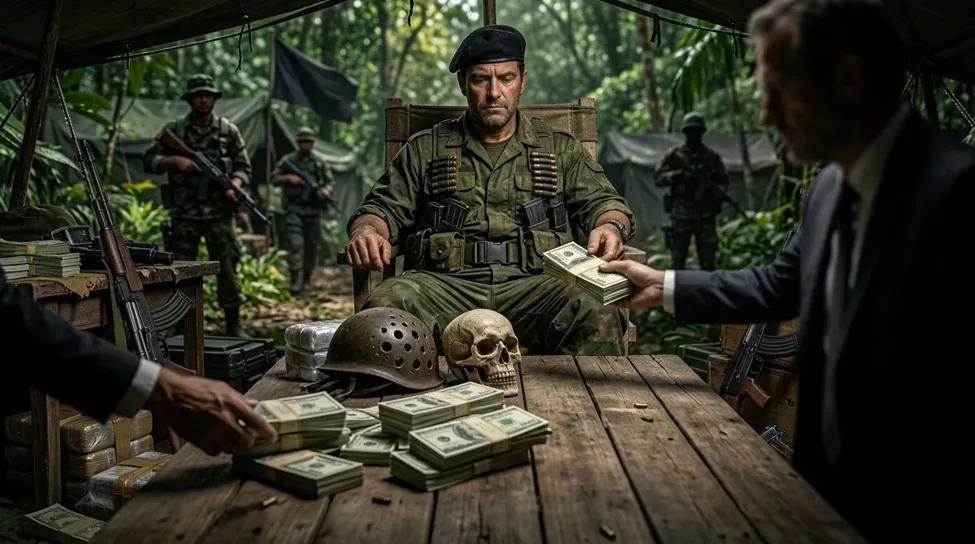
In the depths of the Colombian sub-Amazon, where cell phone signals fade long before the road does, a man moves whom the government defines as a “drug trafficker dressed as a revolutionary” and whom the campesinos almost whisper about: Iván Mordisco (El País 2025). Behind that alias is Néstor Gregorio Vera Fernández, head of the Central General Staff (EMC), the main dissidence from the former FARC, and one of the most wanted criminals in Colombia and the United States (El País 2025; Ward 2026).
His story condenses the transition from a Marxist-Leninist guerrilla to a constellation of armed groups that live off coca, extortion, and illegal economies, in territories where the state has almost never fully arrived (Ward 2026; ACLED 2024). Following his path is to understand not only the life of a leader but also the failures of a country that left millions of people at the mercy of foreign rifles (Crisis Group 2025; Ríos 2024).
From El Peñón to war: the origin of a leader
Néstor Gregorio Vera Fernández was born on October 8, 1974, in El Peñón, Santander, a rural municipality far from the political and economic center of Colombia (Wikipedia 2022). He grew up among farm work, unpaved roads, and the intermittent presence of armed actors; in that landscape, violence was not news: it was part of the scenery.
In the late nineties, he joined FARC-EP, like so many young people of his generation: with a borrowed rifle, slogans learned in a hurry, and the promise that in the mountains there would be food, power, and a cause (Ward 2026). He did not arrive as an ideologist but as a common fighter, but soon found his place: he trained as a sniper and an expert in explosives, key trades in a war built on ambushes, mines, and lightning attacks (Ward 2026).
In little time, his first name was left behind, and the alias “Iván Mordisco” began to appear in security reports and in accounts from communities that first saw him arrive as a guerrilla and then as an armed authority (El País 2025).
Learning to command and to do business
The 2000s were the period when he stopped being just another rifle and began to figure as the leader of the 1st Front. While the state launched its strongest offensive against the FARC, he consolidated himself in the regions of Guaviare and Vaupés, where jungle, coca crops, and fast-flowing rivers blend into a perfect scenario for war and drug trafficking (Ward 2026).
In that territory, he took on two tasks that mark the difference between a simple guerrilla and a boss: recruitment —including minors— and the protection of crops, laboratories, and cocaine routes (Ward 2026). In concrete terms, that meant deciding who could plant, how much was paid for each kilogram of base paste, who bought, which chemicals entered, and what shipments left through the rivers to Brazil, Venezuela, or the Caribbean coast (Ward 2026).
Mordisco soon understood something that would condition his entire career: whoever commands the coca commands the territory. Since then, his power was no longer measured only in rifles but in hectares of cultivation, laboratories under his influence, and secured routes (Ward 2026).
The peace of Havana and the decision to continue the war
The peace process in Havana between the government of Juan Manuel Santos and the FARC culminated in 2016 with the signing of the Final Agreement and the promise to leave behind more than half a century of war (Cambridge 2022). But not everyone within the guerrilla was willing to make that leap.
While the secretariat prepared for disarmament and the transition to legal politics, the 1st Front, under the command of Iván Mordisco, took another path. In a letter sent to the leadership and made public in 2016, he announced that his front would not adhere to the agreement and invited other leaders who shared that vision to remain armed (El País 2025).
While thousands of guerrillas concentrated in rural areas to hand over their rifles, he and several hundred fighters remained in the jungle, keeping weapons, routes, and contacts from the coca business (El País 2025; Ward 2026). That gesture made him one of the first major dissidents of the peace process and made it clear that, for him, war remained a good business and a source of power that was hard to let go (El País 2025).
From associate of Gentil Duarte to head of the Central General Staff
After the signing of the agreement, what remained of the FARC fractured. Multiple dissident structures emerged: some never demobilized, others rearmed shortly after, and many found in illegal economies a way to sustain themselves (Cambridge 2022). In that scenario, two names gained strength: Miguel Botache Santillana, alias Gentil Duarte, and his ally in the Amazon, Iván Mordisco (El País 2025).
Duarte, former head of the 7th Front, promoted the articulation of different dissident fronts into a sort of federation that maintained the armed apparatus and the business, but without the old political structures of the original guerrilla (El País 2025). Mordisco became one of his strongest partners in the southeast, managing coca corridors and hard-to-access jungle areas (Ward 2026).
In 2022, the death of Gentil Duarte in a border area left a leadership vacuum. From that internal dispute, Mordisco emerged stronger and ended up in charge of the largest dissident network, which adopted the name Central General Staff (EMC) (El País 2025). Since then, his face has become the most visible of the ex-FARC mafia and an unavoidable actor when talking about peace, war, and drug trafficking in Colombia (El País 2025; ACLED 2024).
The network of allies: from the rural areas to the offices
The power of Iván Mordisco does not rely only on the armed men who accompany him. Behind him is a much broader network that starts in the rural areas and extends, in the form of corruption and fear, to offices and government buildings (Ecoi.net 2025).
In the villages under the influence of the EMC, the organization operates as a de facto authority: it decides what is planted, how much is paid, who can stay, and who has to leave. It applies a parallel justice system that extends from “fines” and hard labor to exile or murder, and regulates the presence of NGOs, churches, and state projects (El País 2025; Ecoi.net 2025). For many communities, the first visible uniform is not that of the state but that of the dissidents.
On the margins of the state, the business requires other gears: public servants who facilitate contracts or permits, corrupt members of the public force who sell information or allow the passage of discreet trucks, and business networks that launder money through farms, shops, and front companies (Ecoi.net 2025; ACLED 2024). It is not a grand centralized conspiracy, but rather a chain of favors and silence that keeps the machine running smoothly.
Who protects Iván Mordisco?
In official statements, Iván Mordisco appears as "public enemy number one." But if one looks calmly at his survival history, the question that many in the regions ask is different: does everyone really pursue him, or are there people from within that clear the way for him?
A leaked report from the Prosecutor's Office showed that the guerrilla organization under his command received intelligence from the state for years. As Colombia Reports revealed from that document, Mordisco's structure had paid informants within "government agencies" who warned of operations and sabotaged repeated attempts to capture one of his most feared lieutenants, alias “Mayimbú,” head of the Western Coordinating Command until his death (Alsema, Colombia Reports, Nov 22, 2022). That report describes how Mayimbú was able to “move freely” in the southwest of the country thanks to that network of state and civilian informants in a region where the dissidents had recovered former FARC territories (Alsema, Colombia Reports, Nov 22, 2022).
What seemed like rumor was documented: El Espectador revealed, based on files from the Prosecutor's Office, that the feared dissident "Mayimbú" paid informants in state entities to anticipate operations and remain untouchable in Cauca (El Espectador, Nov 22, 2022). In parallel, investigations compiled by Semana and taken up by organizations like Colombia Support Network and Colombia Reports detailed how networks of military and police diverted rifles, ammunition, and even vests that on paper appeared as destroyed but reappeared in the hands of the same dissidents they claimed to be combating (Alsema, Colombia Reports, Nov 21, 2022; Colombia Support Network, May 21, 2023).
This same package of leaks spoke of a weapons trafficking network within the Army: colonels, majors, sergeants, police, and civilians who stole rifles, ammunition, and grenade launchers from military units to sell to illegal groups like Mordisco's organization, the ELN, and narco-paramilitary structures (Alsema, Colombia Reports, Nov 21, 2022). A witness recounted that “initially we obtained almost everything at Indumil,” the army's own arms factory, and that afterwards the weapons were removed from logistics battalions, passed through front companies and warehouses, and ended up in the hands of dissidents (Alsema, Colombia Reports, Nov 21, 2022).
Another investigation, summarized by Colombia Support Network, reached an equally devastating conclusion. Following a seizure of hundreds of cartridges and vests on a road in Nariño, the Prosecutor's Office discovered that the ammunition used by the dissidents to kill soldiers, social leaders, and civilians came from a lot that the army itself had ordered destroyed according to an official document of “final destination” (Colombia Support Network, May 21, 2023). The same bullets that on paper were “destroyed” reappeared in the rifles of Mordisco's men and other armed groups (Colombia Support Network, May 21, 2023).
In parallel, the international press has reported new accusations against high-ranking officials and employees suspected of sharing sensitive information with dissident factions, which has forced the government to open internal investigations into possible intelligence leaks and under-the-table agreements (Financial Times, Nov 25, 2025; Colombia Reports, Nov 25, 2025). In this uncomfortable mirror, the country's most wanted leader not only hides in the jungle: he also takes refuge behind leaks, silences, and complicities that originate in the very offices from which, in public, they swear to be hunting him.
All this corrupt machinery does not only help to explain why a man like Iván Mordisco remains alive and in command. It also has a direct human cost: while a few sell information and weaponry from the comfort of an office or a barracks, honest soldiers, police, and investigators go out each day to patrol trails, escort missions, document massacres, and search for graves, not knowing if the operation has already been leaked to the other side. They are the ones who end up ambushed on dark roads, trapped in mines, or marked as targets in war notebooks that they should never have had access to the state's plans. The betrayal of a few turns those who do fulfill their duty into cannon fodder and leaves even more isolated those who, from the institutionality, truly try to confront Mordisco's structure.
Venezuelan border, Cartel of the Suns, and Tren de Aragua
Looking at Mordisco only from the Colombian side leaves out an important part of the map. On the border with Venezuela, the EMC's routes intersect with other criminal structures and networks of state corruption. Various reports and analyses describe how leaders of the FARC and, later, their dissidents have used for years the network of corrupt military and officials known as the Cartel of the Suns to move cocaine through Venezuelan territory, taking advantage of their control over ports, airports, and land crossings (BBC 2025; Caracas Chronicles 2025).
More than an official alliance sealed with statements, it is a convergence of interests: the same channels that once served the original guerrilla remain available to Mordisco's dissidents and other partners who pay to use those routes (Caracas Chronicles 2025; Colombia One 2025).
In that same corridor operates the Tren de Aragua, a Venezuelan mega-gang that originated in prisons and expanded throughout the region by leveraging migration, informality, and institutional weakness.
Today, it has documented presence in cities and border crossings of Colombia, where it engages in extortion, human trafficking, micro-trafficking, and other crimes (NPR 2025; Ecoi.net 2025). In practice, the EMC of Mordisco, Tren de Aragua, the Gulf Clan, and other structures share neighborhoods, prisons, and trails, alternating moments of implicit cooperation with episodes of open war for control of the same income (Ecoi.net 2025; Colombia One 2025).
The judicial weight of his name
As his territorial and economic power grew, so did his list of judicial proceedings. In Colombia, the Attorney General's Office has opened dozens of investigations against Iván Mordisco for homicides, terrorism, forced displacement, recruitment of minors, drug trafficking, and other crimes linked to the EMC's activities in departments such as Cauca, Guaviare, Meta, and Vaupés (Infobae, Jan 12, 2026).
In January 2026, the Prosecutor's Office took a qualitative leap: it formally charged him with genocide against the peoIndigenous Nasa bloc, indicating it as responsible for a pattern of murders and persecution in northern Cauca between 2022 and 2025 (Infobae, Jan. 12, 2026). The file collects dozens of homicides of Indigenous Nasa, in addition to recruitment of minors and systematic attacks against leaders and traditional authorities (Infobae, Jan. 12, 2026). The case is being processed in specialized human rights offices and has become the judicial symbol of what the dissidents represent for Indigenous peoples.
Furthermore, it faces processes for massacres, mass graves, and attacks on public forces, as well as assaults and restrictions on the work of humanitarian organizations in various regions (Ecoi.net 2025).
The accumulation of files places him among the most wanted leaders by Colombian justice.
The pressure is no longer limited to the internal sphere. The government of Gustavo Petro has filed a complaint with the International Criminal Court to investigate the actions of the EMC as possible war crimes and crimes against humanity committed since 2017, including murders of social leaders, signatories of the peace agreement, Indigenous individuals, and recruitment of minors (Crisis Group 2025). The name Iván Mordisco, thus, starts to enter the vocabulary of The Hague as well.
Status of Iván Mordisco before the United States
The United States has redefined its stance towards the FARC and its dissidents in recent years. In 2021, the State Department revoked the designation of the FARC as a terrorist organization, considering that the original guerrilla had disarmed through the 2016 agreement (Blinken 2021).
At the same time, Washington shifted focus towards the structures that refused to demobilize.
Within that new framework, Néstor Gregorio Vera Fernández, alias Iván Mordisco, appears as a leader of the dissidents and is designated as a global terrorist, which implies the freezing of any assets under U.S. jurisdiction and the prohibition for U.S. citizens and companies to maintain commercial relations with him (OFAC 2021; Cambridge 2022). For U.S. foreign policy, Mordisco sits at the intersection of drug trafficking and terrorism, inheriting part of the position once held by former FARC commanders in Washington's listings (Blinken 2021).
“Total peace,” abandonment, and the metastasis of the conflict
The rise of Gustavo Petro to power was marked by an ambitious promise: a “total peace” that sought to bring guerrillas, dissidents, and urban criminal structures to the negotiating table. To make this possible, Congress approved a legal framework that allowed negotiations with armed political groups while simultaneously agreeing to submissions with large criminal organizations (Ríos 2024). The EMC of Iván Mordisco was one of the actors included in this design.
However, the data and testimonies on the ground tell another story. Independent monitoring indicates that, although some direct confrontations between public forces and armed groups decreased, ceasefires and partial truces gave organizations like the EMC space to reorganize, recruit, and expand into new municipalities (ACLED 2024; LAWGEF 2024). Meanwhile, the State failed to fill those territories with judges, schools, roads, or productive projects: the discourse arrived, but the deep transformation did not (Crisis Group 2025).
In the regions where Iván Mordisco governs, not only did peace with the FARC fail: the State failed. For years, communities warned that the absence of effective justice, basic services, and real alternatives to coca was leaving the path clear for anyone arriving with weapons and clear rules, no matter how harsh (Crisis Group 2025; Ríos 2024). In many of those places, the only one who sets standards and resolves conflicts remains the armed man.
At the beginning of 2026, the dialogue between Iván Mordisco's EMC and the government of Gustavo Petro arrives with short breath. After solemn announcements of ceasefire, partial suspensions following new massacres, and divisions within the group itself, the table remains standing more out of inertia than hope (ABColombia 2025; Justice for Colombia 2025; Reuters 2024). No one dares to declare the process dead, but even EMC leaders have acknowledged that it is very difficult for a serious agreement to be reached before this government ends (Reuters 2024). In the meantime, in the jungles where peace is supposed to prevail, what communities see is something else: armed men on the move, disputed territories, and an uncomfortable feeling that “total peace” got stuck halfway between discourse and reality (ACLED 2024; Crisis Group 2025).
Geopolitical closure: the shadow that crosses borders
Looking at Iván Mordisco only from Colombian maps is short-sighted. His business and war also rely on what occurs across borders. In Venezuela, the EMC's routes overlap with networks of corruption within the armed forces, accused of facilitating cocaine trafficking to the Caribbean and Central America using their control over strategic infrastructure (BBC 2025; Caracas Chronicles 2025). The channels once used by the old FARC remain available to the dissidents and other criminal partners (Caracas Chronicles 2025).
In that same corridor operates the Tren de Aragua, a mega-gang that has turned massive migration and informality into fuel for its expansion and already has documented presence in several cities and border crossings in Colombia, Ecuador, Peru, and other countries (NPR 2025; Ecoi.net 2025). The EMC of Mordisco, the Tren de Aragua, the Clan del Golfo, and other structures share trails, neighborhoods, and prisons, sometimes as situational allies and at other times as mortal enemies (Ecoi.net 2025; Colombia One 2025).
Seen from Washington, Brussels, or Bogotá, Iván Mordisco ceases to be a “local problem” and becomes a piece of a larger puzzle: a transnational criminal economy that connects coca-growing peasants, corrupt military personnel, regional gangs, and consumer markets worldwide (El País 2025; Americas Quarterly 2026). While politics swings between promises of total peace and purely repressive responses, he and his circumstantial allies continue to do what they do best: read the gaps of the State, exploit the fissures in the agreements, and turn every border into an opportunity.
References
ABColombia. “EMC Peace Talks Timeline.” ABColombia, Sept. 7, 2025,
https://www.abcolombia.org.uk/emc-peace-talks-timeline/.
ACLED. “‘Total Peace’ Paradox in Colombia: Petro’s Policy Reduced Violence, but Armed Groups Grew Stronger.” ACLED, Nov. 27, 2024,
Alsema, Adriaan. “Colombia State Officials on Guerrilla Payroll: Report.” Colombia Reports, Nov. 22, 2022,
https://colombiareports.com/state-officials-tipping-off-colombias-farc-dissidents-prosecution/.
“Colombia’s Military Trafficking Arms for Guerrillas: Prosecution.” Colombia Reports, Nov. 21, 2022,
https://colombiareports.com/colombia-investigating-military-arms-trafficking-for-guerrillas/.
Americas Quarterly. “The Unfulfilled Promises of Colombia’s Peace Process.” Americas Quarterly, Jan. 19, 2026,
https://www.americasquarterly.org/article/the-unfulfilled-promises-of-colombias-peace-process/.
BBC. “What Is Cartel de los Soles, Which the US Is Labelling a Terrorist Organization?” BBC News, Nov. 24, 2025,
https://www.bbc.com/news/articles/cy8j4ye5x0mo.
Blinken, Antony J. “Revocation of the Terrorist Designations of the Revolutionary Armed Forces of Colombia (FARC) and Additional Terrorist Designations.” U.S. Department of State, Nov. 30, 2021,
Caracas Chronicles. “What You Should Understand about the Cartel de los Soles.” Caracas Chronicles, Sept. 25, 2025,
Colombia One. “Colombia Focuses on Local Narco Groups, Not Venezuela’s Cartel de los Soles.” Colombia One, Sept. 16, 2025,
https://colombiaone.com/2025/09/17/colombia-cartel-de-los-soles-local-narco-groups/.
“Colombia: From ‘Total Peace’ to Local Peace.” International Crisis Group, Jan. 29, 2025,
Colombia Support Network. “SCANDAL: COLOMBIAN SOLDIERS WERE SELLING WEAPONS TO THE FARC DISSIDENTS, LATER ON THE CRIMINAL GANG WAS KILLING OTHER COLOMBIAN SOLDIERS. HERE’S THE PROOF.” Colombia Support Network, May 21, 2023,
“El País. “Iván Mordisco, the ‘Drug Trafficker Dressed as a Revolutionary’ Who Is Challenging the Colombian Government.” El País English Edition, Aug. 25, 2025,
“El Hackeo a la Fiscalía: El Temido Disidente ‘Mayimbú’ Pagaba Informantes en el Estado.” El Espectador, Nov. 22, 2022,
Ecoi.net. “Major Criminal Groups Operating in Colombia, Including Their Presence, Areas of Influence, Modus Operandi, Connections and Conflicts, as Well as State Response.” ecoi.net, June 16, 2025,
https://www.ecoi.net/en/document/2128307.html.
Infobae. “The Prosecutor’s Office Charged ‘Iván Mordisco’, Head of the EMC, with Genocide against the Nasa People in Cauca.” Infobae Colombia, Jan. 12, 2026,
Justice for Colombia. “Ceasefire Extension among Core Points Agreed in Government and EMC Peace Talks.” Justice for Colombia, 23 Jan. 2025,
LAWGEF. “Colombia News Brief for December 10, 2024.” Latin America Working Group, 10 Dec. 2024,
https://www.lawg.org/colombia-news-brief-for-december-10-2024/.
NPR. “Tren de Aragua Explained.” NPR / The Index Podcast, 24 Nov. 2025,
https://www.npr.org/2025/11/24/g-s1-99000/u-s-label-maduro-cartel-de-los-soles-terror-organization.
OFAC. “Kingpin Act Designations Removals; Venezuela-related Designations.” U.S. Department of the Treasury, Office of Foreign Assets Control, 1 Dec. 2021,
https://ofac.treasury.gov/recent-actions/20211201.
Ríos Sierra, Jerónimo. “Total Peace?” Phenomenal World, 24 Mar. 2024, https://www.phenomenalworld.org/analysis/total-peace/.
Reuters. “Exclusive – Peace Deal with Colombia Unlikely before End of Petro’s Term, EMC Rebel Says.” Reuters, 12 Mar. 2024,
https://ca.news.yahoo.com/exclusive-peace-deal-colombia-unlikely-110319927.html.
Ward, Tom. “Meet Iván Mordisco, the Cocaine Warlord Fighting to Protect the Amazon.” The Gentleman’s Journal, 19 Jan. 2026,
https://www.thegentlemansjournal.com/article/ivan-mordisco-cocaine-amazon-about/.
Wikipedia. “Iván Mordisco.” Wikipedia, 28 July 2022,
https://es.wikipedia.org/wiki/Iv%C3%A1n_Mordisco.
About the Author
William L. Acosta graduated from PWU and Alliance University. He is a retired police officer from the New York Police Department, a former military member of the United States Army, and the founder and CEO of Equalizer Private Investigations & Security Services Inc., a licensed agency in New York and Florida with international reach. Since 1999, he has led investigations in narcotics, homicides, and missing persons cases, in addition to participating in criminal defense at both state and federal levels. A specialist in international and multi-jurisdictional cases, he has coordinated operations across North America, Europe, and Latin America.
Comments