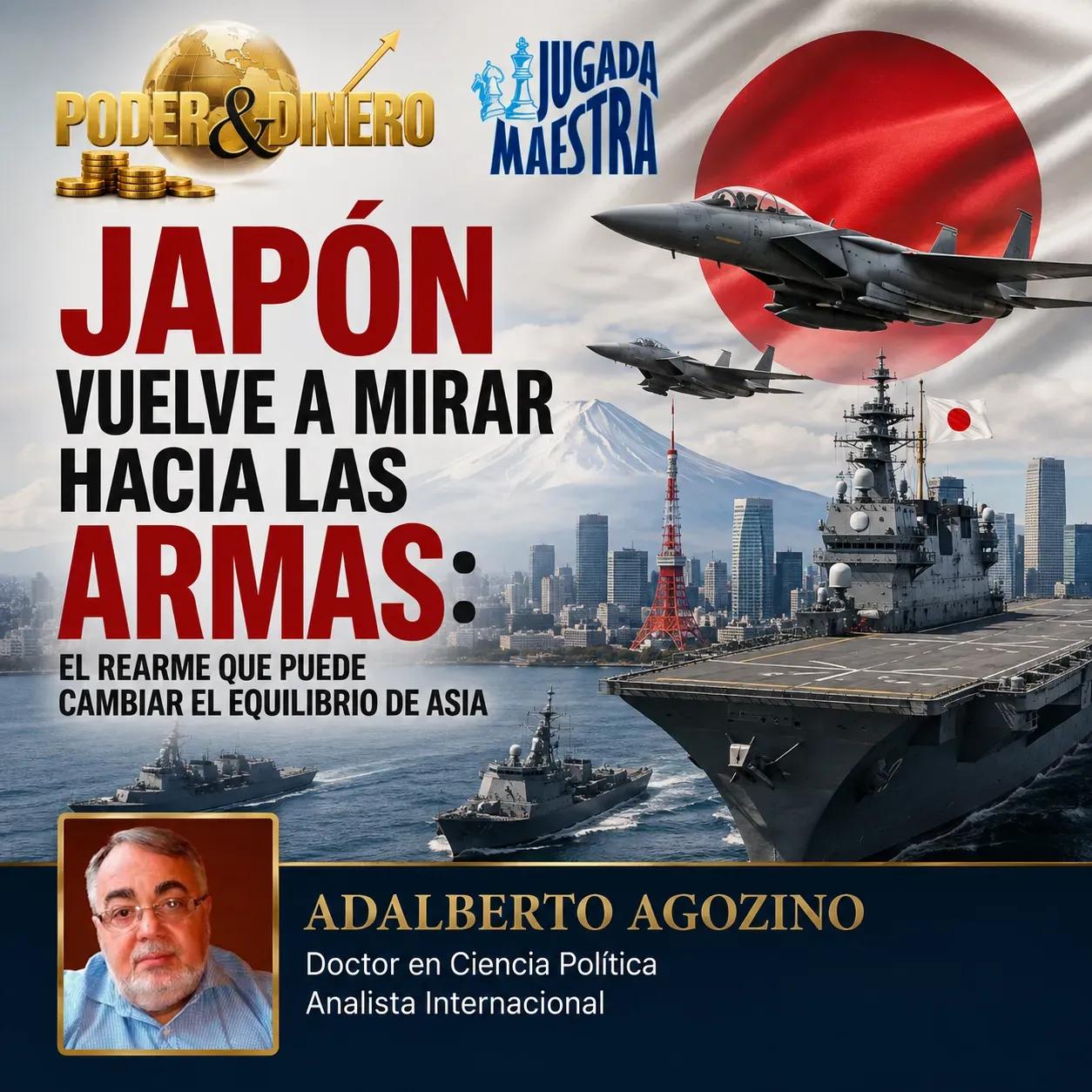
There is something profoundly symbolic in the new Japan that is being built. As the country commemorates these days the 81st anniversary of Hiroshima, its government presents a new security model that would have been difficult to imagine for any of the generations that grew up under the trauma of war. Japan, the only power that has suffered a nuclear attack in history, is rapidly increasing its military capabilities and making the defense industry a piece of its economic strategy.
This is no longer just about having a Self-Defense Force capable of protecting the national territory. Tokyo wants radars, long-range missiles, submarines, space systems, artificial intelligence, drones, cyber capabilities, and a military industry capable of producing for Japan and for other countries. The new Defense White Paper presents this transformation as a response to the deterioration of the strategic environment, but also as an economic opportunity. The defense industry, the document argues, can contribute to innovation, strengthen the technological base, and generate activity for both large and small companies.
It is the last stop on a journey that began long before Sanae Takaichi.
The country that wanted to leave war behind
The Japanese Constitution of 1947 was born under U.S. occupation and made pacifism one of the foundations of the new national identity. Its Article 9 renounced war as a sovereign right and prohibited the maintenance of land, naval, or air forces intended for armed conflict. However, the Cold War soon made apparent the contradiction between that principle and the strategic need to contain the Soviet Union and Communist China.
In 1954, the Self-Defense Forces were born. The language was deliberately careful: Japan did not have an army, but forces meant exclusively for defense. For decades, that balance worked. Washington assumed most of the strategic responsibility while Tokyo focused its resources on becoming an economic power.
The situation began to change after the end of the Cold War. The first Gulf War, the 9/11 attacks, North Korea's nuclear program, and especially China's military rise, have eroded the old restrictions.
Shinzo Abe accelerated the process. The security legislation approved in 2015 allowed the exercise of collective self-defense under certain circumstances and turned the so-called “proactive pacifism” into the political formula to reconcile the pacifist past with a greater capacity for military action. Now Takaichi is taking that logic to a new dimension.
China is the reason that explains almost everything
In official Japanese discourse, China occupies a place that no other country can dispute. The new White Paper defines it as the greatest strategic challenge for Japan and warns of the rapid expansion of its military capabilities.
Beijing responds that Tokyo exaggerates the threat to justify its remilitarization. The Chinese Ministry of Defense has accused the Japanese government of reviving a policy of “new militarism” and has warned that Taiwan constitutes a red line that Japan must not cross.
The dispute is not rhetorical. In recent years, China has increased its activities around Taiwan and maintains a growing presence around the Senkaku Islands, administered by Japan and claimed by Beijing as Diaoyu. The archipelago is located in a strategic area close to the main maritime routes and to Japan's westernmost islands.
For Tokyo, the problem is that a war over Taiwan could hardly remain confined to the Strait. U.S. military facilities in Japan would be essential for any Washington operation. The Japanese islands located in the southwest of the archipelago would be close to the operational zone. Japanese trade routes could also be affected. Therefore, Taiwan has ceased to be, from the Japanese perspective, an exclusively Chinese issue.
Prime Minister Takaichi expressed this with a clarity that provoked a strong reaction from Beijing by suggesting that a Chinese attack on Taiwan could create a situation that threatened Japan's survival and justified the action of its Self-Defense Forces. The subsequent diplomatic crisis has brought relations between Tokyo and Beijing to one of their most delicate moments in recent years.
The Japanese strategic conclusion seems simple: the greater China's ability to forcibly modify the status quo around Taiwan, the greater the price Beijing must pay for trying.
Money changes direction
The transformation has an economic dimension that must not be underestimated. Japan has raised its defense spending to the equivalent of 2% of its GDP, fulfilling the target it set to strengthen its military capacity. The budget for the fiscal year 2026 reaches 9.0353 trillion yen, while spending directly related to strengthening defense hovers around 8.8 trillion. It is a considerable transformation for a country that for decades maintained military spending around 1% of GDP.
But the government wants to convince the Japanese that it is not just about spending. The bet is to create a competitive, technological, and export-oriented defense industry. This idea would have been politically difficult even a generation ago. For decades, Japanese companies manufactured military systems mainly for the Self-Defense Forces and under strict export restrictions. Mitsubishi Heavy Industries, Kawasaki Heavy Industries, Mitsubishi Electric, and Fuji Heavy Industries developed advanced capabilities, but within a relatively closed domestic market. Now the doors are opening.
The Mogami frigate is the most visible example. Australia has chosen the Japanese design for its future fleet of frigates, turning Mitsubishi Heavy Industries into one of the big beneficiaries of the new military export policy. The Australian contract also has a strategic significance: Japan is starting to integrate as a security provider for other Indo-Pacific countries.
The transformation also reaches combat aviation. Japan is participating alongside the UK and Italy in the Global Combat Air Programme, aimed at developing a new combat aircraft for the 2030s. Mitsubishi Heavy Industries leads the Japanese participation and Mitsubishi Electric is preparing new facilities to produce electronic systems for the aircraft. The company expects its defense business to reach 690 billion yen annually by 2031.
The message is clear: Japan wants rearmament to generate an industry. And it wants that industry to, in turn, provide rearmament.
The economy will be the toughest test
The idea of using defense as a growth engine is not without its foundations. Military investment can stimulate high-tech sectors in which Japan retains extraordinary advantages: electronics, robotics, sensors, advanced materials, artificial intelligence, space, shipbuilding, and precision systems.
The government also wants start-ups to participate in this process, a break with the traditional Japanese defense contracting system. The war in Ukraine has also demonstrated the value of cheap drones, artificial intelligence, and autonomous systems compared to extraordinarily costly conventional military platforms. The new Japanese White Paper devotes considerable attention to these technologies.
But there is a second side to the coin. Japan is an aging society, with a declining population and extraordinarily high public debt. The International Monetary Fund projects real growth of just 0.8% for 2026, following 1.1% in 2025, and warns that spending on interest, healthcare, and long-term care will exert increasing pressure on public finances.
The problem is not that Japan cannot finance rearmament. It can. The problem is what it will have to sacrifice if it decides to continue increasing it. A yen invested in a missile cannot be simultaneously invested in education, civil research, care for an aging population, or infrastructure. The IMF has called for prudent fiscal policy from Tokyo and a credible trajectory for debt reduction.
That is why the argument that defense will be a new engine of growth must be taken with caution. It may boost certain industries. It may generate innovation. It may open international markets. But it will not replace the structural reforms that Japan needs to recover sustained growth. Rearmament can be an industrial policy. It is not a magic solution to Japan's demographic problem.
A new military industry
The most profound consequence may occur at the heart of the Japanese economy. For decades, the defense industry was almost a residual activity of large industrial conglomerates. Now it can become a strategic sector. Mitsubishi Electric, for example, aims to substantially increase its military sales over the coming years thanks to radars, missiles, systems for the GCAP program, and components intended for the Australian Mogami frigate.
The relationship with the United States is also changing.
In May 2026, Tokyo and Washington agreed to accelerate industrial cooperation to jointly produce missiles, including the SM-3 Block IIA and AMRAAM. The Japanese Ministry of Defense has named that initiative “Operation Supercharge.”
The alliance thus ceases to be solely military. It is becoming an industrial alliance. Japan provides technology, capital, manufacturing capacity, and a sophisticated industrial base. The United States provides critical military technologies, intelligence, operational experience, and a huge market. The combination can turn both countries into a much more integrated technological-military bloc. And that is precisely what concerns China.
The new Pacific balance
The most important geopolitical consequence of Japanese rearmament will probably be the modification of the balance in the first island chain of the Pacific.
A militarily more powerful Japan complicates any Chinese strategy aimed at projecting force towards the western Pacific. Its submarines, planes, anti-ship missiles, surveillance systems, and space capabilities increase the cost of any Chinese operation. But Japan is also not acting alone.
The United States is reinforcing the alliance. Australia has become an increasingly close military partner. The Philippines has acquired renewed importance. India participates in the Quad framework. And South Korea, despite its deep historical reservations towards Japan, is increasing trilateral cooperation with Tokyo and Washington.
The Japanese Ministry of Defense itself notes that in 2026 cooperation with the United States, Australia, South Korea, and the Philippines has intensified. It is difficult to imagine a framework for containing China in the Indo-Pacific without Japan at its center.
South Korea: an uncomfortable ally
Here appears one of the paradoxes of the new strategy. Japan and South Korea have reasons to distrust each other, but they have even greater reasons to cooperate. Both face the threat of North Korean missiles and nuclear weapons. Both depend on the United States. Both have fundamental interests in preventing China from unilaterally altering the regional balance.
During 2026, Tokyo and Seoul have intensified military dialogue, with meetings of defense ministers and cooperation mechanisms that would have been difficult to imagine during the worst moments of their historical disputes. But Japan's colonial past remains present.
The strengthening of Japan's military may be accepted by Seoul as long as it is perceived as a response to China and North Korea. If Tokyo were to move towards a broader reinterpretation of its Constitution or towards unequivocally offensive capabilities, the Korean reaction could be much less favorable. Historical memory continues to be a strategic variable.
Taiwan, the breaking point
Nowhere else will the effect of Japanese rearmament be more visible than in Taiwan. For China, the island is part of its sovereignty. For Japan, a conflict in the Strait could directly affect its national security. For the United States, Taiwan is one of the main scenarios where its strategic credibility would be put to the test.
Geography does the rest. Japan is very close to Taiwan and controls decisive positions in the southwest of its archipelago. Okinawa houses essential U.S. military facilities. The Yonaguni and Ishigaki Islands are on the front lines facing the Taiwanese scenario.
In the event of conflict, Japan could provide bases, intelligence, air defense, logistics, and support to U.S. forces even without initially entering combat. If the conflict directly affected Japanese territory, the situation would be completely different.
This explains why Beijing is watching closely every Japanese military reform. China does not only fear Japan. It fears Japan united with the United States, Australia, South Korea, and other regional partners.
Washington gets the partner it needed
For the United States, Japanese rearmament is good strategic news. Washington has been calling for years for its Asian allies to take greater responsibility for their own defense. Japan is responding.
The alliance becomes more useful the more capable Japan is of defending its own islands, intercepting missiles, monitoring the seas, and producing weapons. In May, the defense ministers of both countries agreed to rapidly advance in deepening cooperation and strengthening the joint military presence in southwestern Japan. But there is an important difference compared to Cold War Japan. Tokyo no longer wants to be merely the protected one. It wants to become a strategic partner.
The consequence may be a more autonomous Japan within a
Closer alliance with the United States. It is not a contradiction. Japanese military autonomy can, paradoxically, strengthen the U.S. alliance.
The Paradox of Rearmament
History has an irony here that is hard to ignore. Japan says it is rearming to prevent a war. China interprets the rearmament as a threat. China is increasing its capabilities. Japan responds. The United States strengthens its alliance with Tokyo. Beijing deepens its military preparations. North Korea uses the new environment as an argument to maintain its nuclear arsenal.
The logic of deterrence works precisely because each actor knows that a war would have an unbearable cost. But the same logic can generate a spiral of military buildup. The memory of Hiroshima introduces an additional dimension.
Survivors of the atomic bomb have warned that the gradual abandonment of pacifism may erode one of the core elements of Japanese international identity. Masako Wada from Nihon Hidankyo has argued that Japan regained international confidence precisely because it promised never to go to war again.
Her warning is not a minor objection. Japan is not only modifying its defense budget. It is revising one of the pillars of its national identity.
The country that for decades made Hiroshima a universal symbol of the dangers of war is once again becoming a top military power. The fundamental difference is that this time Japan does not seem to be seeking an empire or its own sphere of influence. Its declared goal is to prevent others from imposing one. That nuance will be decisive.
If Tokyo manages to build sufficient military capability to deter China without fueling an uncontrollable dynamic of confrontation, Japanese rearmament could become one of the main pillars of stability in the Indo-Pacific. If it fails, Asia could enter a new arms race.
The paradox is that both possibilities arise from the same decision.
Japan is rearming because it considers that the world around it has become too dangerous to continue being post-war Japan. And in doing so, it is inevitably contributing to creating a different Asia: an Asia in which the balance will no longer depend solely on Washington and Beijing but also on Tokyo's ability to decide how far it is willing to go.

Comments