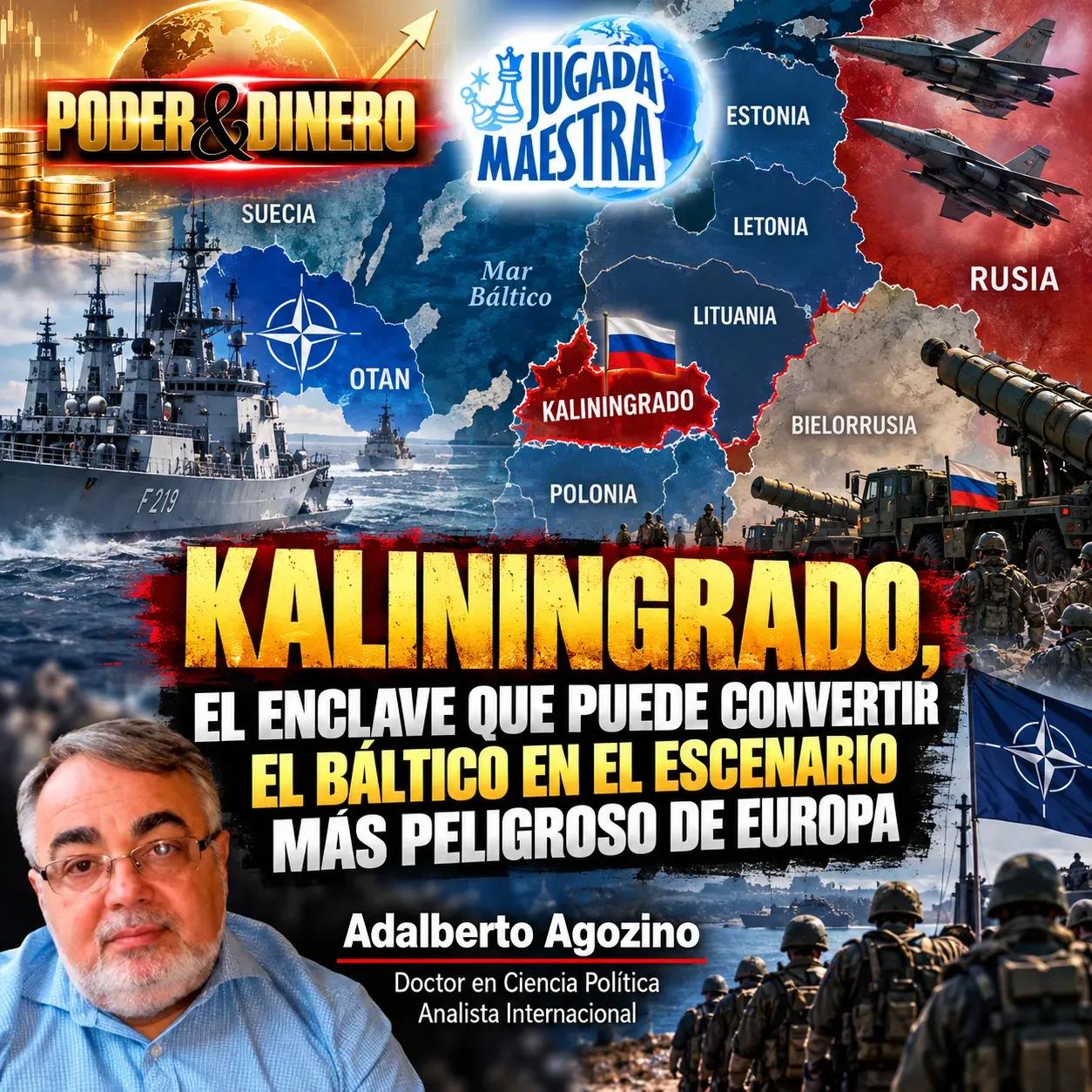
Kaliningrad occupies a relatively modest area on the European map, but no purely geographical consideration allows us to understand its true strategic weight. The Russian oblast, about 15,000 square kilometers, is separated from the continental territory of the Russian Federation and directly borders Poland and Lithuania, both members of NATO and the European Union. The nearest Russian border is several hundred kilometers away, and Moscow is more than a thousand kilometers distant. The enclave is therefore a territorial anomaly born out of World War II that, after the disappearance of the Soviet Union, gained even greater importance by being embedded among Western states.
The history explains a large part of that exceptionalism. Kaliningrad was Königsberg, a city founded in 1255 by the Teutonic Order that later became the capital of East Prussia and one of the great intellectual centers of the Germanic world. Immanuel Kant was born and lived there, whose presence continues to be part of the historical identity of the city. Königsberg was also a place of contact between German, Polish, and Lithuanian cultures and an important university and trading city. World War II definitively shattered that historical continuity.
The British bombings of 1944 and the battle fought in 1945 destroyed much of the city. The German capitulation was followed by the mass displacement of the German population and the incorporation of the northern region of East Prussia into the Soviet Union, a decision solidified in the territorial arrangement of Potsdam. Königsberg was renamed Kaliningrad in honor of the Bolshevik revolutionary Mikhail Kalinin, and the surviving German population was gradually replaced by citizens from other Soviet regions.
The Soviet decision had evident military rationality. Moscow acquired a Baltic port with relatively ice-free waters during the winter and an advanced position in the heart of Northern Europe. During the Cold War, Kaliningrad became an important Soviet naval base and a heavily militarized territory. The dissolution of the USSR turned that advantage into a problem: Russia retained the enclave but lost territorial continuity with it. Lithuania's independence made Kaliningrad a true Russian land island within the European space.
The subsequent incorporation of Poland and Lithuania into the European Union in 2004 and their membership in NATO multiplied that uniqueness. For a time, Moscow tried to combine the military dimension with an economic strategy that aimed to turn Kaliningrad into a sort of “Hong Kong of the Baltic”. The region had a special economic zone and developed manufacturing industries, port activities, fishing, and significant exploitation of amber.
This economic integration project with the Baltic ended up being subordinated to security logic. Studies by the European Council on Foreign Relations had already observed that the expectations of transforming Kaliningrad into a bridge between Russia and Europe were replaced by its progressive conversion into a “fortress” of Russia. Sergey Sukhankin, a regional specialist, has precisely studied that transformation and the simultaneous use of military, political, and informational instruments.
An advanced fortress
The contemporary significance of Kaliningrad fundamentally derives from its position. From the enclave, Russia can threaten extensive areas of the Baltic air and maritime space with missile and air defense systems. The Center for Strategic and International Studies (CSIS) has described the Russian military architecture in the region as part of an extensive network of A2/AD —anti-access/area denial— capabilities aimed at hindering access and freedom of maneuver for adversarial forces. Iskander systems and advanced air defense systems have been deployed in Kaliningrad, while the Russian Baltic Fleet maintains its main naval infrastructure there.
The concept is fundamental to understanding the strategy. Moscow does not necessarily need to use Kaliningrad to launch a ground offensive against NATO. Its value also lies in its ability to turn the space surrounding the enclave into a risk zone for allied aircraft, ships, and ground forces. The combination of ballistic and cruise missiles, air defense, aviation, electronic warfare, and naval forces allows for the creation of a military bubble that conditions NATO planning.
The Royal United Services Institute has also noted that Kaliningrad could play a relevant role in operations against underwater infrastructures in the Baltic, a particularly sensitive area after incidents involving cables and energy conduits. The British organization has highlighted that underwater communication and energy facilities are vulnerable strategic targets and that Kaliningrad, home to the Baltic Fleet, provides Russia with a platform from which to develop such operations.
But precisely that power conceals a weakness. Kaliningrad is surrounded by NATO territories. The enclave may be a fortress, but it is a fortress without strategic depth. In the event of a prolonged war, Russia would have difficulties sustaining its forces if maritime and air communications were interrupted. The problem becomes even greater when observing the so-called Suwałki corridor, the narrow strip of Polish and Lithuanian territory that separates Kaliningrad from Belarus.
The corridor is about 65 kilometers long and constitutes the land link between Poland and the Baltic States. Studies from CSIS and RAND consider it one of the main geographical vulnerabilities in the defense of Estonia, Latvia, and Lithuania. In a crisis, the Russian forces deployed in Kaliningrad and Belarus could simultaneously threaten NATO's land communication lines.
The paradox is extraordinary: what makes Kaliningrad valuable to Russia also makes it a territory difficult to defend. For Moscow, losing the ability to keep access to the enclave open would mean more than a logistical difficulty. It would imply the possibility that a Russian military force deployed in the Baltic could become isolated.
The Baltic after Finland and Sweden
The strategic transformation of the Baltic Sea accelerated with the incorporation of Finland and Sweden into NATO. What during the Cold War had been a maritime space shared between countries belonging to different blocs has become much more favorable to the Atlantic alliance. Kaliningrad thus constitutes a forward Russian platform surrounded by a growing Western military architecture.
The Russian researcher Andrey Kortunov summed up that perception from Moscow by indicating that the Baltic could practically become a “NATO lake”. The statement does not by itself describe a legal reality —the Baltic continues to be an international sea— but reflects the Russian perception of a progressive loss of strategic depth.
For NATO, the matter presents itself in an inverse manner. Kaliningrad constitutes a Russian platform from which the Baltic ally countries and reinforcement lines from Western Europe can be threatened. The problem is not only the existence of Iskander missiles or S-400 systems, but the interaction between those capabilities, geography, and uncertainty about Moscow's political intentions. CSIS has warned that combining Kaliningrad with the Russian capabilities deployed in Belarus may complicate the defense and reinforcement of the eastern flank.
Moscow's response: deterrence and nuclear threat
The most troubling dimension of the current crisis is that Russia has explicitly linked the defense of Kaliningrad with its nuclear capability. In September 2026, Moscow sent a communication to NATO warning that it would use “all its arsenal”, including nuclear weapons, if the alliance attempted to isolate the enclave. Reuters reported that the Russian document accused NATO of following a dangerous course that could lead to direct military confrontation.
The warning was not limited to the diplomatic realm. Vladimir Putin reiterated on October 1 that, in the event of a direct attack against Kaliningrad, the question of employing all available weapons by Russia would be immediately on the table. At the same time, he stated that Moscow did not intend to attack European countries and presented the nuclear threat as a mechanism of deterrence against eventual aggression.
There is also a doctrinal basis behind that rhetoric. The updated Russian nuclear deterrence policy established in November 2024 contemplates the use of nuclear weapons under certain circumstances of conventional aggression that generate a critical threat to the sovereignty or territorial integrity of Russia or Belarus. The document also considers situations related to massive attacks by aerospace means.
This does not mean that Russia has decided to use nuclear weapons in response to any interruption of traffic to Kaliningrad. The doctrine establishes conditions, and the decision rests with the Russian president. But it does mean that Moscow has deliberately incorporated nuclear uncertainty into its deterrence strategy.
Can Kaliningrad provoke a war between Russia and NATO?
The answer requires distinguishing between cause of war and escalation scenario. Kaliningrad is hardly an inevitable political cause of war between Russia and NATO. However, it may become the geographic point where a local crisis acquires a strategic dimension.
The most dangerous scenario would not necessarily be a deliberate attack by NATO against the enclave. It would be a chain of events in which a Russian operation against a Baltic state, a naval incident, a hybrid attack, a transit interruption, or an operation aimed at ensuring communications with Kaliningrad provokes an allied response. Under those circumstances, the military objectives of both contenders could quickly overlap.
Nikolai Sokov, a former Russian diplomat and specialist in nuclear affairs, has precisely warned of the risk of miscalculation. In statements collected by Reuters, he asserted that Moscow fears future restrictions on maritime transport in the Baltic and that, while Europe might interpret certain measures as pressure tactics, Russia could see them as equivalent to an act of war.
This perception problem is central. A maritime control operation that NATO considered defensive could be interpreted in Moscow as an attempt to strangle the enclave. Similarly, a Russian action aimed at ensuring access to Kaliningrad could be considered by Poland or Lithuania as aggression against allied territory.
NATO, for its part, has denied that it is preparing a blockade of Kaliningrad. Secretary General Mark Rutte has insisted that the alliance is defensive and that its military exercises do not constitute a threat to Russian territory.
The importance of Kaliningrad lies precisely in that gray area. It is not necessary for either actor to desire a general war for a crisis to produce an escalation dynamic.
Much more than a military base
Reducing Kaliningrad to a missile platform would be a mistake. The region has an economic, energy, maritime, historical, and symbolic dimension that significantly expands its importance.
Its port of Baltiysk allows Russia to maintain a permanent naval presence in the Baltic and provides year-round access to the sea. Its position also allows it to control, observe, and contest the maritime routes of a region where the economies of Germany, Poland, the Baltic countries, Scandinavia, and Russia converge.
The territory also possesses significant amber reserves and an industrial tradition linked to manufacturing transformation, fishing, and port activity. The exploitation of amber constitutes a distinctive economic and cultural element; sources collected in the provided document indicate that the region concentrates an extraordinarily high proportion of the world's production of this fossil resin.
There is also an energy dimension. After the Baltic states disconnected from the Russian power grid, Kaliningrad has developed capabilities to function more autonomously, with thermal generation, gas storage, and an energy infrastructure aimed at reducing its vulnerability to isolation. The European Council on Foreign Relations has analyzed this transformation as part of Russia's preparation for the enclave to operate even under conditions of separation from the regional energy system.
And finally, there is a historical dimension that should not be underestimated. Kaliningrad is simultaneously a Russian city, an old German city, and a territory that has belonged to the European strategic imaginary for centuries. The university named after the German philosopher Immanuel Kant symbolizes that paradoxical continuity between enlightened Königsberg and militarized Kaliningrad.
Thus, the enclave summarizes one of the essential contradictions of contemporary Europe. It is a territorial relic of World War II transformed into an advanced piece of 21st-century confrontation; a Russian region surrounded by NATO that serves Moscow to project power but that, at the same time, needs to be protected from potential isolation; a city associated with Kant, cosmopolitan reason, and perpetual peace, transformed into one of the spaces where conventional deterrence, hybrid warfare, and nuclear threat intersect most clearly.
That is why Kaliningrad matters so much. Not because it is inevitably the place where a war between Russia and the West will begin, but because it gathers in a few kilometers almost all the ingredients capable of turning a regional crisis into a strategic crisis. The future of the Baltic will largely depend on whether Moscow and NATO can maintain that distinction between deterrence and conflict.
Rontación. The recent nuclear rhetoric demonstrates that the margin of error has decreased. And when the disputed territory is a militarized enclave, surrounded by a military alliance and connected to the rest of Russia by routes whose security Moscow does not fully control, a miscalculation can have consequences much greater than the dimensions of Kaliningrad.
Adalberto Agozino holds a Doctorate in Political Science, is an International Analyst, and a Professor at the University of Buenos Aires.

Comments