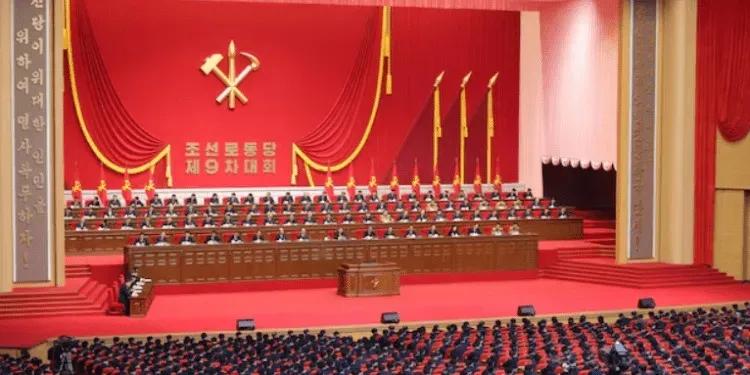
The liturgy of power in North Korea does not allow for emptiness or improvisation. This Thursday, under the vaults of the April 25 Culture Palace in Pyongyang, Kim Jong-un inaugurated the Ninth Congress of the Workers' Party, the most significant political event of the regime that will set the course for the country for the next five years. With a tone oscillating between messianic grandiloquence and unusual optimism, the North Korean leader proclaimed the end of the "worst times" and the beginning of a "new era" of economic prosperity and atomic muscle.
This conclave, which brings together nearly 5,000 delegates and 2,000 observers, is not just an exercise in ideological reaffirmation; it is the showcase of a dictatorship that, far from imploding under the weight of international sanctions, appears to have found in the war in Ukraine and its alliance with Vladimir Putin an unexpected lifeline.
The peninsula on the global chessboard
The strategic importance of the Korean peninsula transcends its borders. Nestled at a friction point between China's ambitions, the military presence of the United States, and renewed Russian expansionism, any move in Pyongyang alters the security balance in the Asia-Pacific. For Washington, the peninsula remains a hotspot of instability that justifies the presence of about 18,000 troops in the South, amid fears that a withdrawal might encourage aggression from the North.
The Kim regime has historically exploited its image as a “hermit kingdom,” a psychopathic and dangerous state that uses its nuclear arsenal as a bargaining chip and guarantee of survival. Geographically, the lack of natural defenses once crossing the Yalu River has turned the peninsula into an eternal battlefield, forging a fierce nationalism mixed with a Stalinist-style Marxism.
X-ray of a communist monarchy
North Korea continues to be the least democratic state in the world. Under the façade of a "people's republic", it operates a single-family dynasty that exerts control through a system of terror that includes summary executions, concentration camps housing over 100,000 political prisoners, and censorship reaching industrial levels. The restrictions are total: the UN warned last year that there is no other population in the world subjected to such deprivations of freedom, with the death penalty even applied for mere consumption of foreign music or movies.
However, the Kim Jong-un who appeared at this congress —dressed in a Western-style suit and tie instead of the traditional Mao outfit— seeks to project the image of a modern, self-assured statesman.
The mirage of economic recovery
The centerpiece of Kim's inaugural speech was the economy. The leader labeled the last five years as a "period of pride" with "notable, broad, and radical" successes. These words sharply contrast with the 2021 congress, where he candidly admitted the "enormous failure" of his prior plans due to the pandemic, natural disasters, and sanctions.
The statistical data, although opaque and largely derived from South Korean estimates, reflect a trend of recovery. After a contraction of 4.5% in GDP in 2020, the North Korean economy grew by 3.1% in 2023 and 3.7% in 2024, its fastest pace in eight years. Much of this relief comes from the revival of trade with China, which remains the lifeline for 90% of its exchanges, and from the export of arms to Russia for the conflict in Ukraine. Additionally, South Korea's National Intelligence Service estimates that the regime generated around $2 billion in 2025, through the theft of cryptocurrencies and illegal cyber activities.
Purge and renewal: Kim's new guard
One of the surprises of the congress has been the profound restructuring of the power elite. Kim has renewed 23 of the 39 members of the Workers' Party executive body. Historical figures linked to the old nuclear guard, such as former intelligence chief Kim Yong Chol, have been excluded, marking a departure from those who were part of the failed diplomacy with Donald Trump in 2019.
As veterans fall, the loyalists consolidate. Jo Yong Won remains the de facto number two, and the influential sister of the leader, Kim Yo Jong, has confirmed her position on the front lines. However, all eyes are on Kim Ju-ae, the teenage daughter of the leader. Although she did not appear at the inaugural session, South Korean intelligence believes she has already been "internally designated as the successor", which would institutionalize the fourth generation of the Kims, a bold move in a deeply patriarchal culture.
Trench diplomacy and the Eastern axis
Regarding foreign policy, the congress seems to reaffirm the isolation from the West in favor of complete integration into the Eurasian bloc. Pyongyang has received congratulatory messages and explicit backing from the governments of China, Russia, Laos, and Vietnam, consolidating its status within a network of like-minded regimes.
A shift toward moderation is not expected. In fact, one of the most sensitive points of the congress is the institutionalization of the doctrine that now defines South Korea not as a brother to be reunified, but as a "hostile state" and the main enemy. With the deployment of 11,000 troops in support of Russia and the development of intercontinental missiles like the Hwasong-20, capable of carrying multiple nuclear warheads, Kim Jong-un has made it clear that his absolute priority remains the "most powerful military muscle."
The great unknown remains Donald Trump. Although the U.S. president has indicated his willingness for another meeting, the North Korean regime has maintained a calculated silence, demanding that any dialogue preclude denuclearization. In this congress, North Korea seeks not only to survive; it seeks for the world to accept, irrevocably, its status as a sovereign nuclear power.
Adalberto Agozino is a Doctor of Political Science, International Analyst, and Lecturer at the University of Buenos Aires, Argentina.
Comments