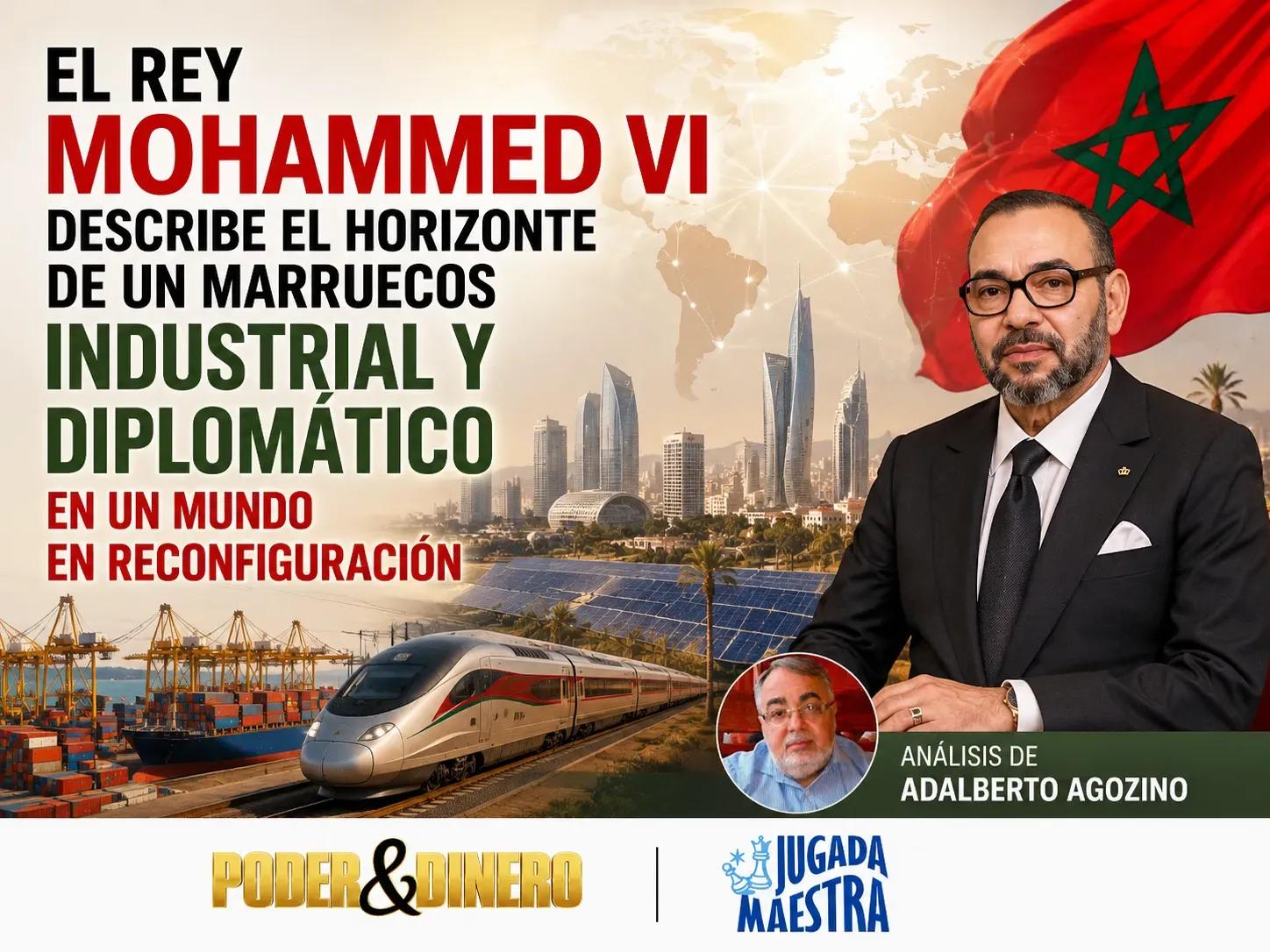
Few interventions by a head of state manage to condense a vision of the country as clearly as that pronounced by King Mohammed VI on the occasion of the Throne Day of 2026. Beyond the ritual protocol and the recounting of achievements from the past year, the message stands as a deep reflection on the development model built over nearly three decades and on the foundations that support the growing economic and diplomatic projection of the Kingdom. In a global scenario marked by geopolitical fragmentation, rivalry among great powers, and economic uncertainty, the sovereign presents Morocco as a state determined to turn institutional continuity into a competitive advantage and industrialization into the main instrument of its international insertion.
There is a substantial difference between speeches conceived to respond to the urgencies of the moment and those that aim to set the coordinates of a historical project. The address on the twenty-seventh anniversary of the ascension to the Throne unequivocally belongs to the latter category. It is not only about celebrating recent advances or presenting the results of a specific government. The text offers an interpretation of the transformation process experienced by Morocco since the end of the twentieth century and, at the same time, a declaration of principles about the role the Kingdom aspires to play in the international system in the coming decades.
From a political standpoint, the speech represents one of the most significant texts of King Mohammed VI's reign. It merges three narratives that have marked the evolution of the country in recent years: the consolidation of a governance model focused on institutional continuity, the construction of an increasingly industrialized and technologically sophisticated economy, and the strengthening of a foreign policy aimed at making Morocco a reference actor between Europe, Africa, and the Atlantic space. The tone deliberately avoids triumphalism. Although the balance is positive, the monarch places achievements within a logic of historical continuity rather than personal success. His assertion that his goal was never to seek personal glory or recognition for a continental or international leadership role, but to faithfully fulfill the duty of serving the people, is particularly revealing.
Beyond its rhetorical dimension, this declaration serves a precise political function: it places the modernization process above the individual figure of the monarch and links it to the continuity of the state. Economic and institutional transformations do not appear as results of isolated or conjunctural decisions but as consequences of a national strategy sustained over nearly three decades. This idea is reinforced in one of the densest phrases of the intervention: all that has been achieved was not the result of chance but the outcome of a clear strategic vision and a governance approach based on initiative, meticulous follow-up, and constructive self-criticism. This assertion likely constitutes the true thesis of the speech. The rest of the message can be read as a demonstration of that premise. Economic transformation, institutional strengthening, industrial expansion, increased exports, and growing diplomatic influence are presented as concrete manifestations of the same organizing principle: the existence of a state project designed to develop over the long term.
From a political analysis perspective, this conception is of particular interest because it breaks with a common characteristic in numerous emerging countries: the discontinuity of public policies. While in much of the developing world, changes in government often imply profound modifications of economic and administrative priorities, the speech precisely claims the stability of strategic orientations as one of the main national assets. It is no coincidence that Mohammed VI repeatedly refers to the concept of governance. The term is used in a much broader sense than usual in international organizations. It does not merely describe efficient administrative procedures but encompasses the state's capacity to formulate national objectives, coordinate institutions, mobilize resources, and maintain coherent policies over long periods.
This vision becomes especially visible when the King states that Morocco is undergoing a decisive stage in its development process, in which a spirit of confidence and optimism must prevail over discourses of despair and frustration. The message introduces here an unusual element in economic speeches: collective confidence is presented as a strategic resource as important as investments or infrastructures. Numerous studies on sustained growth have demonstrated that shared expectations within society, institutional predictability, and trust in the continuity of public policies constitute essential factors for attracting investments and stimulating innovation. The speech explicitly incorporates this logic by presenting social optimism as an indispensable condition for consolidating the modernization process.
Stability therefore occupies the center of the entire argumentative architecture. However, the concept is defined in a particularly broad manner. It does not simply equate to the absence of internal conflict, nor is it exclusively identified with the maintenance of public order. In the sovereign's reasoning, stability represents the state's capacity to preserve institutional continuity in an increasingly uncertain international environment. The formulation is unequivocal: political and institutional stability constitutes an exceptional asset of incalculable value and represents the strategic capital of which Morocco is proud.
This assertion takes on special relevance when observing the immediate geopolitical environment. North Africa and the Sahel continue to face challenges associated with terrorism, armed conflicts, political instability, coups, and economic crises. In the Middle East, multiple hotspots of tension persist, while Europe is undergoing a period of economic slowdown and growing strategic uncertainty. In that context, the speech presents Morocco as a regional exception characterized by institutional continuity and the capacity of the state to execute complex public policies. It is not merely an assertion aimed at internal consumption. It also constitutes a message directed at international markets, foreign investors, and diplomatic partners. In a global context where political risk has become a determining variable for locating investments, stability appears transformed into a true economic resource.
The logic of the reasoning is clear: where there is institutional predictability, it is possible to plan industrial investments that require time horizons of twenty or thirty years; where the rules remain relatively stable, technologically complex sectors can be developed; where institutions function in a coordinated manner, it is possible to build value chains capable of competing internationally. The speech also links stability with institutional efficiency. Mohammed VI asserts that Morocco constitutes an ancestral nation whose institutions act in a spirit of harmony and complementarity, allowing for the consolidation of achievements and the facing of challenges even in adverse circumstances. Rather than presenting institutions as independent bureaucratic structures, the text describes them as components of the same national project. Institutional coordination thus appears as an indispensable requirement to sustain the process of economic modernization.
The reference to the capacity demonstrated by Morocco to organize large international events and manage emergency situations, such as the recent floods that affected various regions of the country, is also significant. The sovereign interprets both examples as evidence of a public administration capable of responding effectively to both ordinary and extraordinary challenges. These examples serve a broader argumentative function: they seek not only to highlight administrative efficiency but to reinforce the idea that economic development is inextricably linked to institutional strength. The organization of large events, disaster management, attracting industrial investments, and building infrastructures are thus integrated within the same narrative about the state’s capacity to execute complex policies.
Once the existence of stable governance, effective institutions, and a long-term strategic vision has been established, the speech shifts the center of gravity towards the economy. It does so not through a simple exposition of macroeconomic indicators nor by resorting to the usual catalog of figures. The message pursues a more ambitious objective: to demonstrate that Morocco has left behind a growth model primarily supported by traditional sectors to become an industrial economy integrated into large global production chains. For a large part of the twentieth century, the Moroccan productive structure was heavily conditioned by agriculture, phosphate mining, and an expanding tourism sector. Although these sectors continue to play an important role, the sovereign's intervention reveals that the national strategy has focused on technology-intensive, knowledge-driven, and industrially innovative activities.
The data regarding economic growth illustrates this evolution, although it does not constitute the core of the message. Mohammed VI recalls that the economy reached a growth rate of around 4.9 percent during 2025 and anticipates that this pace can be maintained or even increased. Beyond the number, the interest lies in the interpretation that the speech proposes of this growth. It is not presented as a conjunctural phenomenon derived from favorable international circumstances but rather as the consequence of a carefully planned structural transformation process. In this sense, the sovereign attributes special importance to the recovery of the agricultural sector after a period of adverse weather conditions. The reference to a successful agricultural campaign and the improvement of water and food security transcends the mere seasonal balance. In a country where water is one of the main constraints on development, the management of water resources acquires strategic dimension.
The true economic heart of the discourse appears when Mohammed VI states that Morocco has managed to establish itself as a hub for industrial, tourism, and financial investment. This phrase summarizes a strategy initiated more than two decades ago aimed at making the Kingdom an industrial platform capable of connecting European, African, and Atlantic markets. The importance of this assertion becomes evident when the King identifies the sectors that today constitute the pillars of the national productive apparatus: automotive, aerospace, renewable energies, and agri-food industry. All of them share three fundamental characteristics: they require high levels of technological investment, generate highly qualified employment, and are closely integrated into international supply chains.
From a comparative perspective, this evolution represents one of the most significant changes registered by an African economy in recent decades. Morocco has not opted to compete exclusively through low labor costs or tax advantages but has sought to insert itself into industrial segments where competitiveness increasingly relies on technological quality, logistics, and institutional stability. The case of the automotive industry constitutes the most eloquent example. The speech recalls that Morocco has become the main exporter of cars on the African continent, reaching an annual capacity of nearly one million vehicles. Even more significant is the fact that the combined exports of the automotive and aerospace sectors already account for more than forty percent of the total exported by the Kingdom, surpassing even the historical weight of phosphates.
This reference encompasses a profound structural transformation. For decades, phosphates symbolized the main exportable wealth of the country. That today industrial manufactures have surpassed this prominence serves as an indicator of the profundity of the experienced change. Exporting raw materials implies participating in international markets from positions generally subordinate to the evolution of commodity prices. In contrast, exporting vehicles, aerospace components, or industrial equipment means integrating into productive networks where added value, technological innovation, and industrial specialization take on much greater importance.
Even more revealing is the reference to the inauguration of new industrial plants aimed at manufacturing aircraft engines and landing gear systems. The aerospace industry is one of the most complex industrial activities. Its development requires high standards of quality, highly specialized labor, technological transfer, international logistical integration, and close cooperation with multinational companies. That Morocco aims to produce critical components for aircraft constitutes evidence of the increasing sophistication achieved by its industrial apparatus. From a strategic perspective, the message conveys a clear idea: the Kingdom does not intend to limit itself to assembling products designed in other countries but rather to gradually advance towards activities with higher technological content and greater capacity to generate national innovation.
This logic becomes clearer when Mohammed VI addresses the development of the electric battery sector. The discourse asserts that this industry demonstrates Morocco's capacity to anticipate technological transformations and integrate into the new production chains linked to strategic industries. The transition to electric mobility represents one of the most significant industrial processes...
"before the 21st century. Batteries are one of the components with the highest added value and currently concentrate intense technological competition among the United States, Europe, and Asia. By highlighting this sector, the discourse suggests that Morocco intends to occupy a significant place in this global transformation.The same logic inspires the development of renewable energies. The sovereign maintains that these projects should not be understood solely as environmental initiatives, but as instruments of economic policy capable of simultaneously reinforcing energy security and industrial competitiveness. While numerous countries continue to approach the energy transition primarily from a climate perspective, Morocco presents it as a tool aimed at strengthening its competitive position. The availability of clean electricity at competitive costs is conceived as a factor capable of attracting energy-intensive industries, especially those subjected to increasing environmental demands from European markets. Within this strategy, Morocco's so-called offer regarding green hydrogen holds a particularly prominent place. The announcement of the authorization of a first series of large projects constitutes one of the most relevant passages of the discourse. Thanks to its solar and wind resources, Morocco has particularly favorable geographic conditions for producing hydrogen using renewable sources, a circumstance that the discourse incorporates as a long-term strategic opportunity.
In reality, the reference to green hydrogen transcends the energy issue. It represents a manifestation of a national strategy aimed at anticipating the industries likely to dominate the world economy over the next decades. This capacity for anticipation constitutes precisely one of the traits that the sovereign claims when speaking of governance based on strategic vision and long-term planning. From this perspective, the industrialization described should not be interpreted solely as a policy aimed at increasing gross domestic product. It is presented as a much broader process of structural transformation through which Morocco aspires to simultaneously enhance its economic autonomy, technological capacity, and international influence. In that logic, the economy stops being considered exclusively as a realm of wealth generation to become an instrument of national power.
One of the most novel aspects of the discourse lies in the close relationship it establishes between economic development and national security. Unlike traditional conceptions, which for decades considered both areas as relatively independent spheres, the monarch's message integrates them within the same strategic architecture. Industrialization ceases to appear solely as an instrument to increase growth or generate employment; it becomes an essential element of the State's autonomy and, consequently, of its capacity to defend its interests in an increasingly competitive international environment. The profound geopolitical transformations recorded since the COVID-19 pandemic, exacerbated by trade tensions among the great powers, the war in Ukraine, and the growing fragmentation of international supply chains, have substantially altered the way many states conceive their security. Excessive dependence on external suppliers in critical sectors has stopped being seen as a simple economic issue to become a question of sovereignty.
It is precisely within this context where one of the central passages of the discourse acquires special relevance. Mohammed VI asserts that, in the face of the return of protectionism and the need to secure production chains, Morocco has positioned the strengthening of national sovereignty and strategic self-sufficiency as one of the fundamental axes of its industrial development. The formulation is particularly significant because it incorporates concepts into Moroccan political language that, until a few years ago, were primarily associated with great industrial powers. Strategic self-sufficiency is no longer solely a concern of the United States, China, or the European Union; it is now presented as a priority also for a middle-income state that aspires to gradually increase its margin of autonomy.
The strategy is articulated around a simple but profoundly deep idea: a country depends less on the decisions of others the greater its capacity to internally produce those goods considered essential for the functioning of its economy and the protection of its population. In that sense, the discourse highlights that the food and pharmaceutical industries already satisfy approximately eighty percent of national needs. The pandemic revealed to what extent even highly developed economies could face difficulties accessing medicines, medical supplies, or certain food products when global supply chains experienced interruptions. Self-sufficiency in these sectors is thus presented as an additional guarantee of stability in the face of future international crises.
Probably the most relevant announcement from a strategic perspective is the decision to develop an industrial and technological base linked to the defense industries and cybersecurity. Although the discourse does not provide specific details about the scope of these projects, the mere incorporation of this objective within national planning is highly significant. The defense industries constitute one of the sectors where technological innovation, scientific research, industrial development, and strategic autonomy converge. At the same time, the increasing prominence of cybersecurity reflects Morocco's adaptation to an international scenario in which threats are no longer limited to conventional military realms but include attacks against critical infrastructure, financial systems, energy networks, and digital platforms. From a geopolitical perspective, this decision can be interpreted as part of a broader trend observed in numerous countries in recent years. International technological competition has turned certain industrial capabilities into genuine instruments of national power.
At this point, the discourse hints at a profound transformation in the way Morocco conceives its international insertion. For decades, the Kingdom was primarily seen as a trading partner, a tourist destination, and an important agricultural and mining producer. Today, the official narrative aspires to present a country capable of developing advanced industries, producing complex technologies, and actively participating in sectors linked to defense, aerospace, energy transition, and the digital economy. The reference to defense industries also carries another, less explicit but equally relevant dimension. It implies recognizing that economic strengthening and military strengthening are complementary processes. No regional power can sustain an ambitious foreign policy without a robust industrial base to support its strategic autonomy.
However, Mohammed VI avoids presenting industrialization as an end in itself. Throughout his intervention, he emphasizes that economic growth only acquires political legitimacy when it translates into an effective improvement of the population's living conditions. The sovereign reminds that the Kingdom continues to develop numerous human development programs and advance in the generalization of social protection with the purpose of improving the citizens' living conditions and strengthening social and territorial justice. The inclusion of this passage is particularly important because it prevents the discourse from being interpreted solely as a defense of economic growth. Mohammed VI seeks to build a narrative where industrial development and social cohesion are closely linked. Of special interest is the insistence on the need for integrated territorial development programs to reach all regions of the Kingdom without exception. This reference highlights a recurring concern in numerous modernization processes: preventing the benefits of growth from concentrating exclusively in large urban centers or the most developed regions.
The financial question also occupies a relevant space. Mohammed VI acknowledges that the economic and social transformation of the country requires resources of an unprecedented magnitude and states that a large part of them must be obtained through mechanisms of internal financing. This assertion constitutes an additional indicator of the growing maturity of the Moroccan economy. For many years, the development of numerous emerging countries relied heavily on international financing or foreign aid. The discourse now proposes a different approach: strengthen the national savings capacity, mobilize the resources of Moroccan financial institutions, and significantly expand access to credit for small and medium enterprises, technological innovation, industrialization, and exports. No sustained industrialization process can indefinitely depend on foreign capital. The consolidation of a financial system capable of channeling internal savings toward productive projects constitutes one of the fundamental requirements to sustain growth over long periods.
The discourse thus conveys a coherent image of the economic model that Morocco seeks to consolidate. It is not simply about attracting international investments but about gradually building a financial and industrial ecosystem capable of sustaining an increasing part of the modernization process with its own resources. In this conception, the State plays a role of strategic coordinator rather than a substitute for the private sector. The King does not propose an expansion of the state apparatus as the exclusive motor of development. On the contrary, he makes an explicit call to the financial system to expand its capacity to support private investment, facilitate innovation, and accelerate the creation of exporting enterprises. Modernization thus appears as the result of a permanent interaction between public policies, entrepreneurial initiative, and institutional stability.
If the first half of the discourse is dedicated to demonstrating that institutional stability is the foundation of economic development and that industrialization represents the main instrument of national transformation, the final section shifts the focus to Morocco's growing international influence. This is not a thematic change but the logical culmination of the reasoning. The external projection of the Kingdom is presented as the natural consequence of consolidating a model of State that has managed to combine political continuity, economic modernization, and institutional capacity. For decades, numerous developing countries tried to increase their international weight through intense diplomatic activity that did not always find support from a solid economic base. The Throne Speech proposes an inverse logic: before aspiring to play a relevant role on the international stage, the State must internally build the economic, industrial, and institutional capacities that make that aspiration credible.
The phrase chosen by Mohammed VI to synthesize that evolution is particularly significant: Morocco's position as a reliable, respected, and influential international actor has been consolidated. Each of those three qualifiers corresponds to a distinct dimension of contemporary foreign policy. The condition of a reliable actor refers to the predictability of the Kingdom's international action. In a scenario characterized by the increasing volatility of alliances and the acceleration of geopolitical changes, credibility has become one of the main diplomatic assets. The qualifier of respected refers to an international legitimacy that transcends the demographic or economic size of the country. Finally, the notion of an influential actor introduces a qualitatively distinct dimension. Influence implies the ability to shape decisions, generate consensus, and actively participate in the configuration of major international processes.
The next assertion from the King deepens this idea by stating that Morocco has become a key economic actor and a sought-after partner within the framework of new balanced and future-oriented partnerships. The expression “new balanced partnerships” reflects one of the main transformations registered in Moroccan foreign policy in recent years. Traditionally, relations between Europe and many African countries were marked by strong political and economic asymmetry. The discourse suggests that Morocco considers this logic overcome and aspires to establish links based on shared interests and mutual benefits. This conception fits fully into the evolution of the international system toward an increasingly multipolar order. The relative weakening of the structures inherited from the post-war period and the rise of new economic powers have significantly expanded the maneuvering room of middle states.
In this context, another of the central phrases acquires special relevance: Morocco can confidently and clearly approach all its partners to propose cooperation initiatives on major bilateral and international issues. From a diplomatic perspective, this assertion constitutes a declaration of autonomy. It does not mean neutrality or equidistance between the great powers but rather the willingness to develop a foreign policy sufficiently flexible to maintain constructive relations with diverse international actors without renouncing its own strategic interests. This aspect is especially visible when Mohammed VI emphasizes that the Kingdom has chosen to diversify its partnerships to strengthen national capabilities and increase the strategic value of the country in multiple."
La lógica que inspira esta política guarda una estrecha relación con la evolución de la economía marroquí descrita en la parte anterior del discurso. Una economía diversificada requiere igualmente una diplomacia diversificada. Las nuevas industrias manufactureras, la expansión de las exportaciones, el desarrollo de las energías renovables y la consolidación de Marruecos como plataforma logística internacional exigen una red cada vez más amplia de acuerdos económicos, financieros y tecnológicos. En consecuencia, la política exterior deja de concebirse exclusivamente como un instrumento de representación internacional para transformarse en una extensión de la estrategia nacional de desarrollo. Desde esta perspectiva, el Reino procura posicionarse como uno de los principales puntos de articulación entre espacios geopolíticos tradicionalmente separados. Su ubicación geográfica le permite proyectarse simultáneamente hacia Europa, el Atlántico, el Mediterráneo, África occidental y el mundo árabe. Sin embargo, el discurso deja claro que la geografía, por sí sola, no basta para garantizar esa centralidad. Resulta imprescindible acompañarla mediante infraestructuras modernas, estabilidad institucional, capacidad industrial y una diplomacia activa.
En los párrafos finales de su intervención, Mohammed VI abandona definitivamente el terreno del balance coyuntural para situar el debate en una dimensión mucho más amplia: la del tiempo histórico. El monarca ya no habla únicamente de crecimiento económico, de inversiones industriales o de relaciones internacionales; reflexiona sobre la manera en que un Estado construye su desarrollo a lo largo de varias décadas mediante la acumulación progresiva de decisiones estratégicas. En una época dominada por la inmediatez política y por la presión constante de los ciclos electorales, el discurso reivindica la importancia de mantener orientaciones estratégicas capaces de trascender gobiernos, legislaturas y circunstancias económicas temporales. La frase elegida resume con claridad esta concepción: los logros económicos y sociales alcanzados trascienden el marco temporal de una legislatura gubernamental o parlamentaria; son, más bien, el resultado de una sucesión de cúmulos positivos, realizados durante años, gracias a la orientación estratégica y a las grandes decisiones acertadamente adoptadas por el país.
Desde la perspectiva del análisis institucional, esta afirmación posee una importancia considerable. Introduce una visión acumulativa del desarrollo. El progreso no aparece presentado como el resultado de medidas aisladas ni como consecuencia de un único programa de gobierno. Surge, por el contrario, de una secuencia continua de políticas públicas que, mantenidas durante largos periodos, terminan modificando estructuralmente las capacidades del Estado y de la economía. El pasaje pone de relieve una concepción del liderazgo basada en la continuidad antes que en la ruptura. Mientras numerosos sistemas políticos tienden a identificar el cambio con la sustitución de políticas anteriores, el discurso sostiene que las grandes transformaciones nacionales requieren precisamente preservar determinadas orientaciones fundamentales con independencia de las alternancias políticas.
No menos relevante resulta la referencia a las próximas elecciones legislativas y a la formación de un nuevo gobierno. Lejos de presentar ese proceso como un punto de inflexión, el soberano expresa su deseo de que la nueva etapa política esté orientada a la consolidación de los logros y la continuación de los grandes proyectos y reformas. Desde un punto de vista institucional, esta formulación reafirma la idea de que las transformaciones estratégicas deben sobrevivir a las alternancias gubernamentales. Las elecciones aparecen integradas dentro de un marco de continuidad donde los cambios políticos no implican necesariamente una redefinición de los grandes objetivos nacionales.
Vista en conjunto, la intervención ofrece también una determinada concepción del liderazgo. Mohammed VI presenta la conducción del Estado como un ejercicio permanente de anticipación estratégica. Gobernar significa identificar con suficiente antelación las transformaciones tecnológicas, económicas y geopolíticas capaces de modificar el entorno internacional, preparando al país para aprovechar esas oportunidades antes de que se materialicen plenamente. La reiterada referencia a la planificación, al seguimiento minucioso, a la autocrítica constructiva y a la visión estratégica adquiere así una dimensión mucho más amplia que la mera descripción de un método de gestión. Se convierte en la explicación del modelo mediante el cual el Reino pretende afrontar un siglo caracterizado por cambios acelerados y por una competencia internacional crecientemente compleja.
Todo discurso político aspira a interpretar el presente. Muy pocos consiguen, además, formular una visión coherente del futuro. El mensaje pronunciado por Mohammed VI con motivo de la Fiesta del Trono de 2026 pertenece a esta última categoría. Su importancia no reside exclusivamente en el balance económico presentado ni en la enumeración de los proyectos actualmente en ejecución. Su verdadera trascendencia radica en ofrecer una narrativa integral acerca del lugar que Marruecos pretende ocupar en un mundo sometido a profundas transformaciones geopolíticas, tecnológicas y económicas. Leído en perspectiva, el texto constituye mucho más que una exposición de logros gubernamentales. Se trata de una formulación estratégica destinada a explicar cómo un Estado de dimensiones medias puede incrementar progresivamente su influencia internacional mediante la combinación de estabilidad institucional, modernización económica, diversificación productiva y una política exterior pragmática.
A lo largo de toda la intervención, el Rey desarrolla una idea que aparece reiteradamente bajo diferentes formas: la fortaleza exterior de un país depende, en última instancia, de la solidez de sus instituciones y de la capacidad de su economía para generar innovación, riqueza y cohesión social. Esta relación entre estabilidad interna y proyección internacional constituye probablemente el principal hilo conductor del discurso. En este sentido, el mensaje se distancia de aquellas concepciones tradicionales que identificaban el poder internacional exclusivamente con la dimensión militar o con el tamaño demográfico. La influencia internacional aparece definida mediante parámetros mucho más complejos. La capacidad para atraer inversiones, participar en industrias tecnológicamente avanzadas, asegurar cadenas de suministro, desarrollar energías renovables, fortalecer la resiliencia económica y construir asociaciones equilibradas adquiere un protagonismo equivalente —e incluso superior— al de los instrumentos clásicos del poder estatal.
Desde esa perspectiva, el discurso pronunciado con motivo de la Fiesta del Trono trasciende ampliamente el significado de una ceremonia nacional. Constituye una declaración de intenciones acerca del papel que Marruecos aspira a desempeñar en las próximas décadas y una síntesis de la visión estratégica que ha orientado buena parte de las transformaciones impulsadas durante los veintisiete años del reinado de Mohammed VI. Más que un punto de llegada, el mensaje presenta esos logros como la base sobre la cual el Reino pretende construir una nueva etapa de desarrollo, caracterizada por una mayor capacidad industrial, una autonomía económica más sólida y una presencia internacional cada vez más influyente en un orden mundial en plena reconfiguración.
Comments