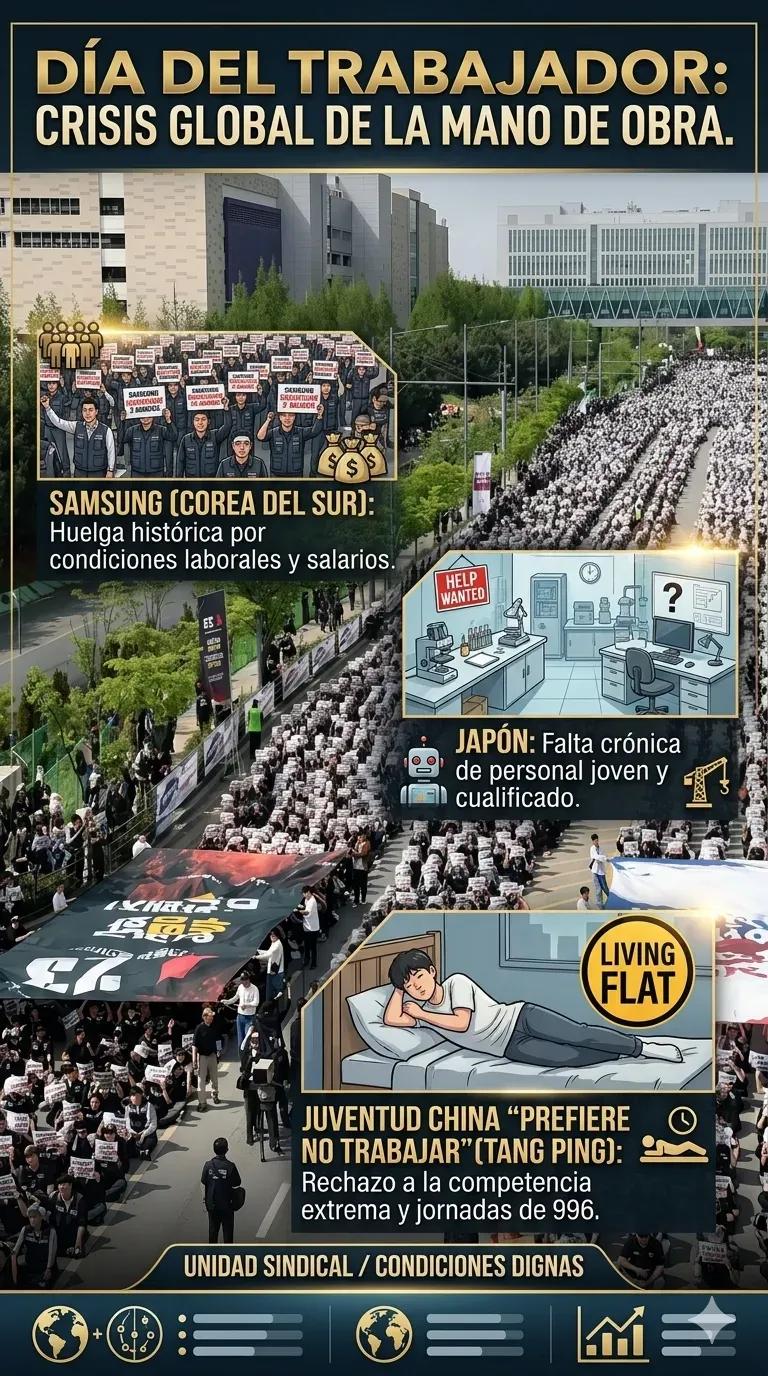
Samsung: the strike at the heart of AI
To understand why the Samsung group is facing its largest simultaneous labor conflict in 55 years of history, we must go back to September 2025. That month, the SK Hynix union—Samsung's main rival in the memory market—agreed with management to eliminate the cap on performance bonuses and allocate 10% of the annual operating profit to those payments for the next ten years. The comparative effect was immediate: it is estimated that each SK Hynix worker could receive bonuses equivalent to about $478,000 just in 2026. An employee in the chip division of Samsung with the same base salary would receive less than a third of that amount under the current scheme.
This gap spurred two phenomena in parallel. On the one hand, an exodus of talent: in the following three months, more than 100 union members left Samsung to join SK Hynix, and several young employees from the chip division formed study groups to prepare for the competitor's selection processes. On the other hand, a surge in union membership: the Samsung Electronics Employees Union (SELU) grew from barely 6,000 members in September 2025 to 74,000 in just a few weeks, becoming the majority union in the company and gaining legal recognition as the official representative of the workers on April 17, 2026. Of the 125,000 employees of Samsung in South Korea, 90,000 are eligible to vote in the process that will define whether the announced strike occurs.
The SELU's demand is concrete: eliminate the cap on bonuses and distribute 15% of the annual operating profit among the workers. The basis of the claim is also strong: Samsung recorded 57.2 trillion won in operating profit just in the first quarter of 2026—becoming the fourth most profitable company in the world during that period—driven by HBM chips that power the AI systems of Nvidia, Google, and Amazon.
Analysts project that the annual operating profit for 2026 could surpass 300 trillion won, more than four times the previous year. Based on that, the demand for 15% amounts to 45 trillion won: more than the company's annual R&D budget and four times the total dividends paid to shareholders last year. If the strike takes place on May 21 in Pyeongtaek, the largest semiconductor plant in the world, losses could reach $680 million per day, according to estimates from the union's own leadership. Choi Seung-ho, leader of the SELU, summarized it precisely: "The chip industry is booming, but those profits are not reaching us."
Samsung responded with what it described as an unprecedented proposal: a salary increase of 6.2% and special bonuses equivalent to 100% of the base salary for every 100 trillion won in annual operating profit. The company argued that eliminating the cap would make it difficult to finance future investments in a capital-intensive and highly cyclical industry.

The conflict is not limited to the semiconductor division. Today, unionized workers at Samsung Biologics—the group's biotechnology arm—began a general strike for five days, the first since the company's foundation in 2011, demanding a 14% increase in base salary, a one-time bonus of 30 million won per worker, and bonuses equivalent to 20% of the annual operating profit. The company estimated potential losses exceeding 640 billion won, equivalent to about half of its sales from the first quarter.
In biopharmaceutical manufacturing, a one-day interruption causes proteins and materials to deteriorate and must be completely discarded, adding a dimension of irreversible operational risk. The union emphasized that the strike responds not only to the salary dispute but to what it described as a management failure: faced with more than a month of negotiation demands, the company responded with legal pressure—including a request for a court injunction—rather than concrete proposals.
President Lee Jae Myung—elected with union support—chose the eve of Labor Day to publicly distance himself from both conflicts, warning that demands that generate popular rejection ultimately harm the entire working class. May 1, 2026, marks the first time in Samsung's history that two of its core companies face simultaneous labor conflicts: one at the heart of the global AI chip supply chain, the other in contract pharmaceutical manufacturing.
The lesson from Japan: when talent is underfunded, it's not easy to recover it
The Japanese shipbuilding industry, which led global markets in the 1980s, fell to 1.4% of the global share of new orders in the first quarter of 2026, according to Clarksons Research. During the same period, South Korea captured 20% of the market. Orders for LNG carriers—a high-value segment—have practically disappeared from the Japanese schedule since 2016.
The sector's diagnosis points to a structural cause: the sustained interruption of naval engineering training during the recessions of the 1990s. The University of Tokyo dissolved its Department of Naval Engineering in 2000; Hiroshima University eliminated the designation "shipbuilding" from its faculty in 1991. Without a doubt, that decision cut the flow of specialized designers for decades.
Tsuneishi Shipbuilding reduced its factory utilization rate by nearly 40% from its historic peak due to a lack of personnel. Yukito Higaki, president of Imabari Shipbuilding, Japan's largest shipyard, admitted to Nikkei that the company cannot even meet domestic demand for replacements.
The government of Japan responded by declaring the shipbuilding industry a national strategic sector and approving a roadmap with an investment of 350 billion yen over ten years, aiming to double annual production to 18 million gross tons by 2035.
However, industry players warn that the shortage of engineers cannot be solved just with financing: specialized human capital takes generations to train and was dismantled in just a few years of cuts. Three decades later, no investment plan has reversed the drop in market share.
China: youth unemployment, the 15th Five-Year Plan, and the bet on robots
According to data from the National Bureau of Statistics of China collected by Trading Economics, the urban youth unemployment rate for the age group of 16 to 24 was 16.1% in February 2026—the lowest level since June the previous year, although persistently high after reaching a historical record of 21.3% in June 2023, when the government stopped publishing the indicator for several months.
In this sense, the Asia Society Policy Institute documented that the largest graduating class in Chinese history—12.22 million university graduates in 2025—faces a labor market hit by the trade war with the United States and disrupted by artificial intelligence in almost all sectors; more than 20% of delivery workers from the two largest delivery platforms in the country have a university degree.

The state's response to the phenomenon of tang ping—"lying flat," the youth's rejection of work and ambition—reveals the political dimension of the problem. The Ministry of State Security attributed the youth's disillusionment to foreign ideological infiltration, warning that hostile anti-China forces only want young people to "lie flat," to become discouraged, so that the country gives up its progress and future, as reported by the Wall Street Journal. In September 2025, the Cyberspace Administration launched a campaign to restrict content that incites "excessively pessimistic sentiments," targeting influencers who argue against meritocracy.
The official framing collides with the Confucian tradition of effort and collective duty that has historically structured Chinese work ethics, which Xi Jinping himself has invoked in repeated calls to young people to "embrace sacrifice."
In this regard, social anthropologist Xiang Biao—director of the Max Planck Institute for Sociology and Ethnography and an intellectual with some influence on Chinese youth: the Chinese version of his book Self as Method was named the most influential book of 2021 by Douban—offers a different reading: in his most recent work, documented by Reporte Asia, he argues that many young Chinese do not reject effort due to foreign influence but because they feel they have lost control of their own lives, absorbed by an educational and labor system that processes them without leaving them with an identity beyond the image of success they must project.
Accelerated urbanization has broken the family and community ties that gave meaning to collective sacrifice; what remains, according to Xiang, is a generation that runs in place while the period of high growth fades.
The center of the "Middle Kingdom" is Innovation
On the other hand, the 15th Five-Year Plan (2026–2030), approved by the National People's Assembly in March 2026, establishes the structural framework in which this tension will play out over the next five years.
The plan explicitly abandons the low-cost manufacturing model and reorients the industrial strategy toward what Beijing calls "New Quality Productive Forces": artificial intelligence, advanced semiconductors, quantum computing, biotechnology, and 6G communications, as outlined in Rödl & Partner's analysis of the approved document.
In this regard, Yu Jie, a researcher at Chatham House, notes that the central challenge for policymakers is to balance the push for technological self-sufficiency with job creation and income growth for young workers amidst high structural unemployment since the pandemic.
More robots or more workers
Robotics occupies a specific place in this framework. The 15th Five-Year Plan designates robotics and "embedded intelligence"—so-called humanoid robots—as one of the country's eight strategic industries, a higher category than it occupied in the previous plan, integrating it into chapters on manufacturing, digital transformation, and health, according to the analysis by the Stanford DigiChina Forum.
Experts from Brookings point out that humanoid robots are one of the riskiest bets of the plan, as they involve technologies not yet proven at a commercial scale; they are already appearing at fairs and exhibitions as hosts and generating emerging sectors for rental, deployment, and maintenance. The Chinese labor platform Maimai registered that job offers related to artificial intelligence grew approximately twelve times year-on-year during January and February 2026, with high-specialization positions like AI scientist or algorithm architect offering average salaries exceeding 70,000 yuan monthly.
Those jobs require exactly the type of training that the majority of Chinese university graduates lack. And plans to reorient university curricula toward science and technology—aligned with the 15th Five-Year Plan—are not expected to have an immediate impact, as industry analysts themselves acknowledge on Nippon.com.
Artificial intelligence also erodes white-collar positions that represented the aspirational destination of the Chinese education system, particularly affecting workers in the early stages of their careers, as Citigroup recently warned in an analysis cited by StratNews Global.
It is worth clarifying that general unemployment in China shows a different trend: the overall urban unemployment rate was 5.1% in December 2025, unchanged for the second consecutive month and at its lowest level in four months, with an annual average of 5.2% for all of 2025. The problem is not the aggregate unemployment but its age distribution: while workers aged 30 to 59 record rates close to 4%, young people aged 16 to 24 quadruple that number. It is an economy that generates jobs, but not of the type or in the volume that absorbs a record university generation entering the labor market with expectations formed in the previous cycle of high growth.
The three crises of Asia within the framework of Latin America
The three cases converge on the same diagnosis: specialized human capital is the scarcest and most contentious asset of the 21st century, and no power—neither the rising one, nor the declining one, nor the one with the largest army of graduates in the world—is managing it without tensions. Latin America does not observe these crises from the outside: it reproduces them with its own variables.
According to the ILO's Labor Outlook 2024, the youth unemployment rate in Latin America and the Caribbean remains almost triple that of adults, and labor informality affects 47.6% of workers in the region. Young people particularly face informality that reaches 60% of those who work, structurally limiting their access to quality jobs. In the second quarter of 2024, the unemployment rate among young people aged 15 to 24 topped 20% in several countries: Uruguay leads with 28.1%, followed by Costa Rica with 23.3%, Colombia with 20.6%, and Chile with 20.1%. One in four young people aged 18 to 24 neither studies nor has a salaried job, and among that total, more than 70% are women dedicated exclusively to household care.
CEPAL warns that without public policies that anticipate the impacts of automation, youth unemployment and informality rates could rise, especially in urban areas where competition...
ncia laboral se intensifica por los flujos migratorios internos. Un estudio prospectivo de CEPAL y Ayuda en Acción proyecta que para 2030, el 70% de la juventud ocupada de la región se concentrará en servicios, con apenas un 13,3% en manufactura —precisamente el sector que en Asia genera los empleos de mayor valor agregado y los conflictos distributivos más visibles.La diferencia estructural con Asia es que en América Latina la crisis del talento no es nueva ni repentina: es crónica. La región no destruyó sus facultades de ingeniería naval en una recesión, como hizo Japón, pero tampoco las construyó con la escala que el momento requiere. No enfrenta un «superciclo» de ganancias que deba distribuir entre trabajadores sindicalizados de alta tecnología, como Corea del Sur, pero tampoco tiene los mecanismos institucionales para hacerlo cuando ese momento llegue. Y aunque no tiene una generación de graduados universitarios sin empleo que el Estado deba movilizar hacia la inteligencia artificial, como China, sí tiene millones de jóvenes fuera del mercado laboral formal sin ningún plan quinquenal que los convoque ni propuesta de horizonte alguno.
La advertencia que emerge de Asia en este 1° de mayo es triple: la automatización concentra riqueza en pocas empresas sin mecanismos de distribución; la desinversión en formación técnica tiene costos que se pagan décadas después; y cuando los jóvenes pierden fe en la movilidad social, la brecha entre el perfil de los graduados disponibles y el tipo de economía que se aspira a construir se convierte en el problema político más difícil de administrar.

Marcos González Gava es co Fundador de Reporte Asia, y especialista en asuntos culturales, y negocios comerciales y financieros con la República Popular China

Comments