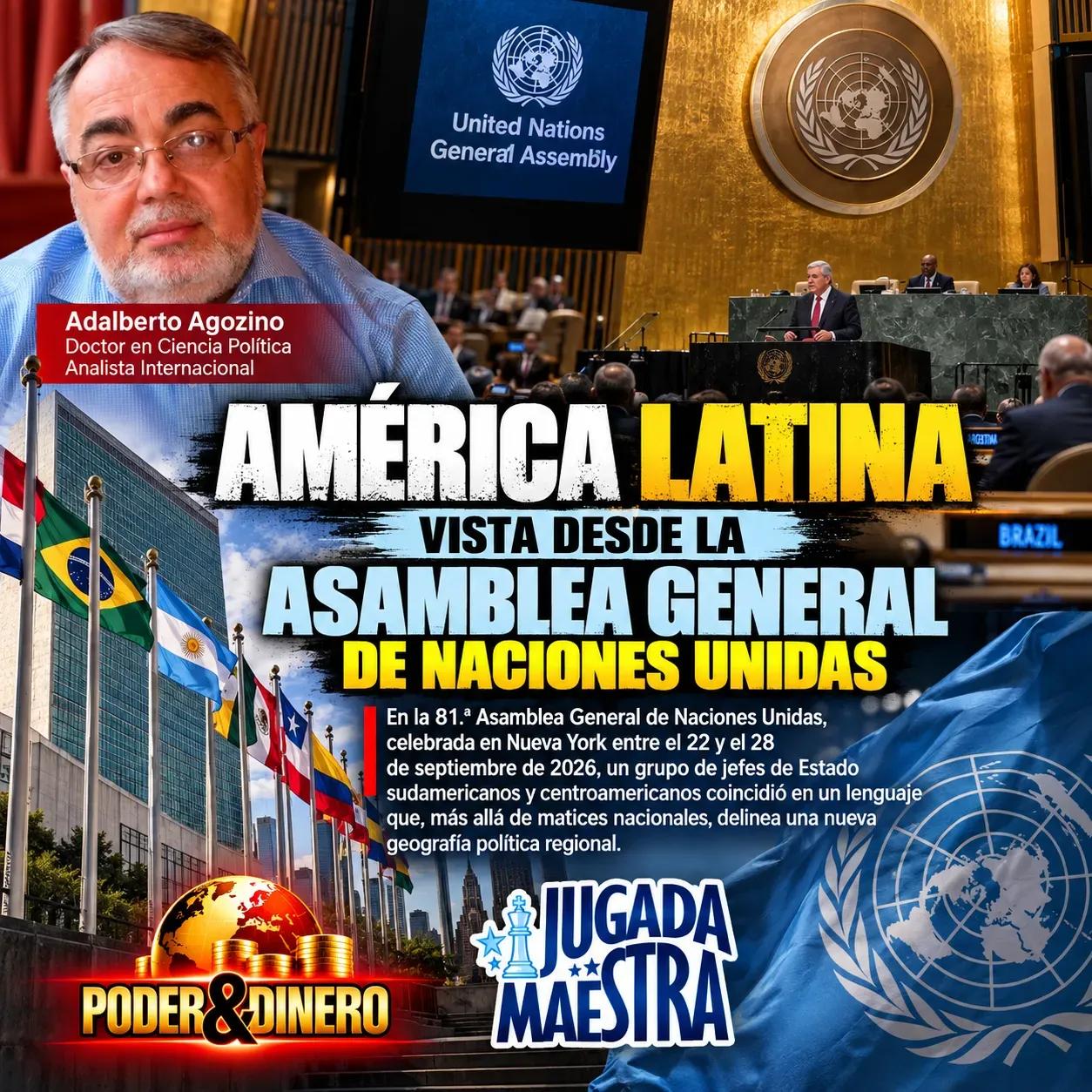
The speeches of Javier Milei (Argentina), Rodrigo Paz (Bolivia), José Antonio Kast (Chile), José Manuel Restrepo representing Abelardo de la Espriella (Colombia), Daniel Noboa (Ecuador), Keiko Fujimori (Peru), Santiago Peña (Paraguay), and Nayib Bukele (El Salvador) do not constitute a unique manifesto. However, they reveal sufficiently dense convergences to outline a shared ideological profile, a recognizable international alignment, and a common diagnosis of the problems these governments consider existential. Against them, a pole emerges, with a different grammar, grouping Mexico, Brazil, and Uruguay, in varying degrees linked to Cuba and Nicaragua.
The clearest coincidence is the securitization of foreign policy. In almost all these speeches, security ceases to be a matter of internal police and is presented as a transnational phenomenon that requires hemispheric coordination. Ecuador describes drug trafficking networks, illegal mining, trafficking, and money laundering; Colombia demands an international architecture against drug trafficking and a common definition of terrorism; Bolivia incorporates "narcoterrorism" into its diagnosis; Chile speaks of organized crime that transcends borders; Peru, in Fujimori's first intervention before the Assembly, equates criminal organizations with terrorist groups and claims the Peruvian experience against the Shining Path as a precedent for a new kind of war; El Salvador, with Bukele, insists that the recovery of the state's monopoly on violence is the prerequisite for any development. Argentina and Paraguay fall into the same logic. The institutional fact that gives consistency to that rhetoric is the adherence of these countries —with different timelines— to the Shield of the Americas, the coordination mechanism promoted by Washington for the exchange of information and the pursuit of criminal organizations. This is not just about verbal analogies: there is a structure of cooperation that links them to each other and to the United States.
This security axis articulates with a second convergence: the defense of an economy open to investment, property, and legal security. Paz contrasts "capitalism for all" with the cycle associated with Evo Morales and Hugo Chávez; Milei radicalizes the defense of free enterprise capitalism and criticism of regulatory interventionism, even in technological matters; Kast offers investors stable rules and respected contracts; Peña insists that prosperity depends on predictable institutions and open markets; Fujimori and Noboa combine economic openness with security priority; Bukele presents the pacification of territory as the asset that allows the return of capital and emigrants. Strategic resources —lithium, copper, hydrocarbons, energy— cease to be merely symbols of extractive sovereignty and are conceived as geopolitical assets to attract investments, technology, and alliances. Artificial intelligence appears, depending on the case, as a driver of growth, a criminal threat, or a field that should not be stifled by preventive regulation.
From those two pillars —hemispheric security and economic liberalism— emerges an ideological profile that is not identical in all, but is recognizable. It is a contemporary right or center-right that combines market liberalism, political or cultural conservatism in variable doses, sovereign nationalism, and a conception of democracy as a counterbalance to authoritarianism. Fujimori introduces the cultural component more clearly than others: the criticism of "international agendas" that would have weakened the family and polarized societies. Milei occupies the libertarian and anti-bureaucratic extreme. Kast and Peña are more institutionalists. Paz represents the most dramatic break with the previous cycle in Bolivia. Noboa, Restrepo, and Bukele prioritize a strong state regarding public order. None of them propose isolation. All accept international cooperation as long as it reinforces, and does not limit, national decision-making capacity. The concept that best summarizes this synthesis is that of a sovereignist multilateralism: reforming the United Nations to make it more effective, less bureaucratic, and more attentive to the priorities of states, not to dissolve it.
International alignments emerge clearly. The United States appears as the main strategic partner, especially in security, intelligence, and, in several cases, investment. Milei declares Argentina "unequivocally aligned" with the West, Washington, and Israel. Paraguay deepens an already close relationship with the United States and Taiwan. Ecuador and El Salvador have built dense links in combating crime. Chile and Bolivia, despite different diplomatic traditions, join the same hemispheric framework. Colombia marks a shift from the previous period. Israel appears explicitly in the Argentine discourse and, more discreetly, in the overall Western affinity. China, Russia, Iran, and Venezuela are viewed with much greater caution than during the wave of governments of the so-called 21st Century Socialism.
The issues that all face, which resonate throughout the texts, are transnational crime, the weakness or capture of institutions, the need to attract capital in a competitive global environment for critical minerals and technology, and the perception that the United Nations system, designed in 1945, responds slowly to contemporary crises. This is compounded, in several countries, by the tension between sovereignty and external pressure, and the claim that democracy should not be reduced to an electoral procedure, but rather be a condition for international insertion and economic freedom. In the Argentine case, the issue of the Falklands resurfaces; in the Paraguayan case, Taiwan; in the Peruvian and Salvadoran cases, the memory of the anti-terrorist or anti-mafia struggle as a source of legitimacy.
Latin America, seen from this Assembly, does not appear as a block nor as a simple "turn to the right." It appears divided into two opposing models, with a middle space that complicates any perfect dichotomy. On one side, the liberal-conservative pole allied with the United States and Israel, whose most visible institutional expression is the Shield of the Americas and whose common language is that of security, the market, and the restrictive or efficiency-driven reform of the UN. On the other, the heirs —in a broad and not uniform sense— of the 21st Century Socialism cycle and a critical sovereignist tradition of U.S. hegemony: Mexico, Brazil, and Uruguay, which are linked in varying degrees to Cuba and Nicaragua. Lula da Silva formulates the thesis that Brazil does not fit in the backyard of any power and defends a multilateralism of strategic autonomy. Yamandú Orsi embodies an internationalist social democracy that rejects both permanent confrontation and subordination. Mexico, represented by its chancellor, insists on non-intervention and international law, in a context of American accusations about cartels. Cuba and Nicaragua radicalize that criticism into anti-imperialism and explicit defense of socialism.
The paradox, underscored by the speeches of the first group, is that they simultaneously claim more national sovereignty and more international cooperation; a stronger state in security and a more open economy; a UN that does not disappear, but that stops imposing internal agendas. This combination —and not a monolithic ideological identity— allows for the discussion of a community of strategic convergence. There is not yet a block comparable to Mercosur nor a formal military alliance. There is, however, a redistribution of preferences regarding the international order. The same words —sovereignty, democracy, multilateralism, development— circulate in both poles with political meanings that differ. This semantic dispute, more than any count of votes in the New York hemicycle, is the most revealing datum of the Latin America that emerges in 2026.
Adalberto Agozino holds a PhD in Political Science, is an International Analyst, and a Professor at the University of Buenos Aires.

Comments