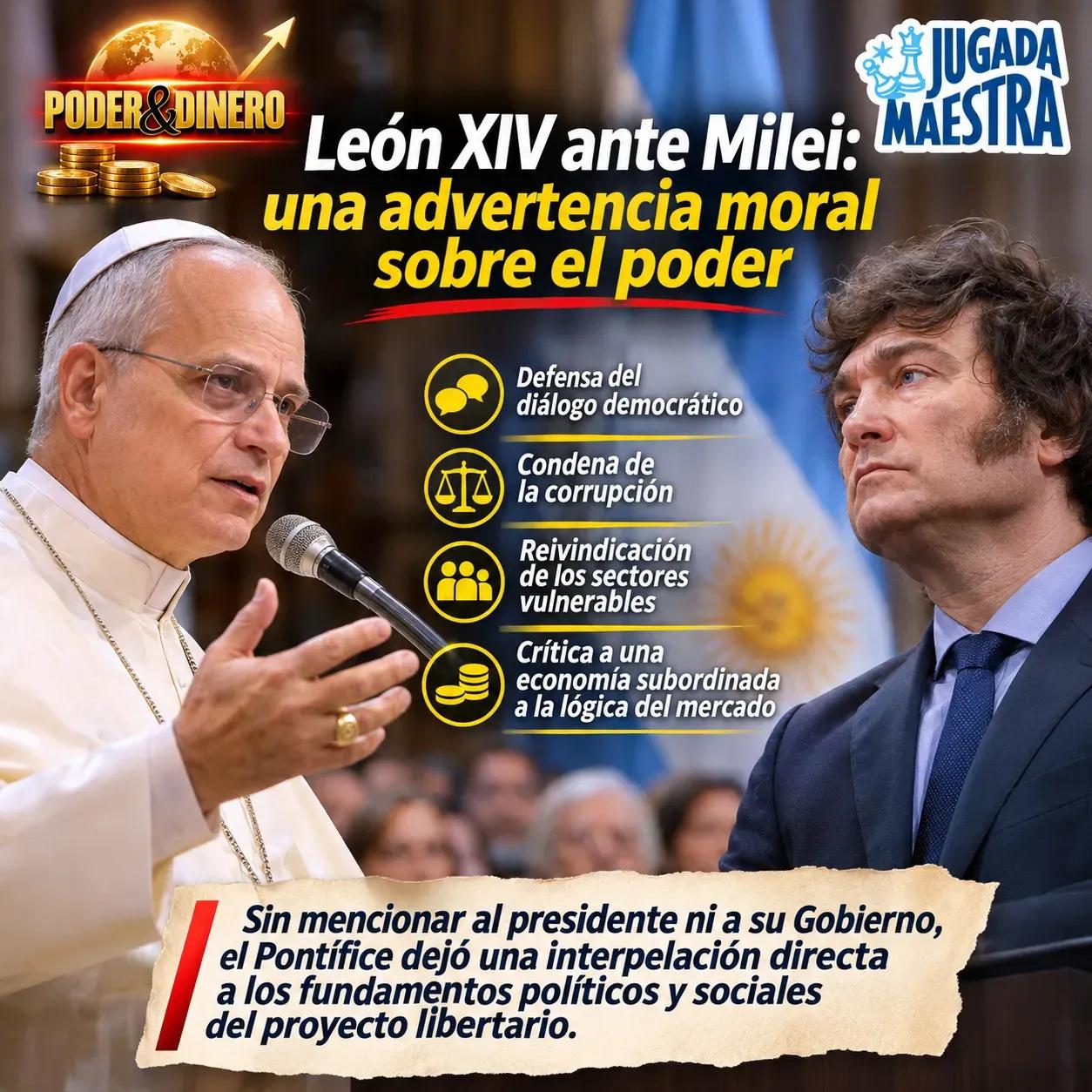
The first public intervention of Pope Leo XIV in Argentina left an impression that can hardly be reduced to the pastoral dimension of his visit. In the Libertad Palace, before President Javier Milei, members of the Government, legislators, governors, representatives of the Justice system, and members of the diplomatic corps, the successor of Francis delivered a speech of considerable political density. He did not make personal accusations, avoided partisan references, and did not turn his intervention into a circumstantial controversy with the government. However, he carefully chose the issues on which he had to speak: the quality of democracy, the responsibility of rulers, coexistence among adversaries, corruption, inequality, and the obligation to place the economy at the service of human dignity.
The absence of proper names did not diminish the strength of the message. On the contrary, it gave it an institutional dimension that exceeded the circumstances of a particular government. The audience knew whom his warnings could reach and which behaviors political that were exposed to the light of his words.
Leo XIV did not need to mention Milei's public confrontations with Brazilian President Luiz Inácio Lula da Silva or with the head of the Spanish Government, Pedro Sánchez. He also did not have to enumerate the disqualifications directed at opposition leaders, journalists, critical economists, or anyone who questions the decisions of the Executive Power. His reflection on the care of words, listening, and recognizing the adversary as a compatriot constituted, in itself, a response to a political culture where personal disqualification has become a common tool of confrontation.
The Pope established an unequivocal relationship between the behavior of leaders and the quality of institutions. “Democracy is also strengthened in the daily way of acting in public life: in the willingness to listen, in the care of words, in the patient search for agreements, and in the ability to recognize in those who think differently a compatriot with whom a common destiny is shared”, he stated.
This was not a superficial recommendation about good manners. Leo XIV was pointing out that democracy is not exhausted in the legitimacy obtained through the ballot box. It also requires practices of coexistence, respect for differences, recognition of plurality, and the acceptance that no electoral majority grants an unlimited right to exercise power.
In this sense, his speech acquired particular relevance in the face of the frequent expressions of hostility from the Argentine president towards political adversaries and international leaders. The controversies with Lula and Sánchez, the disqualifications aimed at opposition leaders, and the repeated confrontations with journalists and critical economists are part of a presidential communication style that has raised questions about its effects on public debate.
The Pontiff did not deny the legitimacy of disagreements nor did he demand a politics without conflicts. His approach was deeper: differences must be able to be processed without destroying the mutual recognition among those who make up the same national community. When criticism is systematically interpreted as aggression, disagreement as a conspiracy, and the adversary as an enemy, the democratic space runs the risk of becoming a scenario of permanent antagonisms.
The warning also reached the exercise of authority. “Authority reaches its highest meaning when it is exercised as service”, he asserted, before reminding that those who govern have the duty to “act with prudence” and “recognize the limits of the power entrusted to them”. The formulation recovers a classical conception of the republican tradition and of the social doctrine of the church: power does not constitute a property of the one who exercises it, but a temporary responsibility conferred to meet the needs of the community.
The international dimension of this warning was also easy to identify. The disagreements with Lula, president of Argentina's main trading partner, and the diplomatic crisis with Spain, triggered by Milei's comments against Pedro Sánchez and his wife, Begoña Gómez, illustrate the consequences that can arise from transferring party confrontation to the arena of relations between states.
The papal concern for political language also finds documentable grounds in the Government's relationship with the press. A study by the organization Chequeado, reported by EL PAÍS, counted at least 1,051 insults, disqualifications, and personal attacks from Milei between his assuming office in December 2023 and February 2025, with an average of 2.4 offenses per day. The majority were directed at opponents, journalists, and critical economists. For its part, the Committee to Protect Journalists collected a survey by FOPEA on more than 113,000 presidential publications on the social network X, in which disparaging expressions against the press workers appeared repeatedly.
The problem, from an institutional perspective, does not lie in a president vehemently defending his decisions or questioning the opinions of his adversaries. This is part of political freedom. The issue is that systematic disqualification can end up replacing argumentation, weakening public deliberation, and generating an environment in which journalists, specialists, and opposition leaders find increasing difficulties in exercising their critical function.
The economy facing human dignity
If the reference to democratic coexistence constituted one of the most significant warnings of the speech, his economic reflection was probably the one that established the most evident doctrinal contrast with the libertarian program.
Leo XIV did not question private initiative, business activity, or the need to generate favorable conditions for investment. On the contrary, he expressed that what “stimulates private initiative” should be favored. But he introduced a fundamental condition: economic growth must also reach those who face the greatest difficulties.
His most forceful affirmation was unequivocal: “The economy must serve the person, and not the person serve the economy”.
Behind this formulation lies an intellectual and moral tradition that considers the market to be an instrument of economic organization, but not an absolute principle capable of solely determining the value of people and the priorities of a society. Efficiency, competition, and profitability can contribute to progress, but do not justify the exclusion of those who lack resources to compete on equal terms.
It is precisely here that the papal message establishes a substantial distance from the more radical interpretations of economic liberalism. A conception that solely relies on the individuals' ability to adapt to the demands of the market runs the risk of converting inequality into an inevitable and, eventually, morally acceptable consequence. This could be termed a form of economic Darwinism: those with greater capacities, resources, or adaptability to the market survive, while others remain marginalized.
The Pope did not literally use that expression nor did he condemn the functioning of the market as an institution. His criticism was directed at the subordination of the person to economic mechanisms and at the indifference to social consequences of public decisions. His thinking is inscribed in the social doctrine of the Church, from the encyclical Rerum novarum of Leo XIII to contemporary reflections on work, inequality, and concentration of wealth.
The reference to retirees, the unemployed, and families struggling to meet their needs acquired special significance in a country that continues to face economic and social difficulties. INDEC reported that during the first half of 2026, poverty reached 32.3% of the population in the 31 urban agglomerates surveyed, while indigence encompassed 7.5%. In September, the monthly inflation was 1.9%, an indicator that must be valued along with the evolution of real incomes and the material conditions of households.
The situation of retirees, people with disabilities, and lower-income sectors constituted another of the central axes of the intervention. The Pontiff recalled that the elderly have contributed for decades to building society and that those who work may also encounter difficulties in supporting their families. He did not demand a stagnant economy nor did he ignore budgetary constraints. He called for economic decisions to incorporate a moral consideration of their human consequences.
Particularly significant was his reference to people with disabilities. “The same dignity demands special attention in illness, dependence, and disability”, he expressed. And he added that it is appropriate to “care, alleviate suffering, accompany, and make each person feel that their life always retains a value that no circumstance can diminish”.
This affirmation gains relevance in the context of the questioning of cuts and assistance policies. The crisis of the National Agency for Disability, with judicial investigations for alleged irregularities in hiring, overpricing, and bribery, has also exposed the vulnerability of a system on which thousands of people depend.
Corruption and the responsibility to govern
The speech included another particularly uncomfortable warning for the government: corruption. Leo XIV stated that these acts “harm coexistence, fuel violence, and divert resources necessary for the common good”. He immediately added a consideration of special significance: “Corruption erodes citizens' trust in their institutions.”
Although the formulation had universal reach, it was inevitable to relate it to the questioning affecting members of the Argentine administration. The case of the cryptocurrency $LIBRA, the investigations into alleged irregularities in the National Disability Agency, and the patrimonial controversies involving then Chief of Staff Manuel Adorni have fueled a public debate on governmental transparency.
The importance of the papal warning is institutional: those who take on public responsibilities must demonstrate integrity, because citizen trust constitutes one of the foundations of democratic legitimacy.
A homeland that does not start from scratch
Another passage of the speech deserves special political consideration. ”No generation begins the homeland from scratch. It receives it”, stated Leo XIV. The phrase represents an implicit criticism of any foundational pretense that considers it legitimate to indiscriminately disregard the institutional, cultural, and social heritage built by previous generations.
The reference addresses both the government and previous administrations. Argentina has suffered a prolonged instability in its public policies, with abrupt changes in economic, institutional, and social orientation each time the political sign of the government changes. The Pope reminded that each generation must preserve what deserves to be preserved, correct inherited injustices, and enhance the common heritage.
In that same perspective, he called for strengthening education, universities, vocational training, and scientific research. His concern for the youth was encapsulated in an uncomfortable question: “A nation must seriously ask itself what it has failed at when its young people must leave their land to fulfill their dreams.”
The phrase contains a critique that transcends migration statistics. A society that fails to offer opportunities to its new generations compromises its own future and squanders a substantial part of its human capital.
The challenge of listening
Leo XIV's intervention also had a symbolic dimension. The joint presence of Milei, Victoria Villarruel, Mauricio Macri, Axel Kicillof, governors from different political orientations, and representatives from practically the entire institutional spectrum demonstrated that it is still possible to share a space without renouncing differences. The meeting offered an image of coexistence that contrasts with the usual fragmentation of Argentine politics.
However, the true effectiveness of the message will depend on whether that photograph is not reduced to a ceremonial circumstance. Milei himself, when asked later about the papal call for dialogue, questioned those who, in his interpretation, make dishonest criticisms of the economic program. The reaction highlighted the distance that still separates the papal exhortation from certain practices of everyday political debate.
Leo XIV did not come to Buenos Aires to arbitrate a party dispute nor to become a focal point for the opposition. His pastoral responsibility led him to formulate principles he considers non-negotiable: human dignity, solidarity, public honesty, institutional respect, and democratic coexistence. But those principles inevitably acquire a political dimension when pronounced before those who have the responsibility to govern.
The final message recovered the purpose of “constituting national unity”, proclaimed in the Preamble of the Argentine Constitution. It was not a nostalgic invocation nor an appeal for an artificial unity that suppresses conflicts. It was a warning about
la necesidad de construir un horizonte compartido.El Papa no mencionó a Milei, no cuestionó nominalmente a sus ministros ni identificó a los responsables de las controversias gubernamentales. Tampoco necesitó hacerlo. En el Palacio Libertad, ante una dirigencia acostumbrada a convertir las diferencias en enfrentamientos personales, recordó que el poder es servicio, que la economía tiene una finalidad humana y que ninguna sociedad puede prosperar si abandona a sus integrantes más vulnerables.
Su discurso dejó así una pregunta que excede al presidente y alcanza a toda la clase dirigente: ¿puede Argentina construir un futuro sostenible si la confrontación sustituye al diálogo, el mercado desplaza a la solidaridad y la lealtad política termina prevaleciendo sobre la responsabilidad institucional?
La respuesta no se encuentra en una declaración presidencial ni en una homilía. Se encuentra en la conducta cotidiana de quienes ejercen el poder y en su capacidad para comprender que la patria que hoy administran no les pertenece: constituye una herencia colectiva que deberán entregar a las generaciones futuras.
Adalberto Agozino es Doctor en Ciencia Política, Analista Internacional y Docente de la Universidad de Buenos Aires
Comments