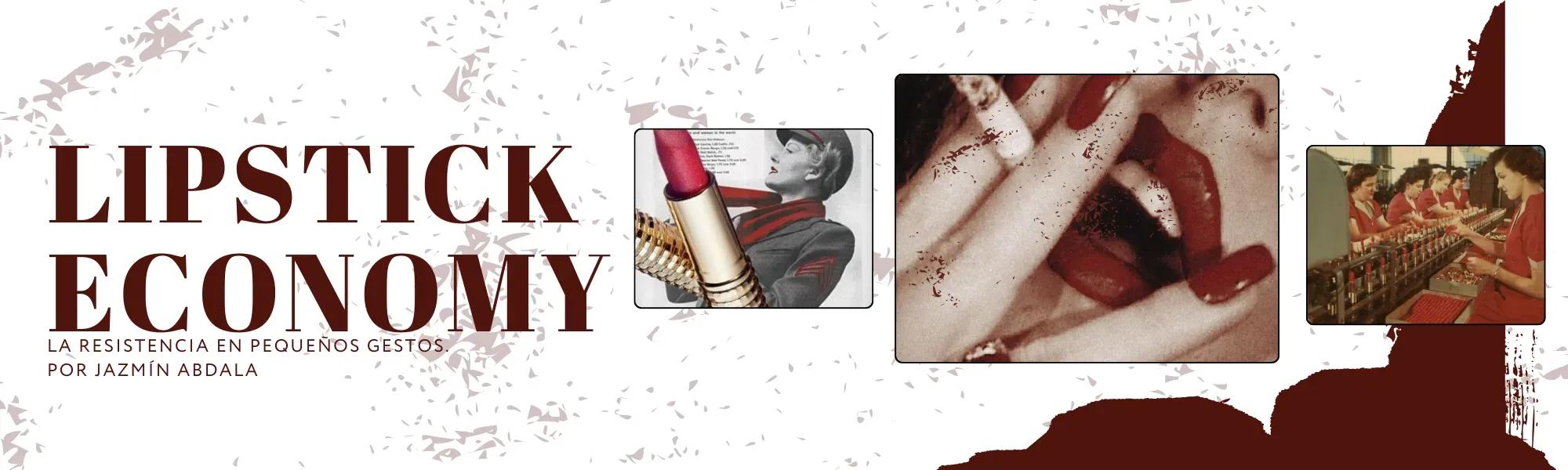
"I look at myself in the bathroom mirror, the one that has a thin crack in the lower left corner, like a scar that no one sees but that I know by heart. The faucet drips: plop, plop, plop. On the shelf, there's one luxury I've had in weeks: a matte red lipstick, bought in installments, like almost everything in this country.
I don't need it, I know. But I opened it anyway. And as I glide it over my lips, I think of something I once read: the lipstick economy.
The theory says, more or less, that when the economy goes to hell, people stop buying cars, appliances, trips, but they keep buying little things that make them feel alive: a perfume, a nail polish, a lipstick. It's not frivolity. It's resistance.
And I'm resisting, standing in front of this mirror, with my paycheck shattered, prices changing as if they had anxiety, and that soft fear that never goes away: the fear of not knowing what will happen tomorrow.
It seems incredible, but lipstick is neither a modern invention nor a marketing strategy.
In ancient Mesopotamia, over five thousand years ago, they already ground semi-precious stones to tint their lips. In Ancient Egypt, Cleopatra painted her lips with a mixture of crushed insects, iron oxide, and substances that today would terrify us. It was toxic, yes. But it was a symbol of status, power, and identity.
Then came centuries when painting one's lips was a sin, a signal of prostitution or witchcraft. In Europe, it was banned; in England, there were laws that annulled marriages if a woman had "deceived" a man by using cosmetics.
The first modern lipstick as we know it appeared in the late 19th century in France, thanks to a perfumer named Maurice Levy, who in 1884 presented a solid color stick in a small metal tube at the Universal Exhibition in Amsterdam. It wasn’t called "lipstick" yet; it was known as stylo d’amour, pencil of love. It wasn't glamorous or mass-produced, but that's where it all began, the object that would later fit into the handbags, backpacks, and pockets of millions of women around the world.
Today, more than a hundred years later, I'm putting on lipstick in a rented apartment in Argentina, in the middle of 2026, while I think about how to pay for the SUBE, the rent, the credit card, and food.
This country has always been a laboratory of crises.
My grandmother still remembers the hyperinflation of 1989 as if it were yesterday. It wasn't just that everything was getting more expensive; it was that money was becoming useless. Prices rose by more than 50% per month, annual inflation surpassed 3000%, and people would get paid and run to the supermarket before prices were hiked again.
The austral—our currency back then—was no longer even trustworthy. It was issued without backing, there were no dollars, the economy was broken. There were looting, riots, real hunger. Alfonsín could not finish his term and handed over power early.
But even in that context, my grandmother says that some women continued to buy creams, nail polish, and lipsticks. Not to show off. To not give up.
I was a kid in 2001, but the memory is stronger than many things I experienced as an adult.
On December 19, a state of siege was decreed. On the 20th, the country took to the streets with pots and pans, anger, hunger, and desperation. There was repression, deaths, looting. De la Rúa left by helicopter as a postcard of national defeat. In just a few days, five presidents came and went. Everything was a shapeless mess.
My parents hid money in jars, cried softly, and yet, one afternoon my mom returned from downtown with a very cheap lipstick purchased at an almost empty pharmacy.
—To remind me that I’m still me—she said.
That is the lipstick economy in its Argentine version: when the country is on fire, we seek small certainties in minimal objects.
In 2026, we hear the expression “tough times” again as if it were a trademark. Inflation, debt, adjustments, reforms, anger, uncertainty. Everything seems temporary, but transience has become permanent.
And I, amid that noise, put on my lipstick.
It's not an intimate choreography; it's not a pose. It's a small, everyday, almost childlike gesture, but deeply human. Putting on lipstick is marking territory on my own body when everything else is foreign: the economy, politics, the price of bread, the future.
I wear lipstick to go to work, to go to the radio, to interview someone, to walk down the street. I put it on even when I’m not going to see anyone. Because seeing myself in the mirror with a little color reminds me that I'm still here.
The word “resilience” is worn out, but I can't find a better one. Resilience is that: the ability to bend without breaking.
Lipstick doesn't fix anything; it doesn't lower inflation or pay the bills. But it builds something invisible: a sense of control amid chaos.
As I apply it on my lips, I think that this simple gesture connects Cleopatra, my grandmother in 1989, my mom in 2001, and me today. All in different crises, with different currencies, but with the same need to not completely disappear.
I look at myself again. The red isn’t perfect; I went a bit over the edge. I wipe it off with my finger, clumsy, human.
This mirror has seen tears, smiles, anger, kisses that later hurt. It has witnessed governments, slogans, broken promises. It doesn't keep dollars or fixed terms, but it holds something more persistent: the habit of continuing on.
Perhaps the lipstick economy isn’t an economic theory. Perhaps it’s just a poetic way of saying that when everything collapses, we still choose not to live in black and white.
And then I understand that I don't put on lipstick to please. I wear lipstick to remind myself that I'm still here, that I can still choose a color in the midst of so much darkness.
I leave the bathroom, close the door. Outside, the country continues to tremble. But I've armored myself. With the only thing I could buy this month: a little red so I don’t become transparent."
Comments