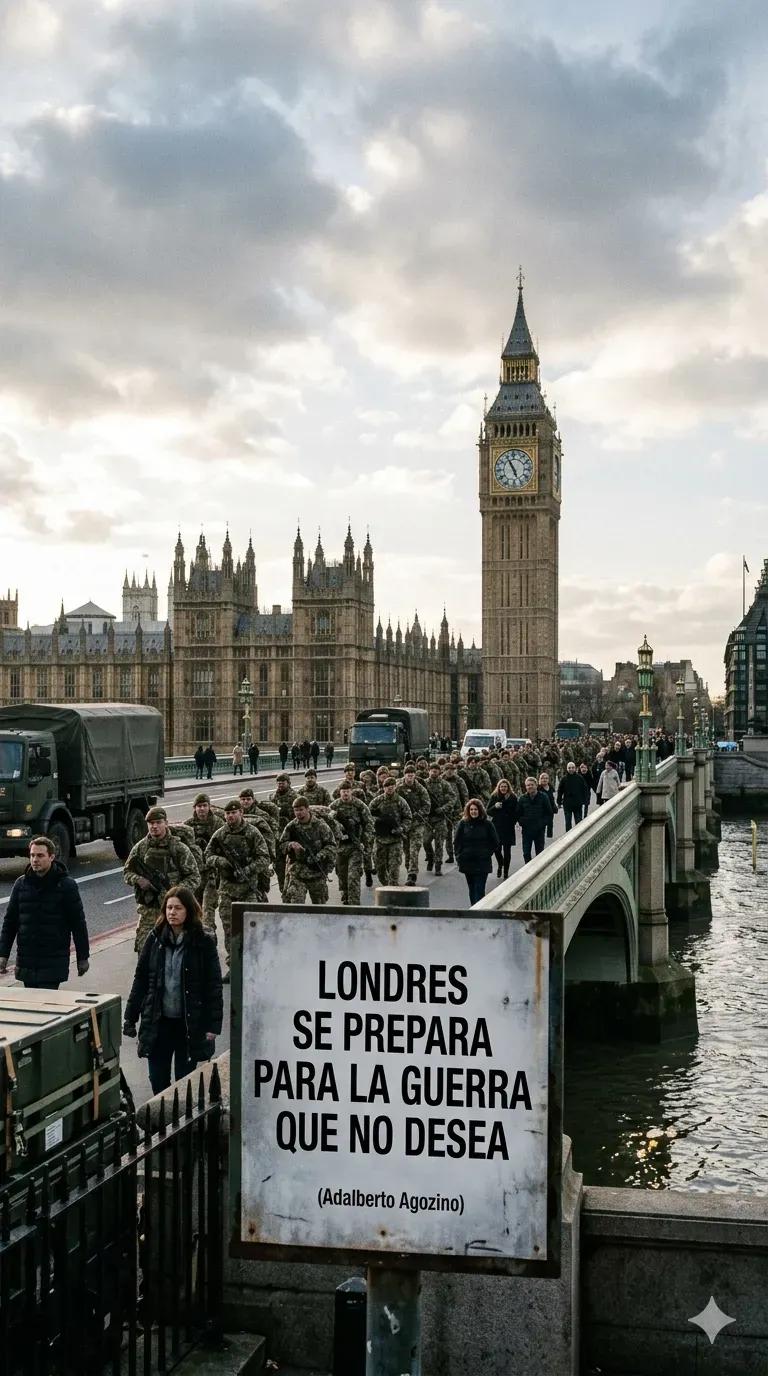
Three hundred years after the popular children's song "Mambrú se fue a la guerra" ironically evoked the supposed death of the Duke of Marlborough, John Churchill, the echo of that melody resonates today with an unsettling literalness. The United Kingdom, heir to that military tradition that forged empires and defined the European balance, is once again preparing for a scenario that many believed to be forever banished: a large-scale confrontation on the Old Continent.
This strategic turn is neither isolated nor improvised. It is inscribed in a continental climate marked by the indefinite prolongation of the war in Ukraine — which has already exceeded four years of open hostilities — the growing confrontation between NATO and Russia, and the perception, increasingly explicit among high military commands, that Europe has entered a "gray zone" between peace and armed conflict. Prime Minister Keir Starmer has been unequivocal in this regard. In March 2026, during a European defense summit, he warned that the West is facing a "war on two fronts": the persistent crisis in Ukraine and the growing hotspots of instability in the Middle East, especially linked to the Iranian conflict and its regional ramifications. "We must accept that there is a war on two fronts — the Iranian conflict and the ongoing Ukrainian conflict —", he declared, emphasizing the need for a generational response to an environment of deep insecurity.
This change in tone transcends mere political rhetoric. In recent months, London has accelerated a set of measures that, viewed as a whole, configure a return to the logic of national mobilization characteristic of the great wars of the 20th century. Among them, the update of the so-called "War Book" stands out — a strategic document whose origins date back to World War I and that structured the British response to large-scale crises for decades. The new version, as detailed by the Chief of the Defence Staff, Air Marshal Sir Richard Knighton, is not limited to the military sphere. In a speech delivered on December 15, 2025, before the think tank RUSI, Knighton presented an ambitious large-scale preparation plan for the nation, adapted to modern threats and contemporary society and infrastructures. The document incorporates lessons from the Cold War, recent conflicts in Ukraine, and hybrid scenarios, contemplating everything from the reorganization of hospitals and protection of critical infrastructures (energy plants, water supply, and communication networks) to industrial mobilization and preparing the civilian population for shortages, energy disruptions, cyberattacks, or sabotage.
Knighton has been one of the most insistent and authoritative voices in emphasizing the seriousness of the moment. "The relative peace that Britain has enjoyed for the last thirty years is increasingly threatened," he asserted. In his remarks, he called for a "whole-society response" that goes beyond strengthening the Armed Forces: "We need more people willing to fight for their country, both in the regular Army and in the reserves. We must build industrial capacity to resupply and rearm, and develop the skills that the defense industry needs." His words — "sons and daughters, comrades, veterans... everyone will have a role to play. Build, serve, and if necessary, fight" — directly evoke the collective sacrifice of past great mobilizations but updated to a context where national resilience includes universities, energy industries, manufacturing, and the National Health Service (NHS) itself.
On the ground, this preparation takes on concrete and visible forms. British troops are actively participating in high-intensity exercises on NATO's eastern flank, especially in the Baltic countries. In Estonia, for example, units of the British Army have been deployed at the Tapa base for maneuvers like Exercise Resolute Warrior 25 and Spring Storm 26, where scenarios of "total war" with Russia are rehearsed: trench combat, operations with live ammunition, simulations of direct confrontations, and warfare in urban or arctic environments. These trainings replicate lessons learned in Ukraine, emphasizing the extreme brutality of modern combat — trenches, drones, electronic warfare, and saturating attacks. General Richard Shirreff, former deputy commander of NATO in Europe, has described these scenarios starkly: it is a war of "extreme brutality", comparable to the most devastating conflicts of the 20th century. At the same time, the United Kingdom has intensified its presence in the High North and the Arctic, doubling the number of troops in Norway and participating in joint exercises like Cold Response and Lion Protector 2026, where critical infrastructures are protected against possible Russian sabotage.
The British effort is also reflected in the budgetary and technological realm. Starmer's Government pledged in February 2025 to raise defense spending to 2.5% of GDP by 2027 — three years earlier than initially planned — with the ambition of reaching 3% in the next Parliament (possibly before 2029, according to ongoing explorations in February 2026). This increase, the largest sustained since the end of the Cold War, amounts to about £13.4 billion in additional annual funding and is partly financed by reducing international aid spending from 0.5% to 0.3% of gross national income. The funds are allocated to modernizing key capabilities: attack submarines, nuclear systems, drones, digital warfare, and especially the reconstruction of the defense industrial base. In November 2025, the Executive announced the construction of at least six new ammunition and energetics (explosives and propellants) factories, with an initial investment of £1.5 billion in a "pipeline always on" that will allow for a rapid scale-up of production in case of need. Part of the £6 billion designated for ammunition in this legislature will be used to manufacture up to 7,000 long-range weapons on British soil, generating more than 1,000 direct jobs and positioning the defense industry as an economic growth engine in all regions of the country.
However, the United Kingdom does not act in isolation. Across the European continent, signals of a similar preparation are multiplying, albeit uneven in intensity and approach. In France, President Emmanuel Macron has promoted a ten-month national voluntary service for young people, aimed at strengthening reserves and projecting deterrence. In Poland, one of NATO's largest armies, a voluntary basic military training program lasting one month has been implemented since 2024, extendable to nine or eleven months for those wishing to join. Germany, which abolished mandatory service in 2011, is considering reintroducing a voluntary or lottery-based model starting in 2026, with mandatory medical exams for 18-year-olds. The Nordic countries, more geographically exposed, are leading this transformation. Sweden reactivated in 2017 a system of mandatory registration for young people of both sexes and is developing a "total defense" strategy that involves all of society; Finland and Norway have maintained mandatory military service for decades, integrating the civilian population into defense planning. Denmark extended conscription to women in July 2025, while Estonia, Latvia, and Lithuania maintain active recruitment systems.
Civil preparation is even more striking. Sweden has distributed crisis manuals to all households, with precise instructions on food storage, locating shelters, and responding to attacks. Lithuania and other Baltic states have produced similar guides. In contrast, the societies of Western Europe, including the United Kingdom, still show some psychological resistance to fully embracing the possibility of large-scale conflict. This perception gap concerns strategists. Knighton has pointed out that the United Kingdom "does not perceive the threat with the same intensity" as some Eastern allies, which could slow down the response at a critical moment. Hence the insistence on opening a public debate on defense costs, the need for broader mobilization, and the training of reserves and cadets to foster a culture of national resilience.
The possibility of a direct war between Russia and European countries remains, in strict terms, a scenario that all actors claim to want to avoid. Moscow denies offensive intentions against NATO and denounces the Alliance's expansion as an existential threat. However, the accumulation of tensions — progressive militarization, incidents in the Baltic, cyberattacks, and hybrid warfare — along with the fragility of current balances, fuels concern that an incident or a miscalculated escalation could trigger a greater conflict. In this context, the United Kingdom seems determined not to repeat the mistakes of the past. The reactivation of the "War Book", the increase in military spending, the push for ammunition factories, and the direct appeal to civil society are part of a strategy that seeks to anticipate the unthinkable, making the country a "harder target" for any adversary.
As in the times of the Duke of Marlborough, war is not a desired destiny, but a possibility that demands rigorous and collective preparation. The old children’s song spoke of an uncertain return. In Europe in 2026, the question is not just who will go to war, but whether the continent will be able to avoid it through credible deterrence and unity. Meanwhile, in London and other European capitals, preparations are advancing with a determination that reveals just how much history, far from being over, is once again urgently claiming its place. The challenge is clear: transform resilience into real deterrence before it is too late.
Adalberto Agozino is a Doctor of Political Science, International Analyst, and Faculty Member at the University of Buenos Aires.

Comments