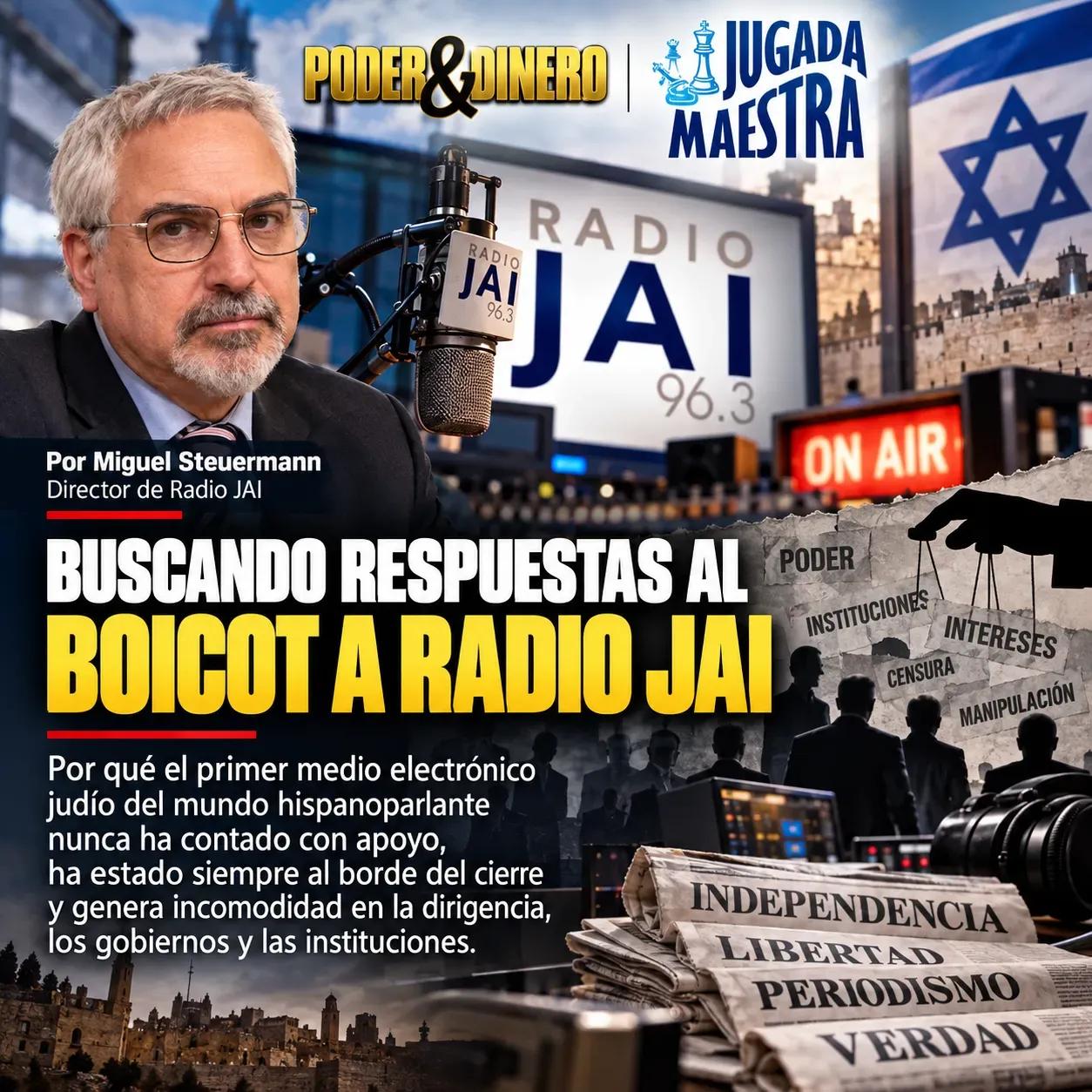
I have dedicated hundreds of hours to trying to understand how it is possible that the first electronic Jewish media outlet in the Spanish-speaking world has never received support. That we have always been on the brink of closure.
Many have asked me over the years how it is possible that Radio Jai has no support. I have attempted, within my limitations, to find answers for them and above all for myself. After 34 years, I believe I have finally arrived at the true crux of the matter.
No one can bear true freedom.
The politicians, leaders, governments, parties, institutions, and also the consumers who prefer to live in a comforting lie rather than an uncomfortable truth.
They cannot bear the non-negotiable freedom and independence.
Yes. What I cannot dominate and manipulate produces fear and rejection. It is a truism that it is impossible to do journalism without freedom, but that is precisely why all governments and organizations try to combat it, restrict it, buy it, eliminate it, and that is why they create alternative media that respond to their official line.
The journalist and teacher Sergio Villarruel, QEPD, taught me this 32 years ago: Journalism is not there to applaud what politicians or current leaders do well; that is what is expected. They ran for office and were elected for that. Journalism is there to show what they do not do well and want to hide from their constituents. Now it is easier to understand why true journalism is always analytical and critical. Its function is to respond to the constituents, not the holders of power. Now it is easier to understand the boycott against Radio Jai.
We were born as an independent medium, as an initiative of some adventurous young people. In the early days, the novelty of listening to our own music and news took hold. Quickly, a medium that gave a voice to all voices and did not censor began to be uncomfortable for the owners of Judaism and the community. We were neither orthodox, nor reformist, nor right-wing, nor left-wing. We gave a microphone to all who had something worthy to say, without ceasing to be deeply self-critical when required. We transformed into a power of credibility without media permissions from the "powerful".
The attack on AMIA marked a turning point.
Unintentionally and for almost obvious reasons, the radio gained greater prominence. We remained distant and critical of the miseries that erupted, of the struggles for prominence, power, and business. We did not align with Beraja, nor with the Szpolski, who were the two owners of the "community" banks that were fighting over the spoils.
An anecdote among hundreds can illustrate it. A little over a month after the attack, for the first time the director of the Radio was received by Dr. Beraja, president of DAIA, along with Alfredo Neuburguer, the political director of the institution. Beraja, always very rational and composed, shouted at that impudent young man who dared to question with solid arguments some actions related to security, communication policy, and community containment. Long years passed before Beraja would dialogue with Radio Jai again, and always with some rejection for a medium that dared to question his absolute truths.
We did not remain silent about the mismanagement of Banco Patricios and the perversion that caused, among others, the downfall of Banco Mayo. In reality, we have never stayed silent about anything. A problem for those who wanted and want to manage, manipulate, and hide.
It is not coincidental that very soon Beraja would establish a television channel, Alef Network, and that Szpolski would promote an AMIA TV program, the newspaper Masortí, and later enter the big leagues with other media outlets as the major operator of kirchnerism. In response, Chabad created its own TV program, and several other media initiatives always responded to sectoral and/or personal interests. Many operators for a plate of lentils.
The Memorandum with Iran arrived. While the leadership of DAIA and AMIA was flirting with Chancellor Timerman, the radio denounced the obvious intention of the cover-up and impunity instrument. They murdered Prosecutor Nisman, and while the community leadership, always so respectful of the institution, avoided speaking about murder, from the Radio it was shouted at full volume and even the direct victims, the persecuted and vilified family of the prosecutor, were accompanied.
In the midst of these moments of national and international significance, the daily small ones. A scam here, another there. A small corruption here, another there. And a medium unwilling to hide them.
Paradoxes occur in our task. Complaints and claims that started on the radio and at first were fought against by the majorities — like the trial in absentia and others — when they become popular or convenient, the leaders of the moment suffer from amnesia and attribute them as their own. It is worth mentioning that for years AMIA was against this, and now appears to declare as if it always supported it. It’s easy. People forget quickly and have no record.
As a curious fact for the reader, I will mention that with the previous president of AMIA, Dr. Leonardo Linetzky, after a pathetic interview he gave to the radio shortly after assuming, in his ignorance of basic topics, we offered to collaborate in a closed-door meeting. It was the first and last meeting during his tenure. With the current president, Dr. Osvaldo Armoza, we have not even managed to have him receive us. Not to mention Rabbi Hamra, who has withdrawn his greeting, which he does not even do with known agents opposed to Jewish life.
A similar dynamic is evident with DAIA. With Dr. Jorge Knoblovits, we never met, and with the current one, Mauro Berenstein, we had to insist for months. We offered collaboration and presented concrete proposals. We never received any feedback. De facto, the presence of independent press is barred from participating in community institutional dynamics, being present in the meetings of the executive committees, and all the more so being able to question. We were not elected.
Some with better memory will recall that the animosity reached such a point that during Dr. Agustín Zbar’s presidency of AMIA and his appetite to monopolize the community — which also included managing DAIA and obviously Radio Jai — we were ousted in order to silence the Jewish Radio. Yes. What the government of Cristina Fernández de Kirchner did not accomplish, nor the worst antisemites, came from the mutual institution of the community.
What happens in Israel is another chapter. Several books could be written. There are similarities with the described phenomena. Nothing about showing nuances, nothing about showing miseries. Everything that the State and its institutions do is spotless. Not to mention after October 7, where any criticism means being a traitor.
We denounce the intellectual and moral poverty and mediocrity of the leadership. We warn about the consequences of losing objectivity and distance from the powerful politicians or businesspeople of the moment.
And here comes the phrase I have heard the most in these 34 years: "Nothing suits that Steuermann, he is a difficult guy." Being critical does not exactly make you popular.
Some wonder how it is that the government of Israel, its national institutions, and others, or the government of Milei which is so close to Judaism and Israel, do not support you. The answer is simple. Freedom means that even if you support Israel or a policy, you will not stop being free to criticize what must be criticized. That is not what power seeks. Power seeks applauders, due obedience, a misunderstood loyalty where no criticism exists. They call it being organic. We call them authoritarian, fascists, opportunists, and without principles.
Erich Fromm already confronted us with the fear of freedom. And today it is summed up in a phrase I hear on the street: "Lie to me because I need you to lie to me."
Going against the system today is showing one’s own miseries.
Influencers have come to break the monopoly that the big editorial media want to impose on you. Too bad many of the guys are as biased as their followers, who seek to reaffirm their opinions and seldom open up to diverse thought. They are the new defenders of absolute truths that they never check or confront, and with that, they fall into the same dynamic they intend to combat.
What are the media that receive support? Their own, those that simply disseminate press releases and official opinions. You will never see a hint of independence in them and certainly no self-criticism or questioning of the system. Today, independent thinkers and journalists are sidelined from the major media. If you do not align with the dictates and interests, you are out.
For the first time, I realize why so many journalists who passed through the radio thanked me for something I never thought. The freedom we allowed them. Something obvious from our beginnings but that does not seem so obvious in other places.
That is the answer to the 34-year boycott.
And the question that remains for us is whether after 34 years on the brink of closure, maintaining this free voice without any support, it makes sense to continue. If it makes sense to keep doing independent Jewish journalism in a world that prefers applauders. If the community really wants a free Radio Jai or prefers to live off press releases.
Can a free voice continue to exist without the support of those it claims to represent?
Miguel Steuerman is the founder and Director of Radio JAI, the radio of the Jewish community of Latin America.

Comments