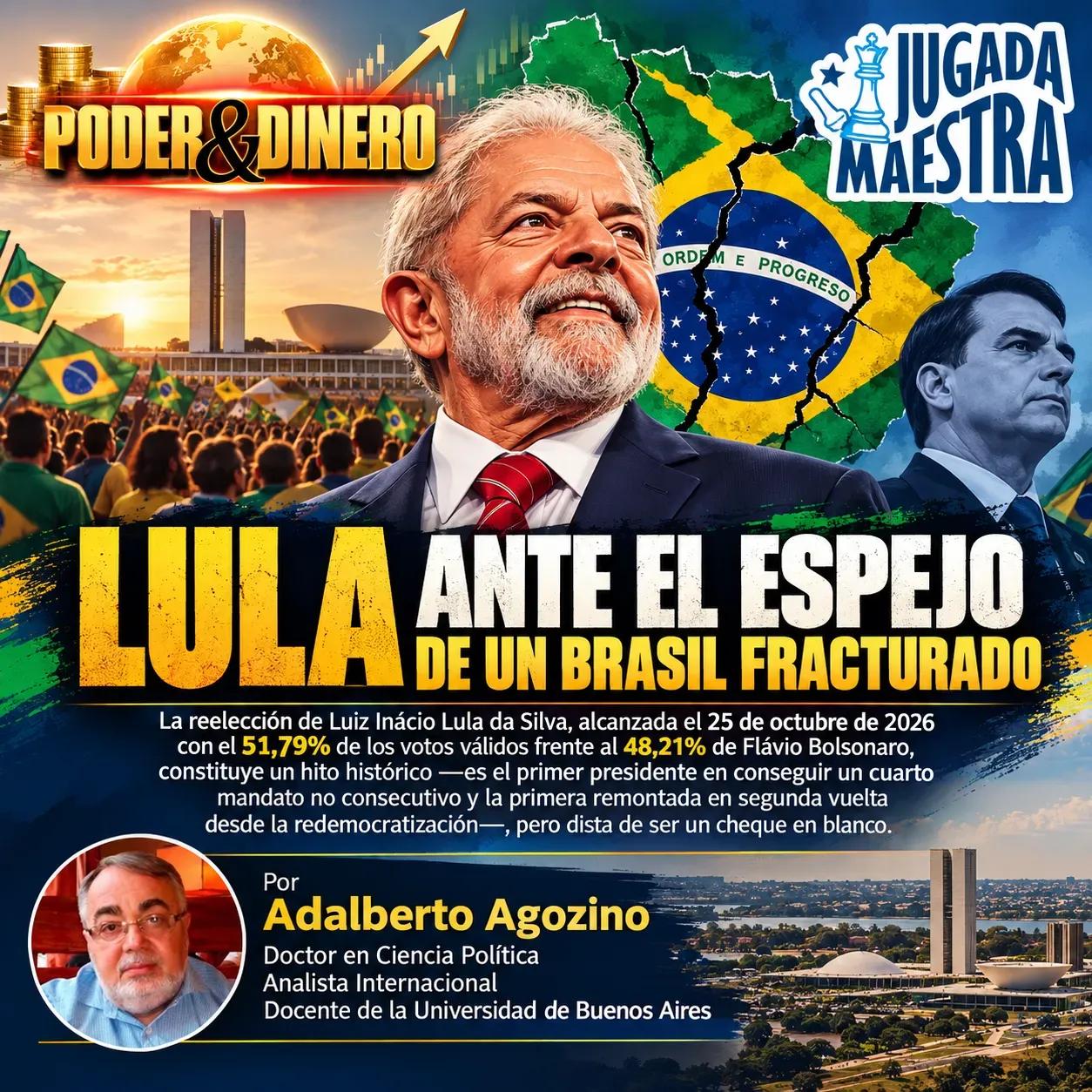
The narrowness of the result, with about 4.4 million votes difference and a country divided into two blocks of comparable size, anticipates a term in which the electoral mobilization capacity of the leader of the Workers' Party must translate into effective governability starting January 2027. The economic slowdown, the debt of households and businesses, the institutional strength of the opposition, and tensions with Washington will test his ability to reconcile social promises with fiscal discipline, while the president's age—turning 81 on October 27—turns succession into a central question for the left.
The victory has not closed the political fracture. Flávio Bolsonaro has announced his intention to legally challenge the result, invoking the two-hour extension in voting due to transportation issues. The electoral authority has proclaimed Lula, and the allegations require verifiable evidence; however, bolsonarism has built part of its identity on distrust towards electoral and judicial institutions. This refusal to accept the outcome may prolong polarization beyond the campaign. Almost half of the valid electorate chose the opponent for various reasons—public safety, tax burden, conservative values, or cost of living—making it impossible to interpret the 51.79% as a homogeneous social majority.
Congress reinforces that restriction. The Liberal Party, the main bolsonarist force, will have 121 deputies and 28 senators, compared to the PT's 70 deputies and nine senators. The right and conservative parties as a whole possess a blocking capacity greater than that of any individual bench. The Centrão, a heterogeneous conglomerate of center and center-right formations, will regain its role as a pivot: its lawmakers negotiate depending on the issue, but in exchange for positions, budgetary resources, and programmatic concessions. As political scientist Mayra Goulart from the Federal University of Rio de Janeiro has indicated, the growing autonomy of legislators, fueled by their influence in the distribution of a substantial part of the federal budget, complicates the construction of stable majorities. Lula will have to ensure that each agreement does not erode the coherence of his program; otherwise, the opposition may use commissions, budget votes, and the political control of the chambers to wear down the Executive.
The economic front is the most immediate test. International organizations project growth, albeit moderate: the International Monetary Fund estimated in October a 2.2% expansion for 2026 and 1.9% for 2027. This is not a confirmed recession, but an economy that is losing momentum and facing persistent inflationary pressures. Gross public debt exceeds 82% of GDP, and less than 8% of the federal budget is susceptible to discretionary adjustments due to the weight of mandatory spending. With benchmark interest rates at 13.75% and year-on-year inflation at 4.6%—above the upper tolerance limit of the Central Bank—business financing becomes more expensive, investment contracts, and household financial burdens multiply. Economist Mauro Rochlin from the Getulio Vargas Foundation has summarized the dilemma with a blunt formulation: “Brazil's three major problems are the fiscal problem, the fiscal problem, and the fiscal problem”.
Simultaneously fulfilling the promises of consumer relief, support for micro-entrepreneurs, real increase in the minimum wage, and expansion of public services will require careful design. About 84 million people and 9.3 million businesses were reported to have delays, according to estimates from Serasa; renegotiation with discounts can restore solvency and reactivate consumption, but it does not eliminate the structural causes of over-indebtedness. Expanding the regime of individual micro-entrepreneurs and certain tax exemptions may favor formalization, although a permanent reduction in revenues without compensation would worsen tensions. The proposal to prohibit online sports betting, framed as protection against family indebtedness, carries an estimated loss of revenue of around 6.8 billion reais by 2027. Free public transport on weekends would increase access to jobs and culture, but requires defining stable funding sources among the Union, states, and municipalities. Overall, the announced initiatives may exceed 300 billion reais, according to the Independent Fiscal Institution; this figure is not an executed cost but a warning about the magnitude of the decisions. The critical distinction will lie in separating measures that raise productivity and future income—infrastructure, education, innovation, energy transition—from those that provide immediate relief without correcting imbalances.
The foreign policy will be conditioned by the relationship with Donald Trump. During 2026, Washington imposed additional tariffs on Brazilian products—25% in certain cases and a 12.5% surcharge linked to measures on forced labor—in a dispute that blended trade with the judicial process against Jair Bolsonaro. Brazil rejected the justifications and defended negotiation without ruling out responses. The challenge is to prevent the defense of sovereignty from leading to a confrontation that harms exports and investment. China absorbed more than 30% of Brazilian exports in 2025, compared to 12% from the United States and 11% from the European Union; this concentration in agriculture, oil, and iron ore strengthens external income but exposes the country to fluctuations in Chinese demand.
Lula has reiterated that Brazil should not subordinate itself to any power. This strategic autonomy requires pragmatism: indiscriminate retaliation would increase import costs and affect businesses and consumers; excessive concession would weaken the sovereignist narrative.
The BRICS offer a framework for financial and diplomatic cooperation with emerging economies, but they do not constitute a homogeneous alliance or an automatic alternative. The bilateral relationship with China responds to interests accumulated over decades; it is advisable to avoid both subordination to Beijing and rupture motivated by pressures from Washington.
The relationship with Argentina adds an immediate difficulty. Javier Milei's verbal attacks against Lula and members of the Supreme Court led Brasília to lower its level of diplomatic representation in Buenos Aires. The intervention of the Argentine president in the Brazilian campaign, supporting Flávio Bolsonaro, exacerbated the dispute, which projects onto Mercosur. Differences over trade openness and regional integration may complicate negotiations, although shared industrial and commercial interests make a rupture costly. As Oliver Stuenkel from the Getulio Vargas Foundation has pointed out, ideological differences weigh on symbolic encounters, but do not always transform the content of bilateral relations. Preserving institutional mechanisms is more relevant than personal affinity. In a regional environment less favorable than that of Lula's early presidencies, his influence will depend less on ideological convergence and more on the weight of Brazilian economic power and the concrete usefulness of integration.
The personal dimension of the mandate cannot be ignored. Lula will conclude the period at 85 years if he completes it. Age does not imply incapacity, but it turns the continuity of leadership into a political issue. For decades, he has been the main factor of electoral cohesion for the left; his union trajectory, experience, and communicative ability have not been fully replicated by any successor. Among the names mentioned are Fernando Haddad and Camilo Santana, although their ability to build national coalitions remains to be demonstrated. The absence of an orderly succession may trigger internal disputes and facilitate the persistence of bolsonarism beyond Jair Bolsonaro, condemned to 27 years for his participation in an attempted coup. The risk of the “lame duck”—loss of influence of a leader approaching the end of their term—has increased: allies may look towards the successor, adversaries intensify offensives, and the president loses the ability to discipline his coalition. Promoting the renewal of cadres and allowing potential successors to gain experience requires a difficult paradox: preparing for the future without undermining present authority.
The legacy of the fourth term will depend on the ability to prioritize. Advancing in reindustrialization, infrastructure, energy transition, and reducing inequality, while maintaining programs like Bolsa Família, responds to structural problems but requires mobilizing resources, attracting private capital, and raising productivity in a context of trade uncertainty and high financial costs. Brazil has advantages—territorial dimension, natural resources, agro-industrial capacity, and energy potential—but converting them into diversified development requires regulatory stability, training, and innovation. Balancing the relief of the material difficulties of the population, confidence in public accounts, and political negotiation without blurring the program constitutes the central test. If he prioritizes immediate spending without funding, it aggravates imbalances; if he applies a severe adjustment, it erodes his social base. Strategic autonomy will only be sustainable if it translates into diversified markets and economic benefits. The victory of October 25 has extended Lula's trajectory, but it has not resolved polarization, budgetary restrictions, nor the succession void. At 80, he has once again demonstrated his ability to contest competitive elections; now he must show that he can govern a divided country and leave institutions capable of functioning when he no longer occupies the center stage.
Adalberto Agozino holds a PhD in Political Science, is an International Analyst, and a Professor at the University of Buenos Aires.

Comments