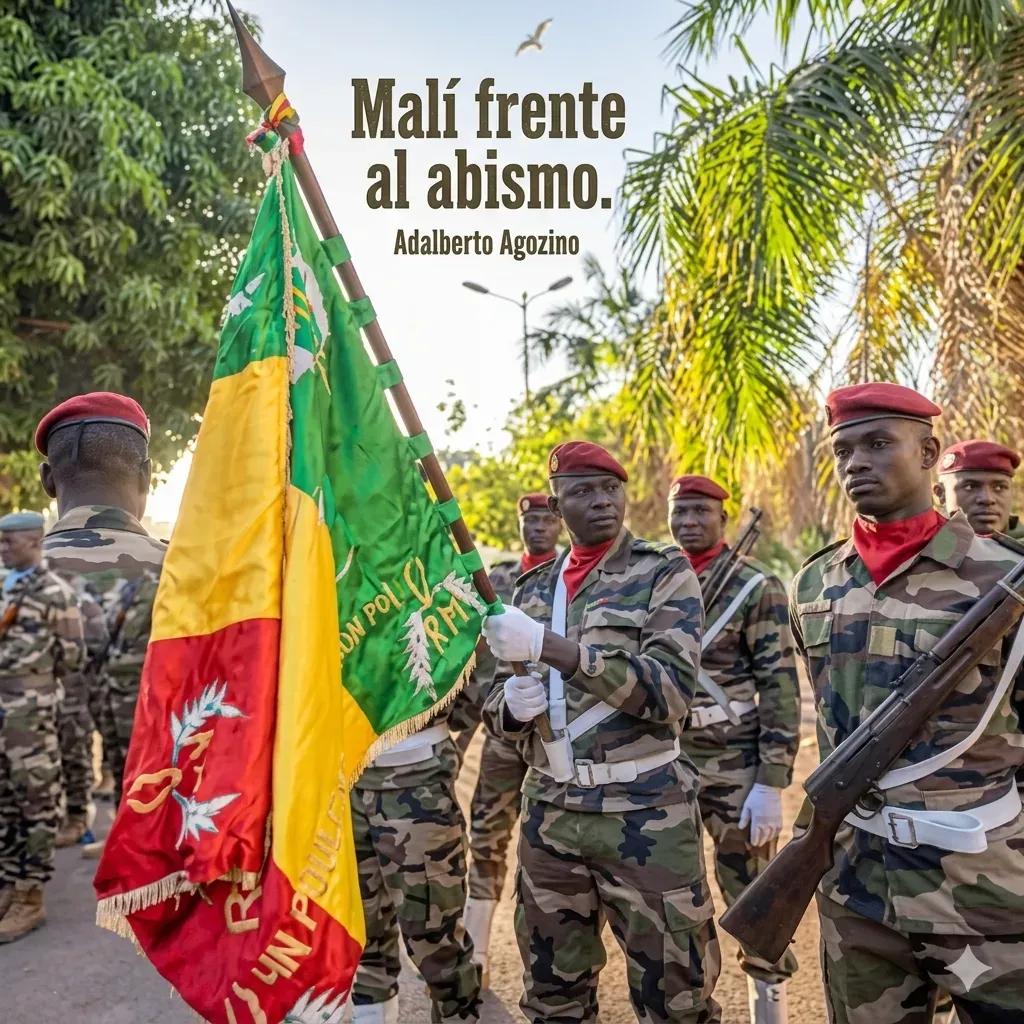
In the early hours of April 25, 2026, an unprecedented coordinated offensive shook Mali to its foundations. Jihadist groups linked to Al Qaeda and Tuareg separatists from the Azawad Liberation Front (FLA) launched simultaneous attacks on key garrisons, from Kati —just a few kilometers from Bamako— to the northern cities of Kidal, Gao, and Sévaré. The Defense Minister, General Sadio Camara, was killed in a car bomb attack in his stronghold of Kati. Kidal, a historic Tuareg bastion, fell into rebel hands, while the Group for the Support of Islam and Muslims (JNIM) announced a siege of the capital and other major cities. The initial silence of the junta leader, General Assimi Goïta, fueled speculation about the regime's stability. When he finally spoke three days later, he proclaimed that "the situation is under control" and promised the "complete neutralization" of the aggressors. However, the magnitude of the events —the death of the regime's second most powerful figure, the tactical withdrawal of Malian and Russian forces from Kidal, and the establishment of an unprecedented alliance between jihadists and separatists— starkly exposed what analysts have been warning for years: Mali today represents one of the most complete examples of state collapse in the contemporary world.
This crisis does not emerge from nothing. To understand it, it is essential to first consider the geographical conditions that have historically shaped its structural fragility; secondly, its complex social composition; and finally, the lethal convergence of armed insurgencies, failed external interventions, and a political drift that has deeply eroded the effective sovereignty of the State. Located in the heart of the Sahel, Mali is a vast landlocked country that extends over more than 1.24 million square kilometers —an area comparable to that of South Africa or Peru— bordering Algeria to the north, Niger to the east, Burkina Faso and Ivory Coast to the south, Guinea to the southwest, and Senegal and Mauritania to the west. This position makes it a transitional space between sub-Saharan Africa and the Maghreb, a historical corridor of legal and illegal trade routes that today facilitate both smuggling and the flow of arms, drugs, and fighters.
The Malian territory presents a marked duality that conditions its fate. To the north lies the Sahara desert, an expanse of dunes, rocky plateaus, and virtually uninhabited areas where state presence has historically been weak or nonexistent. To the center appears the Sahel, a semi-arid strip with sparse vegetation and extreme climatic vulnerability. The south, on the other hand, is relatively more fertile, irrigated by the Niger and Senegal rivers, and concentrates most of the population and economic activity. With a population exceeding 25.8 million inhabitants in 2026, Mali faces an extreme climate of high temperatures and irregular rainfall. Desertification is advancing relentlessly, exacerbated by climate change and demographic pressure, reducing arable lands and exacerbating age-old conflicts between sedentary farmers and nomadic herders. This dynamic constitutes one of the structural factors of violence, intensifying disputes over dwindling resources in a country where the economy relies heavily on gold —which accounts for almost 80% of exports— and where both armed groups and the State itself compete for control of artisanal mines and strategic deposits.
The ethnic diversity of Mali is not merely cultural but deeply political. The Bambara constitute the majority group, mainly settled in the south. They are followed by the Fulani or Peul, traditionally nomadic herders; the Songhai, concentrated in the Niger valley; and the Tuareg and Arabs in the north, with tribal social structures and a long history of resistance to the central power in Bamako. The north, known as Azawad, has been a recurrent scene of Tuareg rebellions demanding autonomy or independence. The 2015 Algiers Agreement sought to integrate these groups into the State and decentralize power, but its partial and conflict-ridden implementation, along with the junta's decision to terminate the pact in 2024, has reactivated tensions. The Coordination of Azawad Movements suspended its participation long ago due to repeated noncompliance; today, the FLA has returned to maximalist demands for territorial sovereignty, sealing an unprecedented operational convergence with jihadists.
Describing Mali as a failed state is not a rhetorical exaggeration but an empirical fact that the events of April 2026 have made undeniable. The central government barely exerts effective control beyond Bamako and some important southern cities. Large regions in the north and center are dominated by non-state actors: militias, insurgent groups, criminal organizations, and jihadist formations. State authority has often been replaced by parallel power systems that administer justice, collect taxes —including zakat— and control entire territories. Among the insurgents, on one side, are the Tuareg separatists of the FLA, whose ideology combines ethnic nationalism and regional demands. On the other —and more determinative— are the jihadist groups linked to Al Qaeda and the Islamic State. JNIM, a salafist-jihadist coalition, and the Islamic State in the Greater Sahara (EIGS) have demonstrated remarkable adaptability to local contexts. They do not limit themselves to armed violence: they have built economic networks based on drug trafficking, smuggling, kidnappings, and resource exploitation, inserting themselves into local social dynamics and aligning with communities like the Fulani herders to gain legitimacy.
These groups compensate for their lack of conventional capabilities with guerrilla tactics, deep knowledge of the terrain, and cross-border mobility. Their fragmented leadership complicates their neutralization, while their strategy prioritizes control of rural areas and strategic routes, progressively weakening the State. The recent offensive in April, in which JNIM and FLA acted in a coordinated manner —reestablishing an alliance that had briefly surfaced in 2012— marks a qualitative leap: it is no longer about gradual erosion, but a direct challenge to the heart of the regime.
Foreign intervention has been a central factor in this evolution. France, the former colonial power, launched Operation Serval in 2013 and then Barkhane, with thousands of soldiers deployed in the Sahel. Despite initial tactical successes, these missions began to be increasingly seen as neocolonial interference and failed to stabilize the country.
The UN mission, MINUSMA, deployed in 2013, became one of the most dangerous in the world before its forced withdrawal by the junta. The vacuum left by the West opened the door for Russia. The Wagner Group, now reconfigured as Africa Corps under the direct control of the Russian Ministry of Defense, has been operating alongside Malian forces since 2021. With around two thousand troops, it has been accused of serious human rights violations, but it has also provided air and logistical support in critical moments. In the April offensive, Russian forces withdrew from Kidal alongside Malian ones in a negotiated maneuver, although Moscow claimed to have prevented a coup and avoided greater civilian losses. The Bamako junta has redirected its foreign policy towards Moscow, signing agreements in mining, nuclear energy, and gold refining, while maintaining tense relations with international organizations and seeking allies within the military axis of the Sahel —Burkina Faso and Niger— within the Sahel States Alliance.
The current government, led by the military junta headed by Assimi Goïta since the coups of 2020 and 2021, combines a sovereignist discourse with authoritarian practices. Internally, it has consolidated power through reforms that reinforce the presidential figure; internationally, it has confronted France and embraced Russia. However, the internal situation continues to deteriorate. Violence is persistent, population displacements —over 400,000 internally displaced people— are multiplying, and the economy remains stagnant despite gold, whose industrial production has fallen in recent years. Reports of abuses by armed forces and their Russian allies feed the cycle of violence and facilitate jihadist recruitment.
In the short and medium term, the likely evolution points to a consolidation of territorial fragmentation. The State will hardly regain control over peripheral regions without a profound transformation of its political and social structure. Jihadist groups will continue to expand, taking advantage of institutional weakness and community tensions. The Russian presence could be reinforced —with recent military equipment deliveries and mining projects— but without guarantees of stabilization, reproducing in many ways the failures of previous interventions. Mali is shaping up as an epicenter of instability with regional and international projections. Its crisis is not solely national but a symptom of the structural fractures of the Sahel, where poverty, climate change, identity conflicts, and geopolitical rivalries converge. Without a comprehensive approach that combines security, development, inclusive governance, and genuine political dialogue, the country will remain trapped in a spiral of violence that threatens to extend beyond its borders, dragging a region already at its limit. Time is of the essence, but the window of opportunity to prevent total disaster closes with each new attack.

Adalberto Agozino holds a PhD in Political Science, is an International Analyst, and a Lecturer at the University of Buenos Aires.

Comments