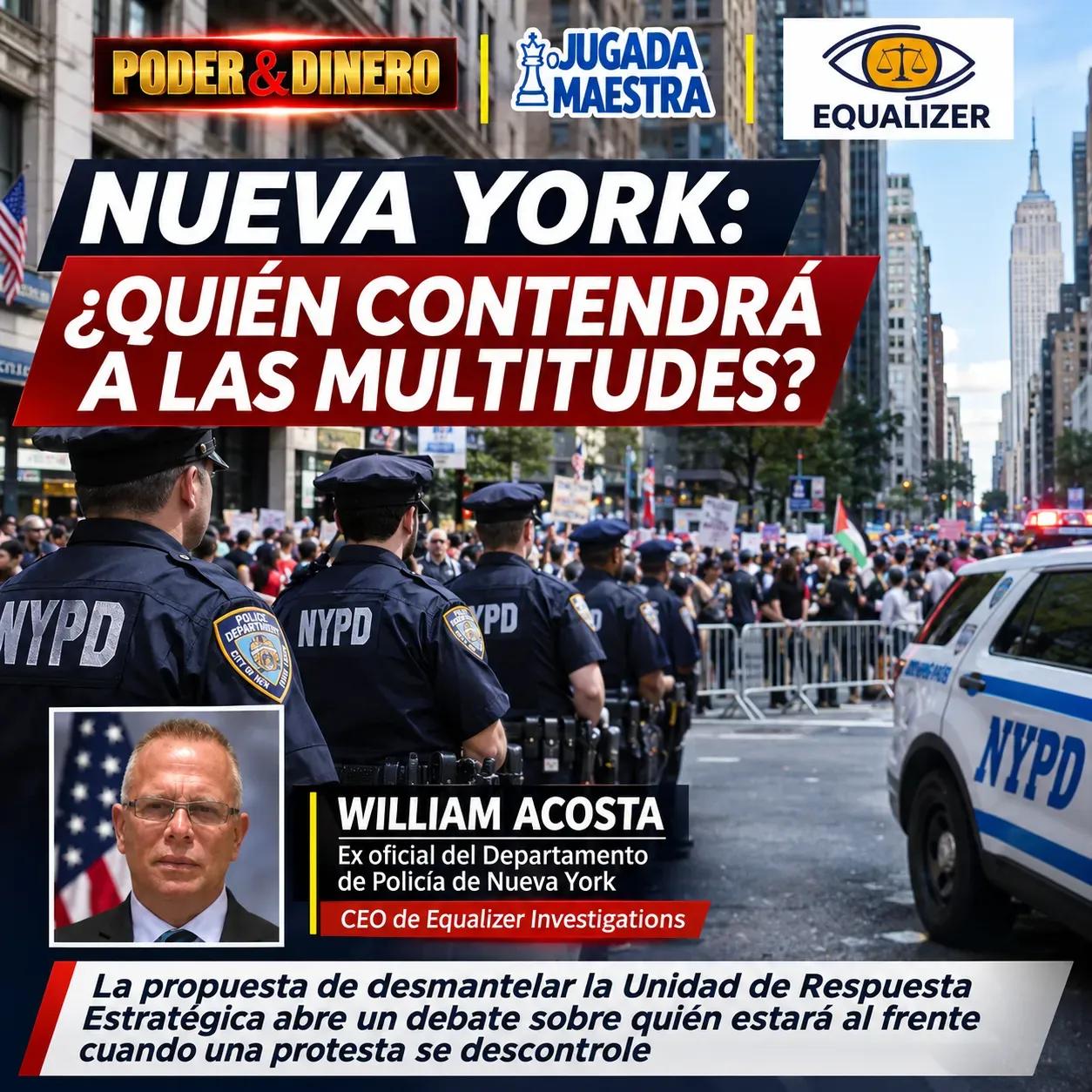
The first bottle comes out of nowhere. When it falls, what was written no longer matters. It tells who is in front of the people, and what that person is allowed to do.
What is moving forward now in the City Hall responds to that in the worst possible way.
THE RIGHT TO PROTEST IS NOT THE ISSUE
New Yorkers have every right to gather. They can march, shout, fill a sidewalk with a permit in hand, and say things about the mayor that would make his press office blush. None of that is under discussion here. That right ends at a single point: when a march starts taking rights away from another person. The driver who cannot get to work. The merchant who sees his display window collapse. The nurse waiting for an ambulance that can't pass. When a protest ceases to be peaceful, it stops being protected, and no city can pretend otherwise.
In a city this size, that limit is crossed. It doesn't take a majority to cross it. It takes a few people who set out looking for a fight and a barrier that is not allowed to stop them.
Almost everyone who marches wants to be heard, and they have every right. The problem is the small group within the protest with another purpose, using a legal gathering as cover to attack offices, damage infrastructure, forcibly enter businesses, burn vehicles, and destroy public property. That is not a suppressed peaceful protest. It is a peaceful protest exploited.
What is at stake is how the decision is made to monitor these protests. The plan to dismantle the Strategic Response Unit and transfer the response to protests to a civilian office did not come from a careful reading of what failed in 2020. It came from a political debt. Democratic Socialists and the networks surrounding them spent years telling this city that its police are the problem and helped put the mayor in office. He owes that movement his position. He does not owe the safety of eight million people who did not vote for him and who are the ones standing on the sidewalk when order is broken.
The one that remains peaceful receives protection from this city and should receive it. The one that ends in burned cars and broken display windows receives a police response, and should receive it. That is not a contradiction. It is the only way to fulfill both promises at once.
The exchange is simple and is being made silently. The people who will pay for it are not in the room where it was decided. They are on the sidewalk.
There is a truth that is almost never said out loud: you cannot control a crowd with people who are not allowed to touch anyone.
Mayor Zohran Mamdani wants to dissolve the Strategic Response Unit. Three people familiar with the decision say that the announcement could come this week, perhaps on Friday, maybe by decree. The unit disappears. A civilian force takes charge of the protests, with uniformed officers waiting nearby and only entering to make arrests. City Hall has discussed placing that body within the new Office of Community Safety.
Being close is not the same as commanding. The document leaves the central question unanswered: who decides that the time has come, and with what authority. None of that withstands a bad night.
This mayor has never been in charge of a line of officers. He has not written a plan to manage gatherings and has never spent past two in the morning in a command post deciding whether to send officers forward or hold them back. Nothing in his career has taught him how people behave when they stop listening. He is writing rules for a job he has never done.
Everything in the profession depends on the sequence. Someone gives an order, someone repeats it, and the formation moves a fixed distance before stopping. Each step exists because once something went wrong and someone got hurt. If it fails in timing, and with everyone already in motion, everything is decided in about four minutes.
The Strategic Response Unit was created about ten years ago to combat terrorism. It was designed to move quickly, get to any point in the city, and hold a scene until specialists arrive. Crowd control was included for a reason: a filled protest is the softest target there is. A body that can close a block can also contain a protest. That was the design from the beginning.
A civilian cannot arrest anyone in a crowd that is pushing forward. They legally cannot move away someone who refuses to budge, nor can they catch what is thrown at them. When the front line gives, as it will, officers who were two blocks away have to get into the crowd to reach their own. By then, the protest has already ended, and what follows are arrests among people who are already scared.
De-escalation only works when there is force behind it. It is a conversation that is held from a visible command position, with a clear voice and an exit that is not a trap. If that force is taken away, the civilian officer is asking everyone to obey with nothing backing the request.
A civilian force has no response to any of that. It has no training, nor the repetition that turns practice into judgment under pressure, nor the tools that the profession requires. No matter how the proposal is divided: the NYPD has to be at the forefront because it is the only municipal agency made and equipped to protect the public at that moment.
The same reasoning wants to now remove police from calls involving people with mental health issues and send social workers to already tense situations. Do the math that no one does. The person is armed. They have already stabbed several. How does a social worker convince them to stop? There is no script for that. There is only response, and it is not that of a clinician.
Not all marches here are a paid crowd, and the argument does not need them to be. It is based on what is documented: paid organizers, buses chartered from other states, protests financed by foundations and campaigns. Within some, there is a small and disciplined group that did not come for the banner but for the fight, and if the police step aside and let that group set the pace, the rest of the day writes itself.
The political establishment has not asked a single serious question about any of this. No one has demanded to know where these protests come from, who is funding them, or why the same organizers and the same faces keep appearing time and again. The cause changes. One week it is Palestine, the next it is the detention of a foreign leader, and the people remain the same. That is not spontaneous and it is not coincidence. Someone is pushing those buttons.
Follow the buses and follow the money, and the same names keep appearing in the papers, and no one in a position of authority convenes a hearing about it. If order is not maintained, what comes is anarchy, and anarchy is exactly what the democratic socialist movement that pushed this proposal is seeking. Any institution that stands between the people and the display window of a business is called an obstacle until it disappears.
Look at what the last six years have left.
In the last days of May 2020, a patrol in Fort Greene received rocks and bottles and ended up set on fire. By May 31, the department had recorded 47 damaged vehicles and 13 burned. Before the disorder ended, 303 police vehicles had been vandalized, almost one million dollars in damages, and fourteen total losses by fire.
During the first two days of June 2020, the city recorded 2,319 calls for commercial burglary within twelve hours and about 51 ATM thefts. Looting spread across Midtown, Lower Manhattan, Fordham Road, and Bay Plaza. The Bronx counted 127 damaged or stolen businesses, 27 on Fordham Road. A tour through the East Village, Lower East Side, and Chinatown found over 70 looted or damaged businesses. They entered Macy's in Herald Square. The attorney general's report included among the affected businesses Bloomingdale's, Chanel, Gucci, Coach, Supreme, Louis Vuitton, Aldo, Nike, Duane Reade, Foot Locker, Nordstrom, Urban Outfitters, Rolex, Verizon, North Face, and Microsoft.
The pattern did not end in 2020. A weekend in January 2023 left four attacks against police property: a bottle thrown at a vehicle, an attempted arson in Midtown, a car painted in Brooklyn, and two units in front of Brooklyn Borough Hall with an obscene phrase. In November 2023, during a pro-Palestinian march in Midtown, several police vehicles in front of the New York Times building were vandalized and one was painted with "Free Gaza"; the protesters entered the lobby. In May 2024, 34 people were taken into custody at the Brooklyn Museum, where works were damaged in the plaza, and security staff was harassed. In June 2025, a man entered a police parking lot in Bushwick and placed fire starters on the hoods, windshields, and tires of 11 patrols.
No one talks about the damage. Broken windows, smashed buses, burned cars, businesses that do not reopen, and employees who are left unemployed. When someone ends up tussling with an officer, the lawsuit arrives, and the lawsuit begins at the moment of arrest. It leaves out everything that came before: the bottle, the barricade, the refusal to disperse, the order that was given three times. Context is the first thing discarded and the last thing that matters.
Then there is Gracie Mansion. In March, two men from Pennsylvania, Emir Balat and Ibrahim Kayumi, were arrested in front of the mayor’s residence. According to prosecutors, shortly after noon, Balat ignited an improvised device and threw it towards the protesters, took another from Kayumi, ignited it, and let it go near the officers before running; the officers took him down. The two devices were the size of a jar, with fuses, nuts, and screws, and the first contained TATP, an explosive that detonates with a spark. A third found in a vehicle did not contain explosive material. The federal charge includes eight counts, including conspiracy to use a weapon of mass destruction and attempted support to the Islamic State. Both pleaded not guilty and are presumed innocent. None of that changes how it was seen that afternoon: a crowd, a cordon, and a device with a fuse.
New York has long been the target of attacks: the car bomb in Times Square in 2010, the pressure cooker in Chelsea in 2016, and the truck on the West Side Highway in 2017 that killed eight people. In September, the mayor said he does not believe that combating terrorism and responding to protests have to be the same task. That is a matter of personnel and deployment, and it has nothing to do with who is outside when it happens.
What he is really managing is a calendar. Councilman Chi Ossé reintroduced a bill that would force the mayor to act. The Democratic Socialists of America are holding their city convention on Saturday, and dissolving the Strategic Response Unit is among their top items. Mamdani has called that organization his political home. An announcement this week comes before someone there can ask him why it took a year.
Pleasing a base is not the same as serving a city. The people who are going to live with this decision are not going to be at that convention. They are on the Fulton street platform at seven in the morning, on the train at midnight, in a parked car on Broadway. None of them asked for less distance between them and a crowd that has already gone out of control.
Then there are the people he has brought with him. His team thinks like him: anti-police, anti-authority, anti-establishment, a one-way street from top to bottom. With one exception, none of them have done that work. The police commissioner knows what happens on the street, and the men and women of the law who answer to her do too, because they are the ones who are standing there. Everyone else in that building is guessing. What they are trying has a name, and it is not reform. They are attempting to reinvent the wheel. The wheel is one. It was built by people who had to make it hold up on the worst night of the year, and every version since then has come out the same shape, for the same reason.
When the crowd turns, someone in a vest has to stand between them and those behind. Mayor Mamdani is about to leave that place empty. New Yorkers are going to feel it before he admits it.
Police Commissioner Jessica Tisch is not going to be the one in front of the microphone. It will be late. It may be raining, and it may be July. The mayor is going to be the one who has to answer who was in charge out there.
And this is the message for everyone who lives here. Before the announcement comes, ask the question that can still be answered: when people stop listening, who gives the order? Do it now, while the direction can still be changed. Afterwards, that becomes an investigation, and an investigation does not return an officer to the street.
About the Author
William L. Acosta
He is a retired New York police officer and founder and CEO of Equalizer Private Investigations & Security Services Inc., a licensed agency in New York and Florida with global reach. Since 1999, he has led investigations into narcotics, homicides, and missing persons, also participating in state and federal criminal defense. A specialist in international and multijurisdictional cases, he has coordinated operations in North America, Europe, and Latin America.
Comments