
At the same moment that the Río de la Plata was beginning its path toward independence, China, Japan, and Korea were living under millennia-old systems that seemed immovable. Fifty years later, none would be the same.
There are dates that function as mirrors. May 25, 1810, is one of them. While in Buenos Aires, the Open Cabildo was deposing the viceroy Baltasar Hidalgo de Cisneros and laying the foundations for what would be Argentine independence, on the other side of the planet, three of the world's oldest and most powerful civilizations were living in a stillness that, viewed from today, appears deceptive. It was not peace: it was the silence preceding an unprecedented transformation.
China: the giant that still did not know what was coming
In 1810, the throne of the Qing Empire was occupied by Emperor Jiaqing, the fifth son of the legendary Qianlong, whose reign had taken China to its greatest territorial extent. Jiaqing inherited an empire that remained one of the largest economies in the world, but he also inherited its fractures: widespread bureaucratic corruption, a population that had explosively grown during the 18th century, and a tax burden that crushed farmers in the interior provinces.
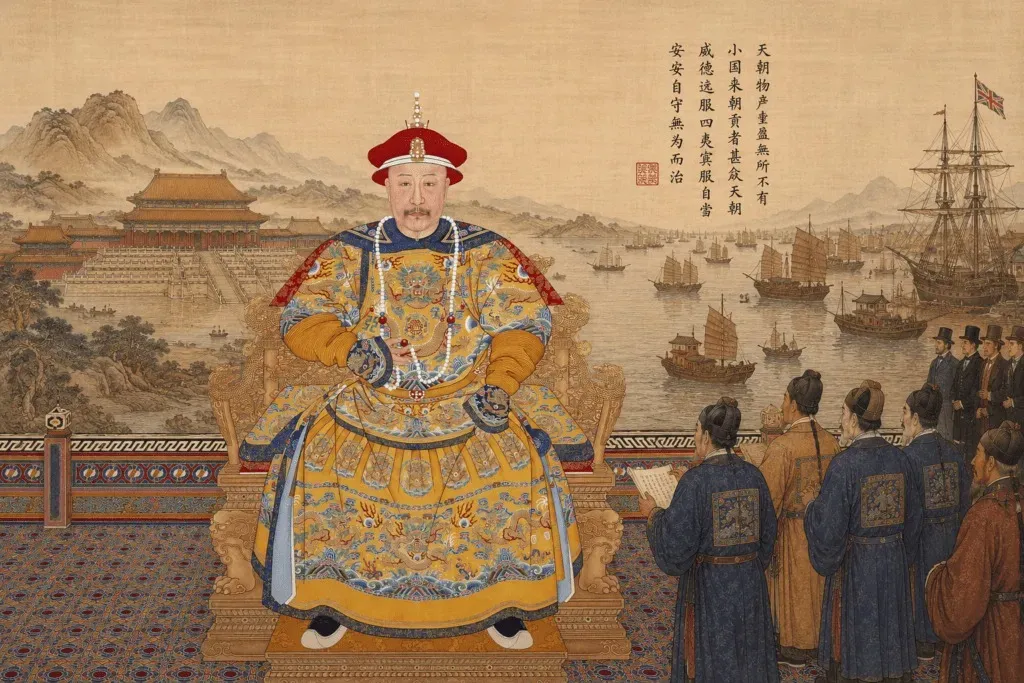
European presence was still marginal. All trade with the West was confined to the Canton system, a regime that forced foreign merchants to operate exclusively through Guangzhou and under conditions strictly controlled by the imperial state. The British, who already dominated global trade, looked at China with equal parts appetite and frustration.
It was just three decades before that order would be broken. The First Opium War, between 1839 and 1842, would mark the beginning of the so-called “century of humiliation”: unequal treaties, forced ports, cession of Hong Kong. None of this was imaginable in May 1810. China saw itself as the center of the world. And in many ways, it still was.
Japan: the country closed in its own splendor
About 2,000 kilometers to the northeast, the Japanese archipelago was living one of the most unique periods in its history. The Tokugawa shogunate, in place since 1603, firmly maintained the sakoku policy: a regime of isolation that prohibited the entry of foreigners, restricted Japanese travel abroad, and reduced international trade to a single controlled channel: the Dutch in the artificial port of Dejima, Nagasaki.
But isolation was not stagnation. The Edo period was a time of extraordinary cultural and urban vitality. Edo —modern-day Tokyo— was already one of the most populated cities on the planet. Kabuki theater drew crowds. Ukiyo-e prints documented a sophisticated, ironic, and visually stunning society.
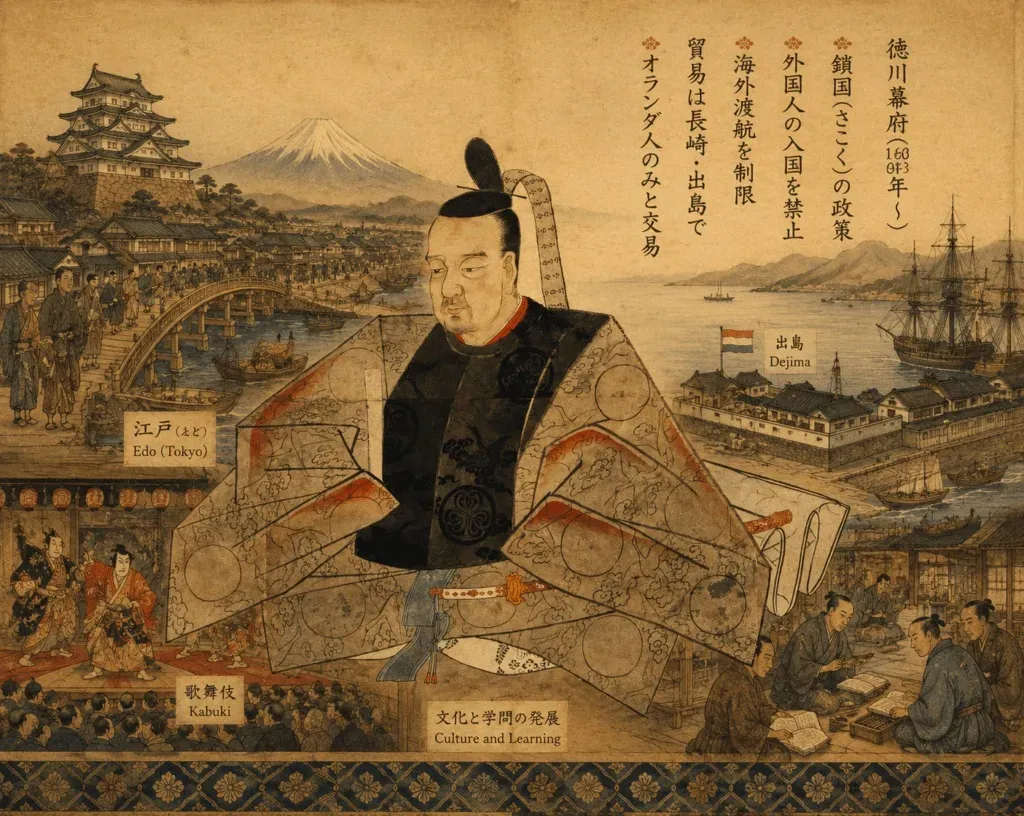
The merchant class was growing. Literacy was increasing. Japan was a complete, perfectly functional world that had decided it did not need the West.
That decision would last another forty-three years. In 1853, Commodore Matthew Perry anchored his steam fleet in Edo Bay and demanded the opening of the country. What followed was the Meiji Restoration: the fastest industrialization in modern history and the transformation of a feudal shogunate into an imperial power in less than half a century.
Korea: the kingdom that chose not to exist for the world
Further south on the peninsula, the Joseon dynasty had governed Korea since 1392. It was a tributary kingdom of Qing China, structured around a Confucian philosophy that permeated everything from family relations to the functioning of the state. The yangban aristocracy monopolized political power and access to knowledge. Imperial examinations determined who ascended and who did not.
If Japan was closed, Korea was hermetic. So much so that Westerners trying to approach —Jesuits, merchants, explorers— encountered almost absolute resistance. The nickname that would remain in history, “The Hermit Kingdom,” was not a metaphor. It was a precise description of a foreign policy that regarded contact with the outside as a threat to internal stability.
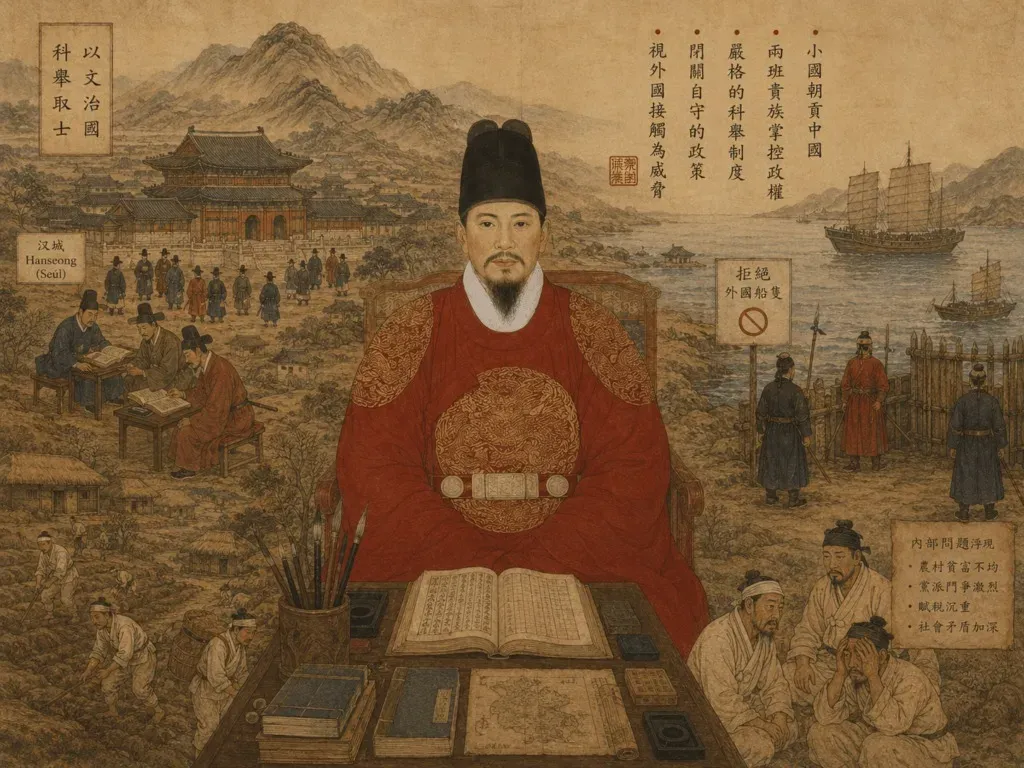
By 1810, that stability was already showing cracks. Rural inequality was deepening. Court factions faced off with increasing violence. Fiscal problems accumulated social tension. But none of those crises yet pointed outward. The danger appeared internal, and solutions were also sought within.
A model that would change in fifty years
The remarkable thing about this simultaneous snapshot —Buenos Aires in 1810, Beijing in 1810, Edo in 1810, Seoul in 1810— is the speed with which it became obsolete. In fifty years, the political, economic, and cultural map of East Asia would be completely rewritten.
China entered a cycle of wars, humiliating treaties, and partial disintegration of central power that would not close until the 20th century. Japan, on the other hand, absorbed the Western impact with a discipline and speed that astonished the world: by 1905, it had militarily defeated Russia, the first time an Asian power triumphed over a European one in modern times. Korea was caught in the middle: contested between China, Japan, and Western powers, it was finally annexed by Tokyo in 1910, exactly a century after the May Revolution.
As Buenos Aires began its process of independence looking toward the future, East Asia was living the last chapter of a millennial order. Neither of the two worlds knew the transformations that awaited them. But history, as always, would not wait to unfold.

Marcos González Gava is Co-Founder of Reporte Asia, Specialist in commercial and financial negotiations, and cultural affairs with the People's Republic of China

Comments