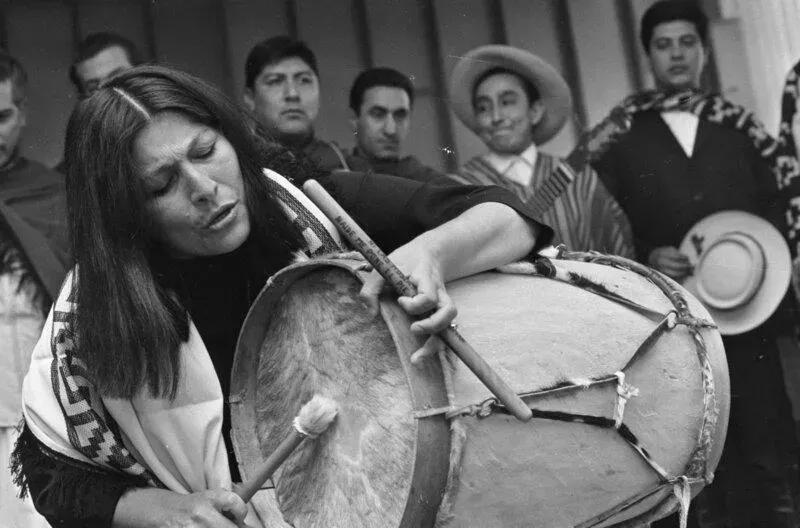
There is something deeply revealing —and also unsettling— in the way a society decides to speak about its most representative figures. Not for the sake of empty solemnity or symbolic shielding, but because in that gesture something deeper is at stake: the limits of disagreement, the quality of public debate, and ultimately, the type of community we are building. What happened with Enzo Ferreira and his comments about Mercedes Sosa is not simply an isolated outburst, nor just another scandal within the constant noise of social media. It is, rather, an uncomfortable mirror that reflects a moment in time: one in which criticism easily slips into disdain, and where words lose their weight until they turn into a projectile.

For yes, it is completely legitimate to disagree with Mercedes Sosa. It would be absurd to demand ideological unanimity in the face of a figure who, precisely, never aimed to be neutral. Her political commitment was explicit, her positioning was clear, and her work itself is inseparable from that stance. But there is an essential —and increasingly blurry— difference between dissenting and degrading. Between discussing ideas and reducing a person to an insult that addresses their body or their illness. This is not a matter of political correctness or excessive sensitivity: it is a matter of thought. When the argument disappears and is replaced by aggression, what remains is not a stronger position, but a weaker one.
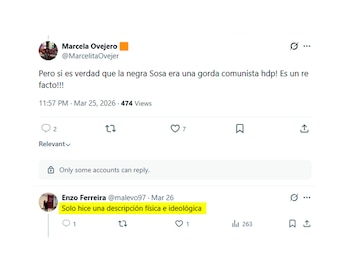
Calling Mercedes Sosa a “fat communist” is not an ideological critique. It is a brutal simplification that reveals more about the one who utters it than about the figure it aims to attack. And when that simplification escalates to terms like “cancer,” the problem ceases to be rhetorical and becomes ethical. There is no discussion there about models of the country, about history, about culture. There is, instead, a form of dehumanization that disguises itself as opinion, as if everything could be said without consequences as long as it is framed within the freedom of expression.
But freedom of expression is not a pass for emptiness. It is not the automatic license for any form of symbolic violence. It is, in any case, a tool to enrich the debate, not to degrade it. And when someone, from a place of public responsibility, confuses those dimensions, what becomes evident is not only a lack of sensitivity but a precariousness in how to understand the public.
Because it matters who speaks. It is not about an anonymous user lost in the digital ocean, but about someone who holds an institutional position, who is part of a structure that, paradoxically, carries the name of the very artist they insult. That tension is not anecdotal: it is deeply symbolic. What does it mean to direct a station named after Mercedes Sosa while reducing her to an insult? What kind of relationship with culture does that gesture imply? It is not enough to offer half-hearted apologies or to clarify that one recognizes her talent. The problem is not whether she is considered a good singer or not, but how she is named, and the kind of language chosen to refer to someone who, beyond any political positioning, is part of a country’s cultural heritage.
Reducing Mercedes Sosa to an ideological label is, besides being unjust, intellectually lazy. Because it involves ignoring —or choosing to ignore— the complexity of a figure who traversed decades of Latin American history, who was persecuted, censored, forced into exile, not for an ideological caricature, but because of the real weight of her voice in contexts where singing could be a political act in itself. Her work is not limited to partisan militancy or a slogan. It is, in many ways, an emotional archive of an era, a sensitive record of collective pains, struggles, and resistances.
There is something profoundly uncomfortable about figures like hers, and maybe that's why they generate such extreme reactions even today. Not because they are unquestionable, but because they force us to think. Because they challenge us. Because they do not fit easily into the binary logics of the present, where everything seems to need to be resolved in terms of absolute adherence or rejection. Mercedes Sosa is not just what she thought politically. She is also what she generated, what she represented, and what she left in those who listened to her at times when silence was imposed.
And yet, even if someone chose to focus solely on her ideological dimension, even if they chose to discuss it, question it, or reject it, none of that would justify resorting to insults. Because insults do not illuminate, do not argue, do not persuade. They only close off. They are the final point of a conversation that hasn't even started.
Perhaps the most troubling thing about all this is not the act itself, but the naturalization that surrounds it. The speed at which this type of expression circulates, is shared, and even celebrated in certain spaces. The idea that anything goes, that verbal violence is merely another style within public conversation. As if the degradation of language had no impact, as if it did not gradually shape the way we relate to each other.
Because words are not innocuous. They build climates, enable practices, delineate what is possible. When the threshold of what can be said is crossed, when insults become common currency, what erodes is not just respect towards public figures, but the very quality of the common space. And that, sooner or later, has consequences.
In that context, the reaction from Mercedes Sosa's family and various cultural spaces introduces another register, almost in contrast. Not because they deny the gravity of what happened, but because they choose not to respond in the same tone. In that decision is a form of positioning that, far from being naive, is deeply conscious. It is not about silencing in the face of the affront, but about not reproducing its logic. Not entering a spiral where the response to hate is more hate, where discussion turns into a competition of disqualifications.

“Her memory does not need defense,” they say. And maybe there is some truth to that. Not in the sense that injustice should not be pointed out, but in the idea that there are trajectories whose historical density renders them resistant to such attempts at reduction. The work of Mercedes Sosa does not depend on the opinion of an official or on the viralization of a tweet. It is inscribed in something broader, deeper, and harder to erode.
But that does not mean it is the same. It does not mean that the way we talk about our cultural figures is irrelevant. On the contrary: it is precisely there that an important part of our collective identity is at stake. In how we remember, in how we name, in how we discuss.
Perhaps the question that lingers is not what Ferreira said, but what happens to us as a society when such discourses find a place. At what moment does it become acceptable to replace argument with offense? At what point do we stop demanding a minimum of consistency, respect, and thought from ourselves?
Because it is not about shielding anyone from criticism. It is about sustaining the very possibility of criticism, which can only exist if there is something beyond insults. One can disagree with Mercedes Sosa, with her ideology, with her positions. All that can be discussed, reviewed, even rejected. What cannot —or should not— be done is to empty that discussion of content until it turns into a series of disqualifications that say nothing, that build nothing.
There is ultimately something that exceeds this specific case. It has to do with how we understand the word. With whether we use it to open or to close, to think or to attack, to build or to destroy. And in that choice, which seems minimal, everyday, almost automatic, much more is at stake than we believe.
Because when the other ceases to be someone with whom we can discuss and becomes someone to ridicule, the conversation is already lost. And when the conversation is lost, what remains is not a freer society, but a noisier, more violent one, and, at its core, emptier.
Perhaps that's why Mercedes Sosa still unsettles so many. Not for what she said, not even for what she sang, but for what she compels us to question. About the past, about the present, about the place culture occupies in all this. About what we do with our differences.
And, above all, about whether we are still capable of upholding them without destroying ourselves in the attempt.
It pleases me, but you need to give context before this reflection; let’s not make the assumption that everyone knows what happened.
There is something deeply revealing —and also unsettling— in the way a society decides to speak about its most representative figures. But before leading to that reflection, there is a concrete, recent, and disturbing fact that forces us to pause.
In recent days, a series of posts went viral on the X social network made by Enzo Ferreira, coordinator of Radio Nacional Tucumán and provincial representative of La Libertad Avanza. Although the messages date back to February, their recent circulation generated strong social, political, and cultural rejection. In those posts, Ferreira referred to Mercedes Sosa with expressions like “fat communist” and also replicated another user's message that labeled her as “cancer.” Far from retracting immediately, he defended his words arguing that it was a “physical and ideological description,” and even appealed to “dark humor” to justify the tone.
The reaction did not take long to arrive. The artist's family publicly demanded his resignation, highlighting the gravity of a public official —and more so, someone at the helm of a station named after the singer herself— expressing in those terms. The Cultural Entity of Tucumán also condemned the remarks, labeling them as unacceptable within the public sphere and warning about the danger of hate and devaluation discourses circulating from institutional spaces. With the scandal already established, Ferreira published a response in which he apologized to the family, although he maintained his ideological stance and reiterated that his words had been, in part, “descriptive.”
This is the starting point. Not an abstract discussion, not a theoretical hypothesis about the boundaries of freedom of expression, but a concrete fact that once again puts into tension something deeper: what we understand by dissent, what place we give to respect, and what kind of public conversation we are building.
For yes, it is completely legitimate to disagree with Mercedes Sosa. It would be absurd to demand ideological unanimity in the face of a figure who, precisely, never aimed to be neutral. Her political commitment was explicit, her positioning was clear, and her work itself is inseparable from that stance. But there is an essential —and increasingly blurry— difference between dissenting and degrading. Between discussing ideas and reducing a person to an insult that addresses their body or their illness. This is not a matter of political correctness or excessive sensitivity: it is a matter of thought. When the argument disappears and is replaced by aggression, what remains is not a stronger position, but a weaker one.
Calling Mercedes Sosa a “fat communist” is not an ideological critique. It is a brutal simplification that reveals more about the one who utters it than about the figure it aims to attack. And when that simplification escalates to terms like “cancer,” the problem ceases to be rhetorical and becomes ethical. There is no discussion there about models of the country, about history, about culture. There is, instead, a form of dehumanization that disguises itself as opinion, as if everything could be said without consequences as long as it is framed within the freedom of expression.
But freedom of expression is not a pass for emptiness. It is not the automatic license for any form of symbolic violence. It is, in any case, a tool to enrich the debate, not to degrade it. And when someone, from a place of public responsibility, confuses those dimensions, what becomes evident is not only a lack of sensitivity but a precariousness in how to understand the public.
Because it matters who speaks. It is not about an anonymous user lost in the digital ocean, but about someone who holds an institutional position, who is part of a structure that, paradoxically, carries the name of the very artist they insult. That tension is not anecdotal: it is deeply symbolic. What does it mean to direct a station named after Mercedes Sosa while reducing her to an insult? What kind of relationship with culture does that gesture imply? It is not enough to offer half-hearted apologies or to clarify that one recognizes her talent. The problem is not whether she is considered a good singer or not, but how she is named, and the kind of language chosen to refer to someone who, beyond any political positioning, is part of a country’s cultural heritage.
Reducing Mercedes Sosa to an ideological label is, besides being unjust, intellectually lazy. Because it involves ignoring —or choosing to ignore— the complexity of a figure who traversed decades of Latin American history, who was persecuted, censored, forced into exile, not for an ideological caricature, but because of the real weight of her voice in contexts where singing could be a political act in itself. Her work is not limited to partisan militancy or a slogan. It is, in many ways, an emotional archive of an era, a sensitive record of collective pains, struggles, and resistances.
There is something profoundly uncomfortable about figures like hers, and maybe that's why they generate such extreme reactions even today. Not because they are unquestionable, but because they force us to think. Because they challenge us. Because they do not fit easily into the binary logics of the present, where everything seems to need to be resolved in terms of absolute adherence or rejection. Mercedes Sosa is not just what she thought politically. She is also what she generated, what she represented, and what she left in those who listened to her at times when silence was imposed.
y. Not because they are unquestionable, but because they force us to think. Because they provoke. Because they do not easily fit into the binary logics of the present, where everything seems to have to be resolved in terms of absolute adherence or rejection. Mercedes Sosa is not just what she thought politically. She is also what she generated, what she represented, what she left in those who listened to her at moments when silence was imposed.And yet, even if someone decided to only focus on her ideological dimension, even if they chose to discuss it, question it, or reject it, none of that would justify resorting to insults. Because insults do not illuminate, do not argue, do not persuade. They only close off. It is the final point of a conversation that did not even start.
Perhaps the most concerning thing about all this is not the fact itself, but the naturalization that surrounds it. The speed at which these types of expressions circulate, are shared, and are even celebrated in certain spaces. The idea that anything goes, that verbal violence is just another style within public conversation. As if the degradation of language had no impact, as if it did not gradually shape the way we connect with others.
Because words are not innocuous. They build climates, enable practices, delineate the possible. When the threshold of what is sayable is crossed, when insults become commonplace, what erodes is not only respect towards public figures but the very quality of the common space itself. And that, sooner or later, has consequences.
In that context, the reaction of Mercedes Sosa's family and various cultural spaces introduces another register, almost in contrast. Not because they deny the seriousness of what happened, but because they choose not to respond in the same tone. There is in that decision a form of positioning that, far from being naive, is profoundly conscious. It is not about remaining silent in the face of offense, but about not reproducing its logic. About not entering a spiral where the response to hate is more hate, where the discussion becomes a competition of disqualifications.
“Her memory does not need defense,” they say. And perhaps there is some truth in that. Not in the sense that injustice should not be pointed out, but in the idea that there are trajectories whose historical density makes them resistant to these attempts of reduction. The work of Mercedes Sosa does not depend on the opinion of an official or the virality of a tweet. It is inscribed in something broader, deeper, harder to erode.
But that does not mean it does not matter. It does not mean that the way we talk about our cultural figures is irrelevant. On the contrary: it is precisely there that an important part of our collective identity is at stake. In how we remember, in how we name, in how we discuss.
Perhaps the question that lingers is not just what Ferreira said, but what happens to us as a society when such discourses find a place. At what point does it become acceptable to replace argument with offense. At what point do we stop demanding a minimum of consistency, of respect, of thought.
Because it's not about shielding anyone from criticism. It's about sustaining the very possibility of criticism, which can only exist if there is something more than insults. One can disagree with Mercedes Sosa, with her ideology, with her positions. One can discuss all that, review it, even reject it. What cannot - or should not - happen is to drain that discussion of content until it becomes a series of disqualifications that say nothing, that build nothing.
There is, ultimately, something that exceeds this specific case. It has to do with the way we understand the word. With whether we use it to open or to close, to think or to attack, to build or to destroy. And in that choice, which seems minimal, everyday, almost automatic, much more is at stake than we think.
Because when the other stops being someone with whom we can discuss and becomes someone to ridicule, the conversation is already lost. And when the conversation is lost, what remains is not a freer society, but a noisier, more violent, and, fundamentally, emptier one.
Perhaps that is why Mercedes Sosa still discomforts so much. Not for what she said, not even for what she sang, but for what she forces us to question. About the past, about the present, about the place culture occupies in all this. About what we do with our differences.
And, above all, about whether we are still capable of holding them without destroying ourselves in the attempt.


Comments