Thinking about “middle powers”
At the end of September 2026, I traveled to Mexico City to present a paper at an event organized by the Konrad Adenauer Foundation, Anáhuac University, and the Institute for Research on Strategy and Defense. During my stay, I also had the opportunity to visit several Mexican security institutions and consult with colleagues from academia, business, and security.
The theme of the conference, “middle powers,” was appropriate to describe the situation in Mexico, although perhaps not in the way the organizers intended. In a certain sense, the meeting was influenced by the line of thought inaugurated by Canadian Prime Minister Mark Carney with his striking speech at the World Economic Forum in Davos in January 2026. There, he argued that “middle powers,” like Canada, must work together more closely and intensely to face the challenges of the world order, exacerbated by the rise of the People’s Republic of China (PRC) and the significant shift in the United States' attitude towards alliances and global institutions.
The event on “middle powers” had a prominent presence of European diplomats and politicians, as well as relevant figures from Mexico, Canada, Latin America, and other regions. The meeting was notably balanced, and its tone was not at all anti-American, radical left, nor favorable to authoritarian states outside the hemisphere.
However, the event was unintentionally overshadowed from the outset by statements made by Mexican Foreign Minister Roberto Velasco at another forum just days earlier, when he stated that Mexico did not share the approach that implied defining itself as a “middle power.” That statement could be interpreted as a sign of the degree of concern within Claudia Sheinbaum's government to avoid any stance that Washington might consider a signal of hostility.
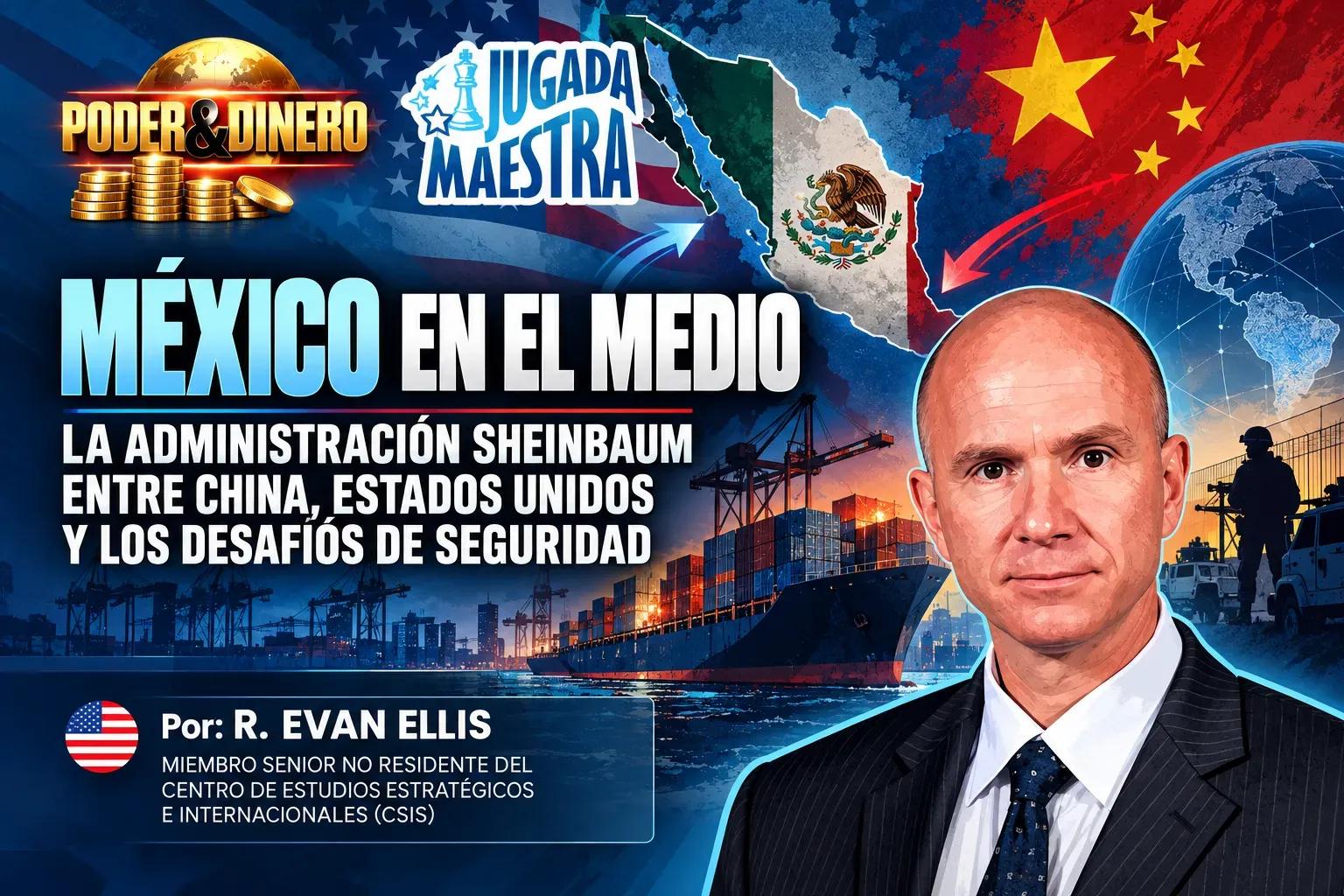
Although the conference examined how global transformations affect countries like Mexico and explored opportunities to increase cooperation—particularly with Europe—for me it inadvertently highlighted an important and ironic reality: Mexico may or may not be a “middle power,” but in the new geopolitics largely determined by Washington and Beijing, it finds itself “in the middle.”
The Mexican government strives to meet the demands of its northern neighbor regarding security, trade, and other issues. At the same time, it works, often with caution and discretion, to diversify its partnerships and demonstrate firmness to its own supporters. The Sheinbaum administration hopes that these actions will be effective without attracting too much attention or provoking the ire of Donald Trump's government.
The diplomatic dilemmas of Mexico
Participants generally agreed that it is unlikely that Sheinbaum's government will follow the inspiration of Canadian Prime Minister Carney and actively collaborate with other countries to achieve “strategic autonomy” between the United States and China.
One high-level participant argued that Mexico, during the presidencies of Andrés Manuel López Obrador (AMLO) and Sheinbaum, had practically renounced the independent activism in foreign policy that once characterized it.
Others discussed how a victory for Flávio Bolsonaro in the Brazilian presidential elections in October 2026 could further isolate Sheinbaum's government, turning it into the last major leftist government in the region. However, some pointed out that given the complex relationship between Sheinbaum and Brazil's current leftist president, Luiz Inácio Lula da Silva, a political change in Brazil might not be entirely negative for the Mexican president.
Still, a prominent figure at the meeting lamented that he had never seen Mexico so alone.
In matters of security, just like in foreign policy, the Sheinbaum administration also finds itself “in the middle.”
Her government adopted a more aggressive stance against criminal organizations than her predecessor, Andrés Manuel López Obrador. According to official figures, homicides decreased by more than 53% during Sheinbaum's administration, while kidnappings fell by 70% since 2019, although many of my Mexican colleagues expressed doubts about those numbers.
Mexico has also scored significant victories against criminal groups, including the operation in February 2026 that ended with the capture of the head of the Jalisco New Generation Cartel (CJNG), Nemesio Rubén Oseguera Cervantes, known as “El Mencho.”
The Mexican government extradited 178 criminals to the United States, including 92 through three mass transfers.
Despite these initiatives and cooperation with Washington, Sheinbaum's administration found itself in a difficult political position due to U.S. extradition requests for the sitting governor of Sinaloa, Rubén Rocha Moya, and other prominent figures linked to AMLO, Sheinbaum's political mentor and founder of the MORENA movement.
Sheinbaum's dilemma deepened when, after she refused to extradite Rocha Moya, he resumed his position and attempted for some time to continue serving as governor of Sinaloa.
The president's position became even more complicated when the U.S. government revoked the visa of Andy López Beltrán, son of former president AMLO, due to credible concerns about possible links to corruption and crime.
Sheinbaum must find a balance between cooperating with the United States on its central priority—combating criminal and terrorist groups in Mexico—and protecting her political mentor and the radical wing of MORENA. Within this sector, many now believe that the president has ceded too much in terms of sovereignty and national dignity by accommodating the demands of the Trump administration.
Finally, Mexico also remains “in the middle” in its trade relations with the United States and the People's Republic of China.
Not only does 83% of Mexican exports go to the United States, but Mexico is deeply integrated into the U.S. and North American economies through its supply chains.
For Sheinbaum’s government, preserving that access and economic integration, including achieving an agreement with Washington to renew the United States-Mexico-Canada Agreement (USMCA), is a national priority.
This priority helps explain Mexico’s decision in January 2026 to impose tariffs of up to 50% on certain imports from countries with which it does not have trade agreements. The measure sought to address a key concern of Washington: preventing Chinese companies from using Mexico as a platform for access to the U.S. market.
While Sheinbaum seeks to accommodate the demands of the Trump administration regarding China, it is difficult for Mexico to completely disrupt trade and investment from that country.
Chinese companies have a significant presence in Mexico, particularly in ports, telecommunications, the automotive industry, assembly, and distribution, among other sectors.
Between 2020 and 2025 alone, companies based in China invested approximately $11.6 billion in Mexico, although those investments drastically decreased amid uncertainty over the renewal of the USMCA.
Shortly before my visit, a Chinese consortium announced a significant investment of $930 million in an industrial complex in Tapachula, in southern Mexico, aimed at manufacturing electric vehicles, auto parts, and other products.
For Mexico, China complements relations with other Asian countries—such as Japan, South Korea, and India—and with the European Union, by providing alternative markets and sources of investment.
Preserving those options is particularly important given the unlikely but potentially very harmful possibility that the USMCA will expire at the end of the ten-year period that began on July 1, 2026. This concern intensified after the Trump administration announced it would not renew the treaty.
Beyond trade, China also maintains a limited but significant presence in military institutions in the region. At least two Chinese students were attending the Mexican Naval War College (CESNAV), one at the Army War College, and another at the National Defense College (CODENAL).
China has also long courted the Mexican space program. However, during my visit, I was pointed out that the People’s Republic of China had made little progress, largely because both the current government and the previous one allocated very few budgetary resources to that program.
These activities, although they may provide limited benefits to the Mexican Armed Forces and other institutions, allow Sheinbaum's government to demonstrate that it maintains a diversity of international relations. This is particularly important to sectors of MORENA and the public that believe her government is adopting an excessively subordinate attitude towards the United States.
Conclusion
I returned from Mexico deeply impressed by the enriching and thoughtful exchanges I had with colleagues and friends during the meeting on middle powers, as well as at the institutions of the Mexican Army and Navy that welcomed me for discussions during my visit.
The experience reinforced my conviction about the importance of cooperation between the United States and Mexico to ensure the security and prosperity of both countries.
In Mexico, Sheinbaum’s government continues to choose to strengthen its ties with the United States, rather than leveraging its other international relationships to build “strategic autonomy.”
However, the discussions held during the important meeting on middle powers reminded me that significant changes in American discourse and actions regarding alliances, international institutions, and other issues are provoking worrying—and sometimes regrettable—transformations in the perceptions and behaviors of numerous partners.
In the long term, these changes could severely damage the strategic position of the United States and its fundamental national interests.
With our Mexican neighbors, as well as with other friends, allies, and partners of the United States, it is more important than ever to act in ways that strengthen trust and foster the relationships upon which American security and prosperity depend.
Dr. Evan Ellis is a research professor of Latin American Studies at the U.S. Army War College’s Strategic Studies Institute. His work focuses on the region's relations with China and other actors outside the Western hemisphere.

Comments