The relationship between Mexico and China is undergoing a profound transformation, though not without tensions. Bilateral trade already exceeds $100 billion annually, and the logic of the relationship has changed: it is no longer just about trade, but about investment, productive relocalization, and industrial collaboration.
However, since January 2026, Mexico has applied tariffs ranging from 5% to 50% on Chinese imports across more than 1,400 tariff fractions—a measure that Beijing has labeled as protectionist and has warned of potential countermeasures.
In this complex context, China Chamber Mexico - a binational chamber led by Vicente Roqueñí, Senior Director of Government Relations and Public Policy for Latam at DiDi - positions itself as one of the central actors in this process, articulating the business ecosystem between both countries in sectors ranging from technology and automotive to logistics, energy, and infrastructure.
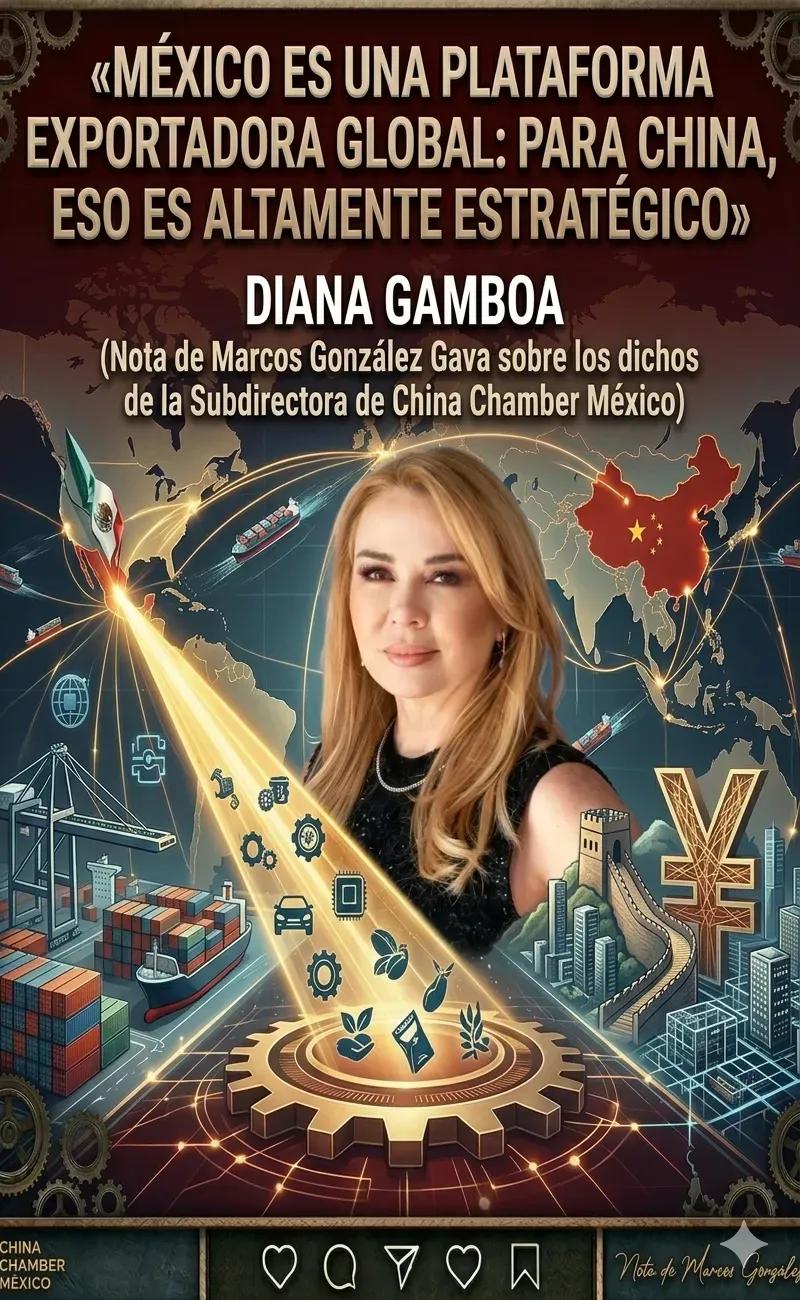
Diana Gamboa heads the sub-directorate of the institution, one of the most active voices in building this link. With a perspective that combines institutional pragmatism and long-term strategic vision, Gamboa carries out the daily work of "translating, connecting, and generating trust" between two business ecosystems that, according to her, have more complementarity than is often recognized. From signing agreements with global actors to coordinating Mexico's presence at international trade fairs in China, her agenda reflects the new stage of a relationship that is no longer measured solely in trade volume.
"We are in a moment of strategic redefinition," Gamboa asserts. "China is already Mexico's second-largest trading partner, but the relationship is transitioning from a purely commercial logic to one of investment, productive relocalization, and industrial collaboration. Today, the link is more sophisticated, more strategic, and with greater sectoral depth." ReporteAsia spoke with her about the recent milestones of the Chamber, the concrete opportunities at this moment, and the geopolitical tensions on the horizon.
An institutional turning point
One of the most significant moments for the Chamber in the last period was the signing of the Memorandum of Understanding with the Chinese Business Representation Chamber in Mexico (CREC) and the coordination of the Mexican pavilion at the China International Supply Chain Expo (CISCE), scheduled for June of this year in Beijing. For Gamboa, these events are not isolated occurrences but signals of a qualitative change in the bilateral relationship.
"This is an institutional turning point," she noted. "The signing of the MoU with CREC and the coordination of the Mexican pavilion at the CISCE reflect an unprecedented level of trust and maturity. What distinguishes this stage is the institutionalization of the business relationship, with formal mechanisms of cooperation and strategic presence on global platforms. Mexico is no longer a passive actor, but an active participant in the construction of global supply chains."
The opportunities of the moment
Beyond the institutional milestones, Gamboa identifies three major vectors of opportunity that define the present of the relationship. The first is smart nearshoring: Chinese companies using Mexico as an export platform to North America. The second is electromobility and technology, with investments in electric cars, batteries, semiconductors, and telecommunications. The third is agroindustry and food, driven by the growing Chinese demand for added-value Mexican products.
"Mexico has the potential to insert itself into global value chains with greater sophistication," she stated. And she also warned about the challenges that this process faces: "The challenge is not just to trade more, but to do it better and with greater added value. There are regulatory barriers, normative differences, geopolitical perceptions due to the USMCA, and a lack of mutual knowledge between companies."
The challenge of the trade imbalance
Trade between Mexico and China exceeds $100 billion annually, but the balance is structurally deficit for Mexico—an asymmetry that President Roqueñí openly acknowledges when he speaks of building a relationship of "strategic allies for shared prosperity." In light of this fact, Gamboa is precise about what the response from organized private sector should be.
"We are focused on three lines: the active promotion of Mexican exports to China, technical support to meet Chinese standards, and the generation of concrete business opportunities through fairs, missions, and platforms like the CISCE," she explained. And she was emphatic in marking the strategic orientation: "The goal is not to stop imports but to strengthen Mexico's exporting capacity."
Huawei on the board and the technological bet
The appointment of Eric Liu from Huawei as vice president of the Chamber is one of the key elements that defines the profile of the institution at this moment.
This is not a minor detail: Huawei has been operating in Mexico for over two decades, where more than 80% of phone calls are made through a company device. But its presence goes far beyond phones: the company has already implemented 2 GW in solar installations and 175 MWh in energy storage projects in the country, and plans to double its network of charging stations for electric vehicles with a goal of 40 operational charging points by the end of 2026. For Gamboa, this inclusion in the board has a meaning that goes beyond symbolic representation.
"Huawei's presence in the board significantly strengthens the profile of the Chamber," she asserted: "it implies incorporating technological vision, global experience, and capacity for innovation. It also reflects the trust of leading companies in the Chamber as a serious and high-level institutional platform."
Air connectivity: expanding what already exists
The Chamber recently led a meeting with representatives of Air China to explore the expansion of air connectivity between both countries. While there are already direct flights between Mexico and China, the current frequency and capacity remain insufficient for the volume of business exchange that the bilateral relationship demands. Gamboa places the issue in a perspective of structural competitiveness.
"A direct flight is not just connectivity: it is competitiveness. An additional direct flight from Air China would reduce logistical times, facilitate business exchange, and boost tourism and investment," she stated.
"From the Chamber, we support any initiative that favors commercial ties between both countries. Any project in this regard is a strategic priority for the bilateral relationship," she added.
The USMCA and the geopolitical tension with Washington
The arrival of Chinese companies in Mexico—especially in the electric automotive sector—is redefining the industrial map of the country and generating tensions with Washington regarding compliance with the USMCA. Gamboa is direct on this matter and defends the compatibility of both relationships.
"Mexico has a unique position: it is a partner of North America but also a relevant actor for China. These are not exclusive relationships, but complementary if managed correctly," she asserted. And she specified the criterion that guides the work of the Chamber: "We promote investments that comply with the regulatory framework of the USMCA and that generate local value, jobs, and technology transfer."
The working committees that shape the agenda
Beyond institutional representation, the Chamber orchestrates its work through thematic committees that translate strategic priorities into concrete proposals. In this regard, Gamboa identifies which ones currently concentrate the most activity.
"Today, the Legal, Human Talent and Migration, Logistics, and Electromobility and Sustainability committees stand out. These committees are building concrete agendas that include regulatory proposals, investment projects, and sectoral strategies," she detailed.
Mexico facing Brazil: the advantage of being a platform
In the competition for capturing investment and strategic Chinese attention in Latin America, the comparison with Brazil is inevitable. Gamboa accepts it and responds precisely, appealing to an argument she considers definitive for the Chinese perspective.
"Mexico has three key advantages: preferential access to the North American market via USMCA, strategic geographical location, and a consolidated industrial base," she enumerated. And she concluded: "Brazil is a huge market, but Mexico is a global exporting platform. For China, that is highly strategic."
Perceptions to improve between both countries
At the end of the conversation, Gamboa offers a personal reflection on the main obstacle that the Mexico-China relationship faces regarding perceptions, drawing from the daily experience of managing this link from within.
For her, "the greatest misunderstanding is perception. In Mexico, China is sometimes seen only as a competitor; in China, the strategic potential of Mexico is not always recognized."
"The reality is that there is enormous complementarity. My role, from the sub-directorate of the Chamber, is precisely to translate, connect, and generate trust between both ecosystems," she concluded.
Note from Marcos González Gava, co-founder of Reporte Asia and specialist in cultural and business-related matters with the People's Republic of China.

Comments