The Middle East is going through a scenario of increasing instability marked by the succession of conflicts, with the participation of the main international powers. The war between Israel and Iran, the intervention of the United States, and the extension of tensions to various Gulf countries have once again highlighted the fragility of the region. In parallel, attacks on strategic infrastructure and threats to maritime routes have heightened the perception of vulnerability that already existed.
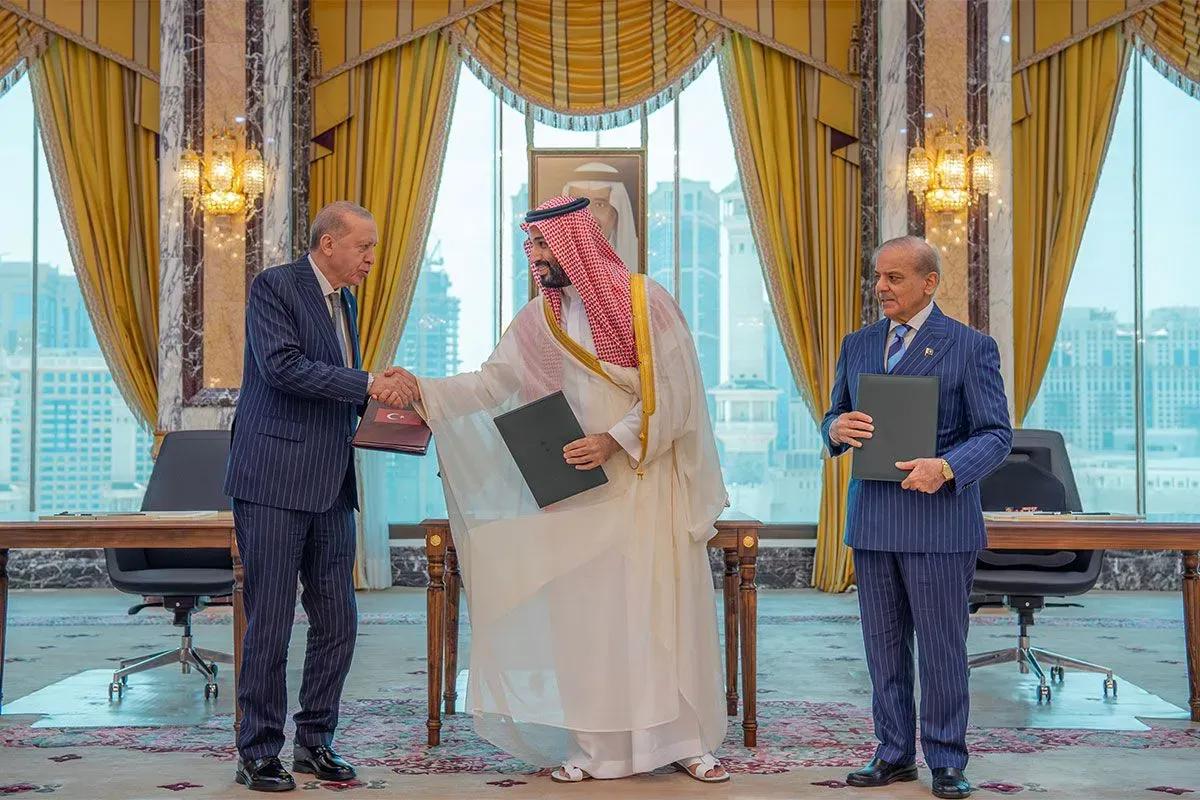
In this context, at the beginning of the month, Saudi Arabia, Turkey, and Pakistan announced a new cooperation mechanism in defense with the signing of the "Joint Defense Agreement of Mecca," through which a potential new system of collective defense is established, considering an armed attack against any of the three member countries as an attack on all three, a provision that recalls the famous Article 5 of the NATO founding treaty.
The importance of the agreement does not only lie in its content but also in the timing of its signing. The region is undergoing one of the most unstable periods in recent years, causing the security of regional states to once again take center stage and making it vital to have greater capacities to respond to a potential escalation.
A response to an increasingly unstable regional scenario
The escalation of tension that the Middle East has faced in recent years, due to a succession of conflicts and crises, has demonstrated the difficulty of containing the consequences of confrontations within the borders of the involved countries.
In this context, the Joint Defense Agreement of Mecca acquires particular importance, as the creation of a collective defense mechanism allows its members to increase their deterrence capacity and establish a coordinated response to possible external aggression.
It is important to clarify that, although the agreement does not identify a specific enemy, and the governments of the three signing countries have insisted that it is a defensive agreement, it is difficult to analyze its emergence without considering the situation of Iran as a threat to regional security. Additionally, it should be noted that part of Saudi Arabia's stability is directly linked to the stability of the Gulf, that Turkey has strategic interests in the Middle East, and that Pakistan maintains a complex relationship with Tehran. Thus, it is understandable that this agreement represents a response to a regional scenario of prevailing uncertainty rather than addressing a specific threat.
Three countries, three capacities
One of the main characteristics of the agreement is the complementarity of the capacities provided by its members.
Firstly, Saudi Arabia possesses significant economic capacity and one of the largest defense budgets in the entire region, reaching approximately US$60 billion, which is 18% of its budget for 2026. In recent years, it has promoted a policy aimed at developing its own military industry in order to progressively reduce its dependence on external suppliers.
Secondly, Turkey has significant conventional military capability and an expanding defense industry, focusing on the development of drones, military vehicles, and electronic systems. This development has made Ankara a player of increasing relevance within the international defense market. It is also important to consider the significance of Turkey's status as a NATO member.
On its part, Pakistan not only boasts one of the most important armed forces in Asia but also brings a different dimension: it has nuclear capabilities, which adds a strategic dimension related to deterrence to the agreement.
In this way, each member of the association brings different resources: economic capacity and energy weight from Saudi Arabia, industrial and technological capabilities from Turkey, and nuclear deterrence capability from Pakistan.
The collective defense clause established in the agreement quickly led to comparisons with NATO. While the principle that an aggression against one of the members constitutes an aggression against all presents similarities with NATO's Article 5, the Mecca agreement still lacks the necessary institutional structure and military command and coordination level to carry out such responses. For this reason, it is more appropriate to understand it, for the moment, as an initial mechanism of strategic coordination among regional powers, with potential capabilities to evolve into a collective security system in the future.
A search for the future
This cooperation could extend to areas such as the production and development of armaments, technological transfer, intelligence, and military exercises. If realized, these mechanisms could progressively increase the capacity of the three countries to act in a coordinated manner.
Moreover, this agreement reflects a trend within the international system: the search for higher levels of strategic autonomy by regional powers. However, this agreement does not necessarily imply the abandonment of existing alliances; rather, it can be interpreted as an attempt to broaden the margin of maneuver, incorporating a scenario where their will holds more weight than in the current landscape.
The possibility that the Mecca Agreement may add new members will be one of the main elements to observe over the coming months. An eventual expansion would considerably modify its scope but would also increase the difficulties of coordinating interests.
The central question will be whether the agreement can surpass its political dimension and become an effective structure for military cooperation. Beyond questioning whether an "Islamic NATO" has been born, the question will be whether the Middle East is beginning to build its own security architecture in a scenario where neither traditional alliances nor conventional capabilities seem sufficient as a response to increasingly complex threats.

Comments