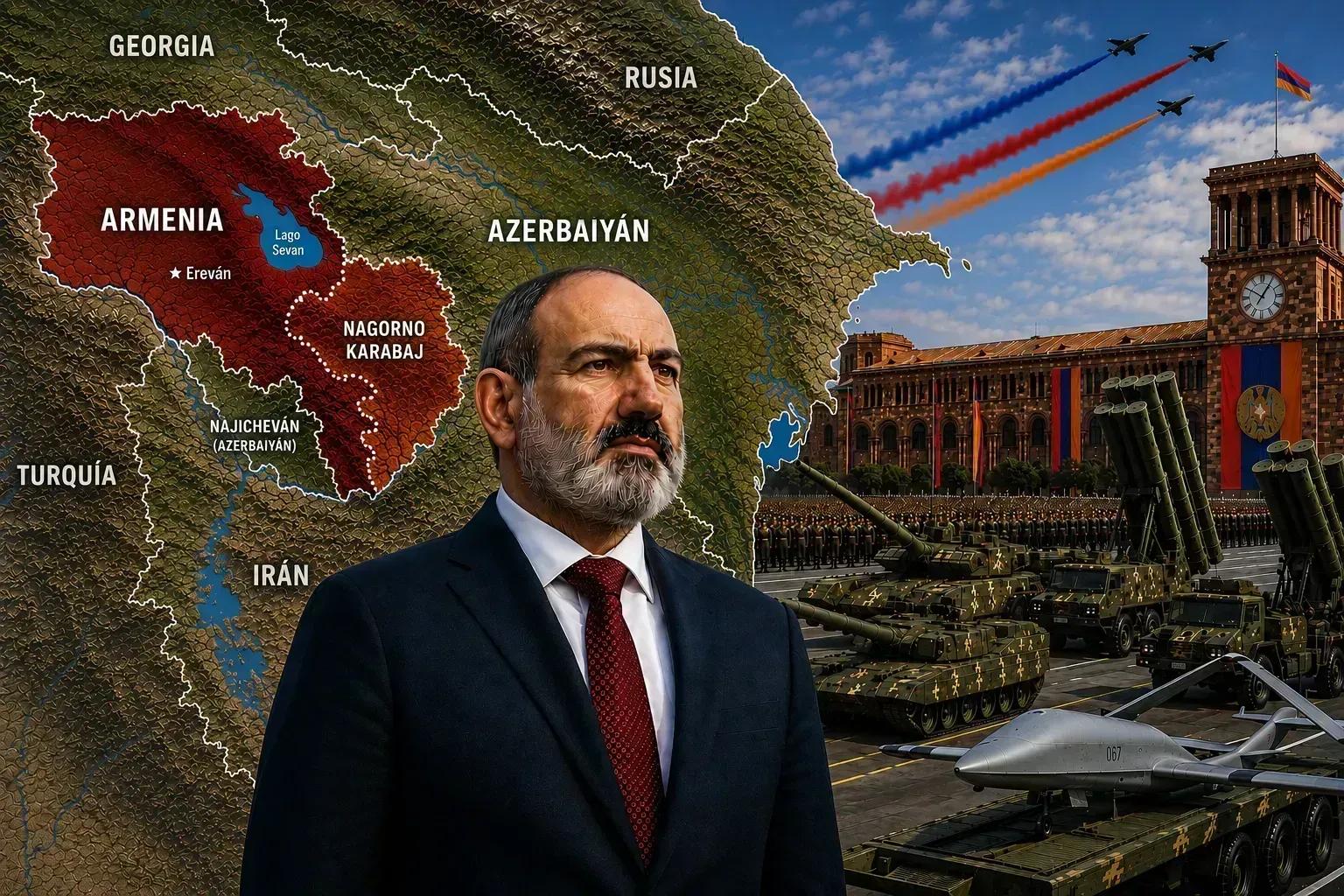
The fall of the Republic of Nagorno-Karabakh or Artsakh in September 2023 marked much more than the end of an Armenian entity with thousands of years of historical and cultural development. It represented the collapse of the geopolitical balance that emerged after the First Nagorno-Karabakh War (1988-1994) –in the context of the disintegration of the Soviet Union– and exposed an uncomfortable reality for Yerevan: the security system that has guaranteed Russia for decades no longer offers real certainties for Armenia. The military defeat against Azerbaijan, the ethnic cleansing of more than 100,000 Armenians from Nagorno-Karabakh, and the increasing diplomatic tensions with Moscow accelerated a strategic transformation that today redefines Armenian foreign policy, state identity, and regional positioning.
The “new Armenia” driven by Prime Minister Nikol Pashinyan no longer seems to be structured around the cause of Nagorno-Karabakh, the post-Soviet legacy, or the historical dependence on the Kremlin. On the contrary, it seeks to move towards a pragmatic model, oriented towards the West and with an increasing approach to Europe. However, this transition occurs from a position of state and geopolitical weakness, military vulnerability, and deep regional uncertainty, especially in the face of the intentions of a strengthened Azerbaijan.
The Armenian defeat and the new regional balance
The Armenian defeat cannot be understood solely as a temporary military failure that occurred during the 44 days of fighting between September and November 2020. The collapse was the result of a structural deterioration of the regional balance accumulated over decades.
Azerbaijan systematically modified the correlation of forces in its favor. This was possible thanks to substantial energy revenues –mainly from the export of oil and natural gas–, the modernization of its Armed Forces through a sustained rearmament strategy, and intense diplomatic work both in its bilateral relations and in multilateral forums. While Armenia acted for decades under the premise that the military balance arising from the victory in the First War would remain relatively stable, Baku directed its efforts towards reversing the status quo established after 1994.
The role of allies such as Turkey and Israel was decisive in that transformation. Ankara consolidated a deep strategic alliance with Azerbaijan under the concept of “one nation, two states”, providing significant political, diplomatic, and military support. The 2020 war highlighted the impact of this cooperation through the massive use of Bayraktar TB-2 combat drones, including assistance and strategic coordination. Israel, for its part, became one of the main suppliers of advanced weaponry for Baku, including drones, precision systems, and technological capabilities that profoundly altered the operational balance on the ground, consolidating the dynamic of “oil for weapons”.
The “44-day War” exposed the doctrinal collapse of Armenia in the face of new forms of combat based on drones, electronic warfare, and technological superiority. The ceasefire agreement sponsored by Russia temporarily “froze” the conflict but did not resolve its structural causes, despite the significant Azerbaijani conquests and a territorially deteriorated Republic of Nagorno-Karabakh, which continued to operate briefly despite its limitations marked by the post-war period.
The blockade of the Lachin or Berdzor corridor –the only ground connection between Nagorno-Karabakh and the Republic of Armenia– carried out by the Armed Forces of Azerbaijan since December 2022 and the offensive launched on the capital Stepanakert on September 19, 2023 ultimately confirmed that the regional balance had decisively tilted.
The subsequent mass displacement of the Armenian population from Nagorno-Karabakh also left a profoundly traumatic image for Armenians: the disappearance of the Armenian presence and heritage in a territory that had occupied a central place in political and national identity for decades. The events of 2023 reactivated in the Armenian collective memory historical traumas deeply linked to the experience of the Genocide suffered between 1915 and 1923 at the hands of the Ottoman Empire –continued by the nascent Republic of Turkey– and the perception of vulnerability in the face of pan-Turkism.
The end of the Russian strategic umbrella
The fall of Nagorno-Karabakh represented a fracture in the historical bond between Armenia and Russia. Since the ceasefire of 1994 sponsored by the Kremlin, the alliance with Moscow was upheld by a relatively clear logic: Russia guaranteed strategic security in exchange for political and military influence in the South Caucasus. This premise was severely damaged after 2020 and practically destroyed after 2023.
The “Russian peacekeeping forces” deployed in Nagorno-Karabakh as part of the tripartite agreement of November 2020 proved incapable of preventing both the blockade of the Lachin corridor and the final Azerbaijani offensive. For large sectors of Armenian society, Moscow passively observed the definitive dismantling of the Armenian enclave.
The military operation in Ukraine initiated in February 2022 also changed the Kremlin's strategic priorities. Russia no longer enjoys the same political, economic, and military margin to sustain simultaneously multiple theaters of influence in different regions of the post-Soviet space. However, reducing the deterioration of the Russian-Armenian relationship solely to the Ukrainian factor would be insufficient. Vladimir Putin also perceives Pashinyan as a risk to Yerevan's alignment with Russian interests.
In recent years, Armenia has deepened its approach towards the West. The recent holding of the European Political Community summit in Yerevan, with the presence of significant leaders from the European Union, and even Ukrainian President Volodymyr Zelenskyy, represented a strong political signal to Moscow. At the same time, Pashinyan increased his criticisms of the Collective Security Treaty Organization (CSTO), publicly questioned Russian inaction in the face of Azerbaijani aggressive actions, and pursued the strengthening of ties with France, the United States, and the European Union.
The Kremlin responded with increasingly explicit warnings regarding the economic and energy consequences Armenia could face if it moves towards deeper integration with Europe. Because Armenia’s dependency on Russia continues to be a structural reality. Moscow maintains enormous influence over key sectors of the Armenian economy, especially in areas related to energy, investments, and trade.
Unlike other processes of "post-Soviet Europeanization," Armenia is attempting to approach the West without sufficient geographical, energy, or economic autonomy to abruptly break with Russia. This contradiction permeates a large part of the foreign policy currently undertaken by Yerevan.
In this sense, Armenia is not an isolated case within the Caucasus. Its neighbor Georgia has faced strong internal tensions for several years regarding its approach to the West, European integration –currently frozen under Prime Minister Irakli Kobakhidze's administration– and Russian influence –which since 2008 has supported South Ossetia and Abkhazia, two separatist entities that have operated for three decades within Georgian territory– reflecting a broader regional dispute over the geopolitical future of the post-Soviet space.
Pashinyan and the redefinition of the Armenian state
Beyond foreign policy, the defeat in Nagorno-Karabakh accelerated a symbolic, identity, and political transformation. Pashinyan's administration seems to gradually promote a new national narrative that is less centered on the imagery of “Armenia as a fortress” –born after the heroic victory of 1994– and more focused on the preservation of the internationally recognized sovereign territory.
One of the most significant recent gestures was the change of the emblem of the Ministry of Defense, which came to explicitly represent the official territory of the Republic of Armenia with its silhouette, definitively leaving behind any symbolic reference to Nagorno-Karabakh. The political message behind this modification is evident: the Armenian state began to visually and doctrinally redefine the limits of its national project.
Additionally, there are other symbolic changes being driven in the military realm, such as the replacement of the traditional shout “hurrah” in Russian with the Armenian term “getsé”, in an attempt to strengthen a state and military identity less associated with the post-Soviet space.
The military parade held on May 28 as part of Republic Day –a date that commemorates the independence of the First Republic of Armenia in 1918– also responded to this logic of sovereign and identity reaffirmation. In the midst of the national trauma caused by the loss of a historical territory, the government sought to convey an image of reconstruction of military capabilities, historical continuity of statehood, and reorganization of the Armed Forces, including the demonstration of weapon systems acquired from China, India, and France.
Pashinyan's Armenia seems to be attempting a highly complex transition: abandoning the political logic of permanent conflict over Nagorno-Karabakh –something that the prime minister himself described as a “historical trap”– to prioritize the survival and statehood of the Republic of Armenia within its internationally recognized borders.
Strategically, Armenia has shifted from discussing the self-determination of a territory legally separate from Armenia to discussing the geopolitical and territorial sustainability of its own sovereign state.
This transformation also permeates Armenian internal politics. In light of the upcoming parliamentary elections scheduled for June 7, Pashinyan seeks to consolidate a “realist” narrative based on the need to adapt to the new regional balance, while the opposition accuses him of having betrayed and surrendered Nagorno-Karabakh, in addition to promoting an agenda functional to Western interests that threatens national identity, historical ties with Russia, and even the traditional role of the Armenian Apostolic Church.
However, the political dispute presents a deep contradiction. Many of the opposition sectors that today exclusively blame Pashinyan for the defeat were linked to the old republican governments and oligarchic structures associated with the old post-Soviet order between 1991 and 2018. It was precisely those administrations –such as those of Robert Kocharyan and Serzh Sargsyan– that maintained a military, political, and diplomatic status quo that ultimately left Armenia in a position of increasing regional isolation, structural dependence on Moscow, and lag in military modernization.
Pashinyan’s re-election in 2021, just months after the defeat in the 2020 war, evidenced that a significant portion of Armenian society does not hold solely its government accountable for the strategic collapse but also the former elites who administered the country for decades. For large urban and young sectors, the old opposition represents a sort of “ghost train” linked to corruption, inertia, and post-Soviet dependence.
The approach towards Europe is also not solely a response to geopolitical calculations. Particularly among the new urban generations –and as a result of the globalizing impact of recent decades– there is a growing cultural identification with the West and a desire to leave behind decades of political and psychological dependency on Russia. In this context, the project of a more integrated Armenia with Europe appears to many as an alternative for modernization, institutional stability, and international openness.
However, the shift driven by Pashinyan continues to develop amid strong tensions, criticism from nationalist sectors, and a society still deeply affected by the defeat, the collapse of Nagorno-Karabakh, and the persistent perception of military threat from Azerbaijan.
The West, corridors, and a conditioned peace
The increasing participation of the United States and Europe in the South Caucasus –in light of Russia's neglect– is not solely a response to diplomatic objectives. Behind the peace and normalization efforts among Armenia, Azerbaijan, and Turkey there is also a strong geopolitical logic linked to trade corridors, energy, Eurasian connectivity, and the expansion of Western influence against regional powers.
Southern Armenia, particularly the marz of Syunik, has become one of the most sensitive spaces...
s of the entire region. There, the interests of Azerbaijan, Turkey, Russia, Iran, Europe, and the United States converge simultaneously..Connectivity projects recently driven from Washington, such as the Trump Route for International Peace & Prosperity (TRIPP), aim to consolidate new regional routes that reduce dependence on Russia and strengthen integration between Europe and Central Asia. Regardless of the final viability of the initiative or the political and security obstacles it still faces, the project reflects a broader trend: the growing U.S. interest in actively participating in shaping the new geopolitical order of the South Caucasus.
In the Western view, the South Caucasus has ceased to be merely a space of frozen conflicts managed by Moscow, transforming into a strategic corridor for infrastructure, trade, and energy. However, within Armenia, many of these projects are perceived less as a “negotiated peace” and more as an institutionalization of defeat.
The structural weakness of Southern Armenia, infrastructure limitations, and geographic vulnerability further deepen fears about potential future pressures related to corridors and territorial sovereignty.
The Aliyev Problem
One of the main obstacles to genuinely stable peace remains the persistence of offensive and maximalist rhetoric from Baku despite diplomatic efforts and the narrative of “normalization of relations.”
Azerbaijan no longer negotiates from a need to reclaim territories but from a position of victory that seeks to shape the new post-war regional order. In this framework, President Ilham Aliyev continues to use historical and political references to the so-called “Western Azerbaijan,” including explicit mentions of Armenian sovereign territories like Sevan and particularly the strategic southern region of Syunik.
In addition, Aliyev insists that Armenia amend its Constitution as a precondition for signing a peace treaty, arguing that certain historical and legal references contain issues such as the unification between Armenia and Nagorno-Karabakh –which never happened due to the fragility in terms of international law of the resolution voted by the Artsakh people and the maintenance of the Republic as a de facto independent state without recognition–.
Although Baku formally maintains its commitment to peace processes, the maintenance of this discourse generates deep doubts within Armenia, the diaspora, and part of the international community regarding Azerbaijan's true strategic intentions. The marked military asymmetry between the two countries also reinforces the perception of Armenian vulnerability in the face of a potential further escalation.
Yerevan's concerns are not merely discursive. Since 2021 and up to now, Azerbaijan maintains military occupations over approximately 215 km² of sovereign Armenian territory in the border regions of Syunik and Gegharkunik, consolidating a dynamic of gradual pressure based on small incursions and establishing positions over sensitive areas.
This is compounded by disputes related to strategic enclaves such as the case of Tigranashen, claimed by Baku and located on one of the main routes connecting the south of the country with Yerevan. This issue is not minor: Armenia faces increasing questions about the logistical and defensive sustainability of a south already vulnerable from a geographic and infrastructural perspective.
In geopolitical terms, Southern Armenia has transformed into a space where:
- the aspirations for territorial connectivity between Turkey, the Azerbaijani enclave of Nakhchivan, and Azerbaijan converge;
- the interests of the U.S. and Europe related to Eurasian corridors coexist;
- the need for Iran to avoid border alterations is present;
- and the gradual loss of Russia's arbitration capacity in the South Caucasus is evident.
The central problem is that wars rarely end definitively. Agreements usually hold as long as the parties perceive stability in the balance of power and high costs in the face of a potential escalation. In the South Caucasus, something different happens: Azerbaijan is convinced that the regional correlation continues to shift in its favor.
In this context, one of the main uncertainties is to determine the extent to which the United States and Europe are truly willing to act as deterrent factors against a potential military escalation in Southern Armenia. Washington promotes connectivity and regional stabilization projects like the TRIPP, whose success necessarily depends on avoiding a new war in the South Caucasus. However, it is still unclear whether Western involvement would reach sufficient levels to serve as a true “security umbrella” against future Azerbaijani pressures.
The big strategic question remains open: whether the current stage represents the beginning of lasting stability on the way to a peace treaty or simply a tactical pause within a region where the balance of power continues to change.
In conclusion, Armenia is likely undergoing the most profound strategic transformation since its last independence in 1991. The defeat in Nagorno-Karabakh not only altered borders and military balances: it also shattered historical certainties about national security, Armenian political identity, and Russia's role as a guarantor of regional security.
In the face of this scenario, Nikol Pashinyan is pushing for a gradual redefinition of the Armenian state oriented towards a more pragmatic foreign policy, a closer approach to the West, and an increasing distancing from Moscow. However, this transition occurs amidst strong regional asymmetries, threatened statehood, economic dependence on Russia, geographical conditioning, and an still unstable geopolitical balance.
The “new Armenia” seeks to adapt to the new order that has emerged after the defeat. But the big question remains open: whether the peace currently promoted in the South Caucasus truly represents a lasting stabilization or simply a strategic pause within a region where the balance of power continues to change.

Comments