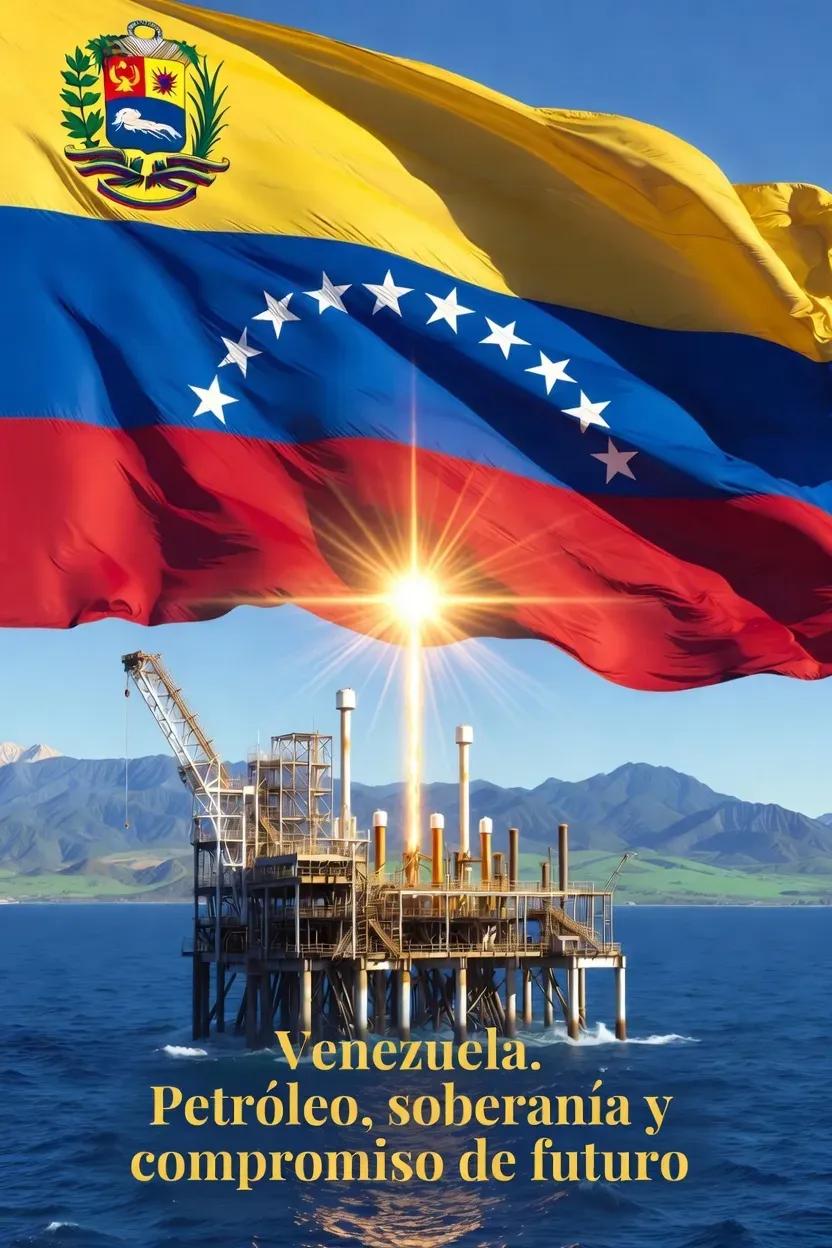
Venezuela has built much of its contemporary history on an unquestionable strategic reality: we are an energy nation. Our country has one of the largest hydrocarbon reserves on the planet, a natural wealth that has profoundly marked our economy, our politics, and our international projection.
But that wealth is not simply an economic advantage. It is, above all, a historical responsibility.
Venezuelan oil represents an instrument of sovereignty. Since the nationalization of the industry in 1976 and the consolidation of the state company, a fundamental principle was established: the resources of the subsoil belong to the Nation and must serve the integral development of the country. Each barrel produced must translate into tangible progress for Venezuelans: infrastructure, education, health, decent employment, and social welfare.
However, recent history shows that possessing abundant natural resources does not automatically guarantee prosperity. The sustained decline in production, the deterioration of energy infrastructure, management errors, and the complex dynamics of the international system have limited the full exploitation of Venezuela's oil potential.
This reality demands profound national reflection.
Venezuela needs to regain a strategic vision of its energy industry. This implies adopting a new oil ethic based on clear principles: institutional transparency, operational efficiency, long-term planning, environmental respect, and understanding oil as a lever for economic diversification.
Oil can no longer be seen solely as a source of immediate income. It must become an instrument of productive transformation, technological modernization, and strengthening of national energy sovereignty.
The country needs to open a serious, technical, and patriotic debate about the future of its oil industry.
A debate that addresses fundamental questions:
How to recover production sustainably.
How to attract investments under clear rules that respect national sovereignty.
How to strengthen the operational capacity of the state-owned company and its workers.
How to ensure that every oil income is managed with strategic responsibility and future vision.
This debate must not be dominated by partisan interests or fleeting visions. It should be guided exclusively by a superior principle: the national interest of Venezuela.
As a Venezuelan, as a professional trained in the energy sector, and as a citizen deeply committed to the fate of my country, I believe that remaining silent in the face of these challenges would be a way of renouncing that historical responsibility.
Therefore, I publicly assume the commitment to actively participate in the national debate about the oil future of Venezuela.
I will do so with respect, firmness, and a deep sense of responsibility.
I will contribute my experience, my reflections, and my proposals with the sole purpose of helping to make our oil industry a driver of economic growth, institutional stability, and social justice once again.
Venezuela has the resources, human talent, and historical capacity to recover its energy industry.
What is required now is vision, responsibility, and national commitment.
If we manage to correctly direct our energy wealth, Venezuelan oil can once again be not only a source of income but an instrument of national reconstruction and hope for future generations.
That is the commitment I assume today before the country.
About the author
Wilmer Ruperti is a Venezuelan businessman linked for decades to the maritime and energy sector. Through his operations in maritime transport and oil logistics, he has participated in key moments of the Venezuelan energy industry, particularly during years of major tension in the national oil sector. His business trajectory has been associated with the international trade of hydrocarbons and the transport of crude and derivatives. Ruperti has publicly maintained the strategic importance of oil as an instrument of national sovereignty and economic development for Venezuela, actively participating in the debate about the country's energy future.

Comments