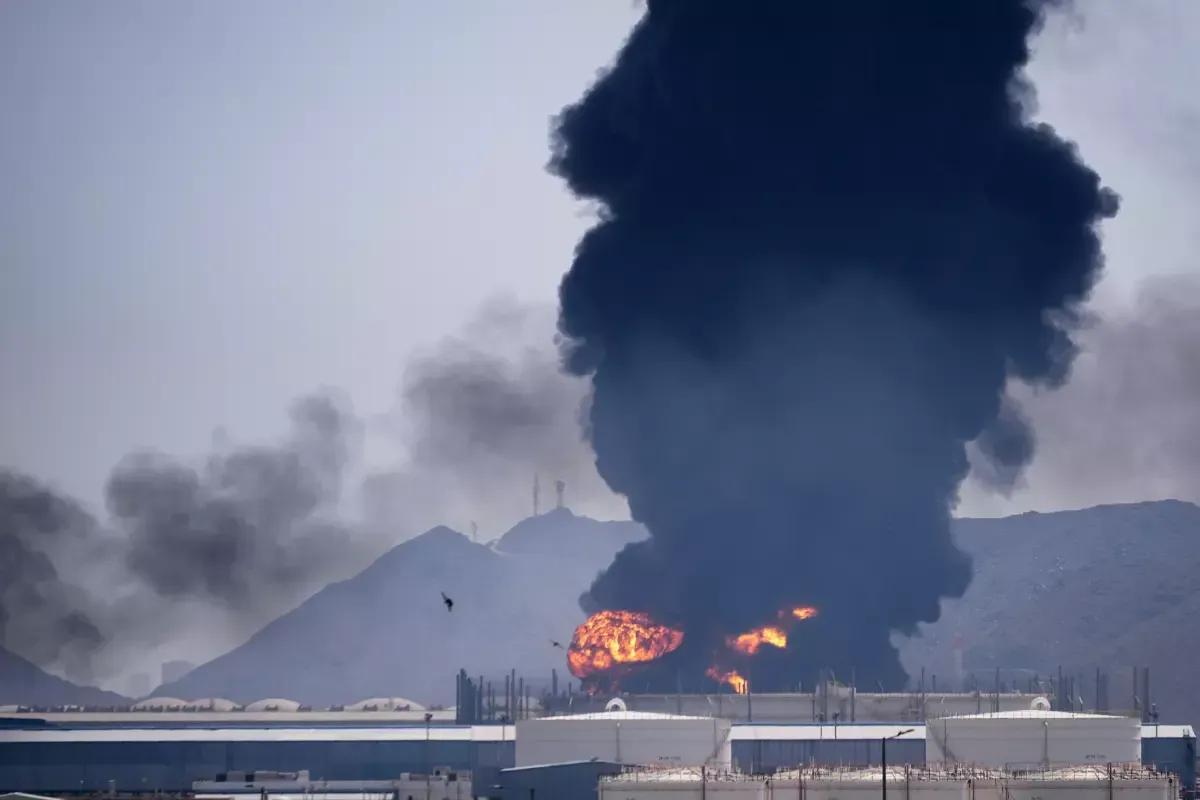
One month after the military escalation in the Middle East, following the bombings by the United States and Israel in Iran, a complex situation is reflected where the official narrative of resistance coexists with clear signs of internal wear, international pressure, and growing uncertainty in the Middle East. The conflict, far from being limited to a bilateral confrontation, has acquired a multi-level dynamic where military actions, strategic deterrence, and proxy warfare set the pace of events.
The Pentagon is preparing for weeks of prolonged ground operations in Iran, with a total of 3,500 infantry soldiers and US Marines arriving in the Middle East for what could become a new and dangerous phase of war, following the decision to escalate the conflict by US President Donald Trump. This could consist of a possible ground operation that would not become a large-scale invasion but rather a set of joint incursions between special forces and conventional infantry troops, translating into a mission that could expose US personnel to various threats, such as Iranian drones and missiles, ground fire, and improvised explosive devices. The White House confirmed that these operations will begin next Wednesday, April 1, with the deployment in the Middle East of a combat brigade and an airborne division, a movement that involves an operation of between 1,000 and 2,000 military personnel.
Following the announcements from the United States, Iran threatened to attack the American aircraft carrier USS Abraham Lincoln if it comes within shooting range, declaring that the Gulf of Oman and the Strait of Hormuz are under Iranian control. This was conceived by the Iranian navy after the sinking of the Dena ship, an Iranian frigate sunk on March 4 by US forces, and this warning is made to notify that Iranian forces are precisely and in real-time monitoring all movements of the US aircraft carrier, currently deployed in the Arabian Sea. Moreover, the Iranian Revolutionary Guard stated that it would consider US and Israeli universities in the Middle East as military targets, after accusing Tel Aviv and Washington of attacking Iranian educational institutions.
Another important point to highlight is that for the first time the Houthi rebels are being involved in the conflict, but this time by announcing a second attack against Israel. The Houthi rebels from Yemen announced that they would enter the Middle East war in support of their ally Iran, and their support translates into a second missile attack against Israel. The rebels had already regularly attacked Israel between 2023 and 2025 in support of Hamas during the war in Gaza. The intervention of this militia threatens to disrupt navigation in the Red Sea, an alternative for some Gulf oil monarchies to the Strait of Hormuz, blocked by Iranian ships; the Red Sea is becoming the key point in this new war, as Saudi Arabia has redirected a good portion of its oil exports to the port of Yanbu, in the Red Sea, to avoid the Strait of Hormuz.
In the context of diplomacy, the United States insists that the outcome is near, and President Donald Trump claims that his forces have dismantled the Iranian military apparatus, so the White House awaits Tehran's response to a fifteen-point peace plan that could resolve the entire conflict. Additionally, it is worth noting the role of Pakistan, which has acted as an intermediary between both sides, will host in its capital, Islamabad, the foreign ministers of Saudi Arabia, Turkey, and Egypt to address the crisis, aiming to make mediation efforts to stop the aggression against the Islamic Republic.
The international community has reacted in disparate ways because on one hand, Western powers have strengthened sanctions and expressed their concern over the escalation, while on the other hand, the role of multilateral organizations is seen regarding warnings about the humanitarian consequences of a prolonged conflict, albeit with limited mediation capabilities in the face of the current geopolitical dynamics.
Thirty days into the conflict, the Middle East finds itself at a critical point because no actor seems willing to back down, but all are trying to avoid a total war. The result is an unstable balance with limited attacks, calibrated responses, and a constant threat of escalation showcasing a geopolitical board where the United States, Iran, Israel, and now the Houthis not only dispute power but can also define the immediate future of the Middle East. The regional balance is fragile; due to the prolongation of tension, it becomes more likely that a miscalculation could turn into a contained war in an open conflict with unpredictable consequences.

Comments