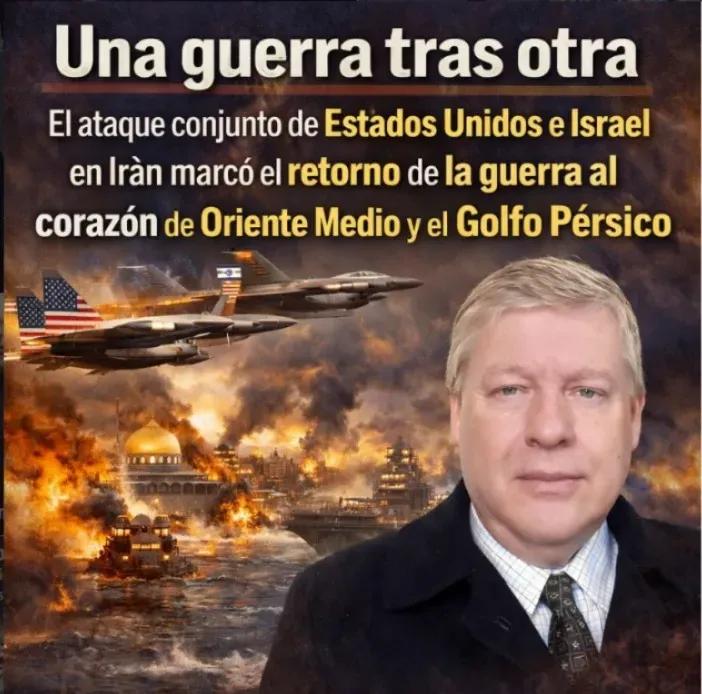
The war quickly returned to the sensitive plate of the Middle East/Persian Gulf. Eight months after the so-called "12-day war," the joint preventive attack Israeli-American on Iran occurred, whose greatest impact was the bombing or precision violence that claimed the life of the Iranian supreme leader. The Iranian counterattack on Israel and American bases located in the Persian Gulf petromonarchies was swift and caused damage. But the greatest detriments occurred when Iran attacked the energy infrastructure of the Gulf countries.
Tehran went even further and achieved the partial closure of the hyper-strategic Strait of Hormuz, a global selective where the "three Gs" of this confrontation converge: geopolitics, geo-economics, and geo-energy. Meanwhile, attacks from Lebanon on populations in northern Israel by the pro-Iranian Islamic group Hezbollah reignited the war between both actors.
Very close, in Syria, the state of fission that the country was in until the fall of Bashar al-Assad has changed, but hotspots remain, sectarian violence persists, and forces loyal to the fallen Alawite regime struggle to control territories. In this context, the situation between Israel and Syria remains tense and has deteriorated further as a consequence of the Israeli advance in southern Syria.
While the Middle East/Persian Gulf was sinking once again into a great bonfire, in the plate or fragmentation belt of Eastern Europe, Russians and Ukrainians were entering their fifth year of war, with no possibility of reaching a ceasefire. Judging by some statements from their military commanders, Russia not only intends to assert its territorial control in the Donbas, but also to extend it to the port and industrial center of Odessa, thereby achieving the economic strangulation of Ukraine.
Far from there, in that strategic ghetto that is part of Africa, total war in Sudan between the national army and the paramilitary group Rapid Support Forces for control of power and strategic assets has resulted in a greater humanitarian crisis and a displacement of millions of people, especially in Darfur.The confrontation in Sudan could inflame the situation in the selective spot of the Horn of Africa where Ethiopia and Eritrea are experiencing a serious crisis centered on geopolitics, as Eritrea fears that the Ethiopian regime seeks to regain the maritime ports it controlled until 1993, when Eritrea gained its independence.
In western Africa, jihadist terrorism keeps Mali and Burkina Faso under pressure. Popular discontent with the governments, the failure of support from foreign expeditionary forces (formerly French, now Russian), and the will and power of jihadist terrorist forces have not only led to government collapses but also destabilize this new territory of geopolitical fission on the globe, which is the Sahel strip.
Then there are the pending confrontations, skirmishes, and situations of "no war": Afghanistan-Pakistan, India-Pakistan, China-India, South China Sea, Malaysia, Taiwan, the Korean Peninsula, Japan-Russia, among the main ones. A gigantic "W" with its lower vertices in the Indian Ocean and Indonesia through which one can traverse conflicts of multiple natures.
In summary, one war after another with the participation of medium powers and major powers that should be, the latter, debating some outline of a new international configuration that restores the necessary "strategic culture" or "international public good" among world-class powers, which avoids "highly dangerous forward leaks."
A war scenario where major powers confront each other is, without a doubt, the most troubling, considering the aggregated power that today’s powers concentrate, that is to say, the might of arms mainly, but also the capabilities derived from other segments of power, from technological to cybernetic, passing through space, energy, economic, robotic, among others. Now, that there is one war after another should not surprise us because war is one of the great regularities of history. From the mythical battle of Kadesh between Egyptians and Hittites in 1274 B.C. (the first recorded confrontation in history) to the current wars, that is, approximately 3,300 years, there are only fewer than 300 years in which there were no wars.
Thus, war is a categorical reality, to the point that there is total war (or post-total war if a nuclear weapon were to be used in a confrontation) while, barring an international order with a greater or lesser degree of détente, there is nothing that even approaches total peace; even peace alone is an abstraction. (It should be clarified that there is also no "total international order," that is to say, a state of international harmony without conflicts or wars and with predominance of multilateralism).
Now, why does war continue to be a regularity to the point where we can say that the last war will always be the next war? Because beyond advancements, interdependence, globalization, connectivity, new themes that require greater levels of consultation and cooperation, contributions that may be achieved with AI applied to diplomacy and negotiations, among others, international relations continue to maintain proto-historical characteristics that make states distrust each other.
The realist thought current in international relations, that is to say, the one that asks questions related to power, influence, interests, capacities, and intentions among states, provides us, as Kenneth Waltz said, a few but significant answers, especially for international times like the current one where there is not only disorder and fractures, but also discord among those "who count."
The state of anarchy among states, that is to say, the absence of a world government, remains the most categorical characteristic. From the critical currents of realism, it is stated that in these approaches there is a pathological issue in insisting on international anarchy in the full 21st century. They argue that there are new topics that "de-anarchize" politics among states because tackling them leads to hierarchizing movements or social dynamics and establishing new forms of collaboration.
Moreover, very recently there have emerged voices, including that of specialist Ian Bremmer, who maintain that international relations are being replaced by "technopolar relations," that is, large technology companies are relocating the authority of states and, therefore, relativizing the condition of international anarchy.
However, while it is true that international politics has pluralized in terms of actors, it is not observed that this greater condition of this politics, anarchy, has experienced any scale impact that has devalued it. On the contrary, the events that have taken place in the world for at least three decades (considering from the financial crisis and what happened in Ukraine-Crimea in 2013-2014) have rather re-anarchized international relations. There is no change from the old post-1945 order towards a direction of multilateralism: the vague proposals made by President Trump about a new order seem to affirm an order with "castocratic" characteristics.
As for the technological poles displacing classical interstate relations, it is questionable, for instance, in China, where power has incorporated "total-digitalitarian" control tools, whether "independent" companies challenge the might of the Chinese Party-State.
What may happen, in fact is already happening, is that technology becomes the main power tool of international competition, with a reduced segment of international technological cooperation remaining.
Another characteristic of international relations is the relationship between the principle of uncertainty of intentions (a state never knows what the intentions of its rivals or competitors are) and strategic-military capacities. Therefore, as American John Mearsheimer warns, the way to "overcome" uncertainty is to possess superior capabilities to others.
In summary, in the 21st century we are witnessing one war after another. And this will continue until an international configuration is established, which must consider experience, without a doubt, but also recognize complex realities and new non-Western actors.
The big question is whether this new configuration or order will be reached after long consultations and negotiations, or whether it will be arrived at "as usual," that is, after a great test of strength in which known but also unknown events will occur, especially if that possible test happens when the power of states is extremely lethal.
Alberto Hutschenreuter is PhD in International Relations. Author of "Geopolitics Never Left. The Great Global Events in Political, Territorial, and Power Terms."

Comments