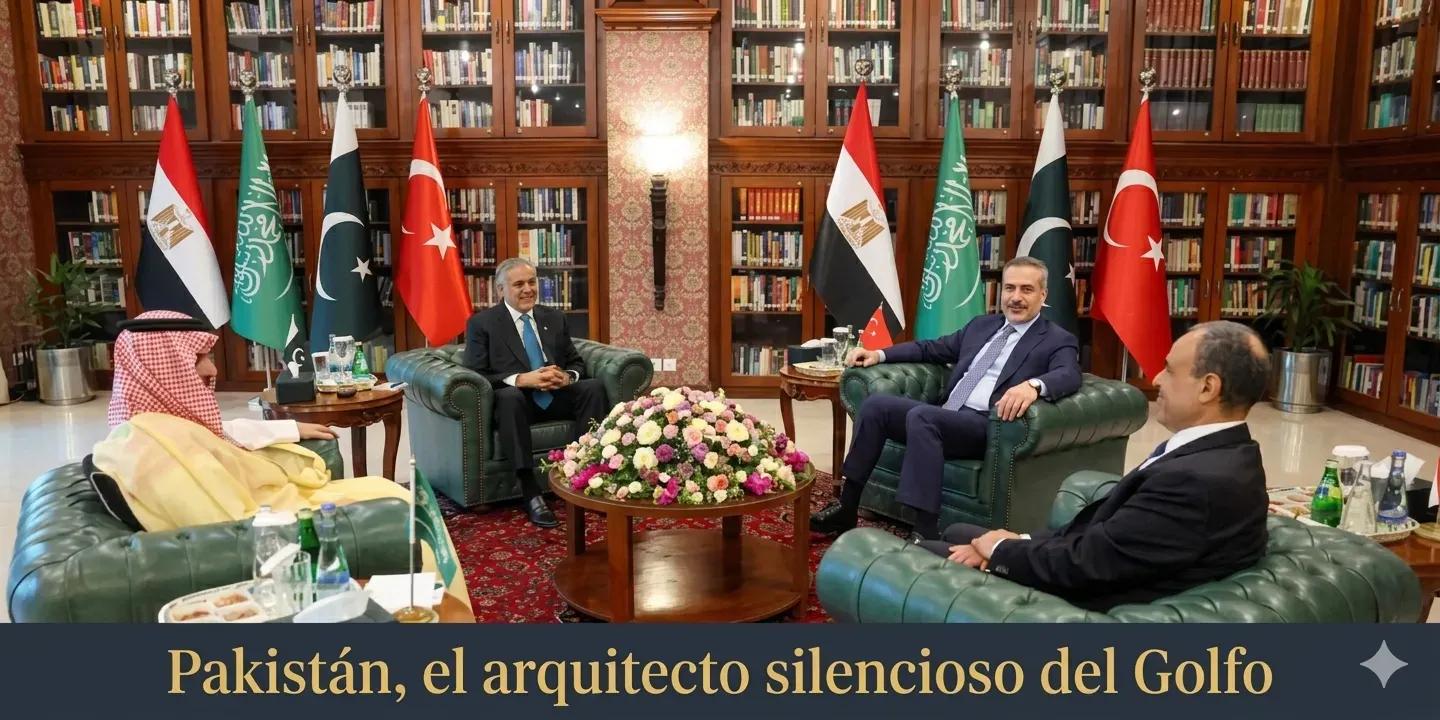
In just a month, Islamabad has transformed from a peripheral player to the center of a shadow diplomacy that keeps alive the possibility of a ceasefire between Washington and Tehran. It does not send aircraft carriers or launch drones; it sends messages, peace plans, and above all, a strategic ambiguity that allows it to benefit from both war and peace. It is the treaty ally of the attacked, the mediator of the attacker, and the guardian of the corridor that makes the disputed strait itself irrelevant.
With more than 880,000 square kilometers of territory and a population exceeding 240 million inhabitants according to the latest census, Pakistan is the fifth most populous country on the planet and one of the most densely populated nations. Its geo-historical position makes it a natural bridge between three worlds: the Indian subcontinent, Central Asia, and the Middle East. From the Indus Valley, the cradle of one of humanity’s oldest civilizations, to the Hindu Kush mountains and the coast of the Arabian Sea, its geography has been a corridor of empires, silk routes, and, today, oil pipelines and fiber optics for millennia. It borders Iran to the west, Afghanistan to the north and northwest, India to the east, and China to the northeast; its 1,046 kilometers of coastline in the Gulf of Oman place it just 400 kilometers from the Strait of Hormuz, the energy chokepoint that now paralyzes 20% of the world’s oil.
Economically, Pakistan is a semi-industrialized power that ranks 23rd in the world in purchasing power parity. Its economy depends largely on remittances from its 2.7 million workers in Saudi Arabia—$685.5 million a month—Chinese loans, and the export of rice, seafood, and pharmaceuticals, which it has just authorized towards Iran in the midst of the war. But its true weight does not reside solely in the numbers: it rests in its capacity to transform financial dependence into geopolitical influence. And that influence multiplies because Pakistan is also the only Muslim-majority country equipped with nuclear weapons. It is estimated to possess between 160 and 170 warheads, an arsenal that makes it the second nuclear power in South Asia and a player whose minimum credible deterrence no one can ignore.
Its military potential reinforces that relevance. The Pakistani Armed Forces, with over 600,000 active personnel and half a million in reserve, rank among the seven largest armies in the world. The Army, Navy, and Air Force are supported by an intelligence network—led by the all-powerful ISI—that operates with relative autonomy and that, in recent weeks, has demonstrated its effectiveness by intercepting Israeli plans to assassinate Iranian Foreign Minister Abbas Araghchi and Parliament Speaker Mohammad-Bagher Ghalibaf. That phone call to Washington, which prevented the last two possible interlocutors from disappearing, was not a symbolic gesture: it was proof that Pakistan can keep a diplomatic channel open when major military alliances are paralyzed.
Its rivalries and conflicts shape and simultaneously limit its maneuvering space. With India, the confrontation over Kashmir has triggered three wars and maintains a latent nuclear tension that forces Islamabad to always look eastward. With Afghanistan, border disputes and the presence of insurgent groups have even led to Pakistani airstrikes near Kabul in recent weeks, an escalation that some analysts interpret as an excuse to immobilize troops that, according to the defense pact with Saudi Arabia, should be defending Riyadh. With China, the relationship is one of strategic alliance and economic dependence: Beijing has invested $62 billion in the China-Pakistan Economic Corridor (CPEC) and controls the port of Gwadar, leased for 40 years. That deep-water enclave in Balochistan, just 400 kilometers from Hormuz, is the land terminal that allows China to bypass the blocked strait entirely. Pakistan must, therefore, navigate between gratitude towards its main creditor and the need not to alienate Washington, its primary non-NATO ally.
It is precisely that network of overlapping alliances—China, the United States, Saudi Arabia, Turkey, Iran—that makes Pakistan a unique actor. It maintains a mutual defense pact with Riyadh that, on paper, obligates it to respond to any aggression against Saudi Arabia; however, it has not deployed a single soldier since the war began on February 28. At the same time, its Foreign Minister, Ishaq Dar, confirmed on March 26 that Islamabad facilitates "indirect talks" between Washington and Tehran, conveying the U.S. proposal for a 15-point ceasefire. On the same day, Pashtun tribal leaders in Peshawar publicly committed to fight "shoulder to shoulder" with Iran in a jihad. And meanwhile, the Chinese-operated Gwadar port continues to receive vessels from the People’s Liberation Army for joint exercises in the Arabian Sea.
Pakistan’s capacity to host and promote negotiations has become evident this week. On Sunday, March 29, the foreign ministers of Saudi Arabia, Turkey, Egypt, and Pakistan itself met in Islamabad to coordinate a de-escalation strategy. Ishaq Dar spoke by phone with his Iranian counterpart Araghchi minutes before the meeting and emphasized that "dialogue and diplomacy remain the only possible way". The European Union, through its president António Costa, has explicitly expressed its support for Pakistan’s efforts. Even Prime Minister Shehbaz Sharif, who last month nominated Donald Trump for the Nobel Peace Prize, has used his personal relationship with the U.S. president to keep the channel open.
This architecture of contradictions is not improvised: it is structural. Pakistan mediates to reopen Hormuz while operating the port that makes it dispensable. It receives billions from Saudi Arabia and remittances from its workers while its citizens are among those killed in Iranian attacks in Dubai. It owes China over $30 billion and receives 81% of its armament from Beijing, yet retains its status as a primary non-NATO ally of Washington. If the strait reopens, Islamabad will earn Western recognition and economic aid. If it remains closed or subject to permanent tolls in yuan, Gwadar will become the most valuable logistical hub on the planet and the CPEC the alternative route that China needs.
In a world where NATO debates mandates and Western powers appear unable to act in unison, Pakistan has demonstrated that an intelligence call and a negotiating table can be worth more than $1.6 trillion in collective military spending. It is not neutrality. It is calculation. And in that calculation, the country that for decades was seen as unstable and peripheral has transformed into the invisible architect of a new regional order. The molecules of oil and the molecules of diplomacy do not understand flags, but they do understand corridors and conversations. And today, both of them pass through Islamabad.
Adalberto Agozino holds a PhD in Political Science, is an International Analyst, and a Lecturer at the University of Buenos Aires.

Comments