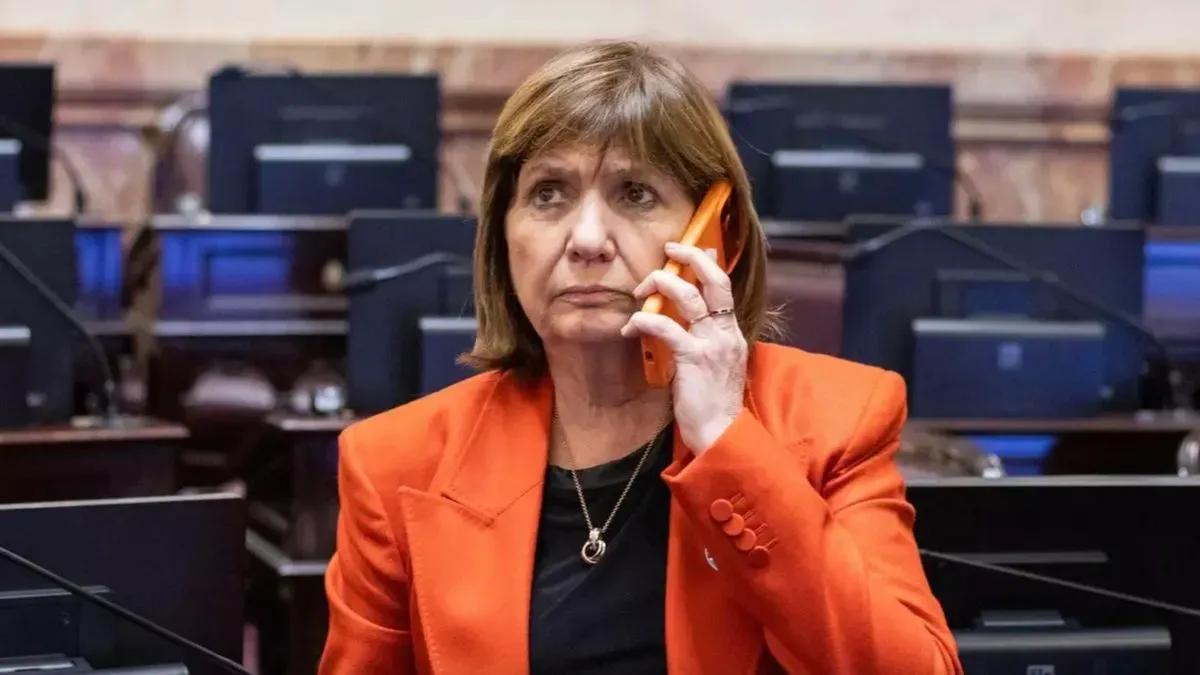
Six months ago, Patricia Bullrich publicly promised that she would not run for the head of government of the City of Buenos Aires. She told this to Mauricio Macri's cousin, Jorge Macri, when they met at the end of 2025. It was a clear promise: I will not compete with you.
Today, that promise "seems to be starting to crack." Not because Bullrich has said anything. Because she is raising her profile in the City, accelerating her agenda, and Mauricio Macri—the former president who removed her from PRO three years ago—is sending her messages.
No one reports this clearly because there is no rupture. There is no statement. There are no shouts of "she's leaving" or "she's coming back." There is something more dangerous: the silent construction of a power structure that operates in parallel to anything that happens in the coming months.
The structure that remains intact
Patricia Bullrich was Minister of Security under Javier Milei until December 2, 2025. Yesterday she was performing duties at Casa Rosada. Today she is a national senator for the City of Buenos Aires with over 50% of the votes.
What happened between those two dates is what almost no one reports.
While she was Milei's minister, Bullrich kept the offices she used for her presidential campaigns open. One on Avenida de Mayo. Another on Bulnes. Legislators, officials, leaders who report to her. Juan Pablo Arenaza. Damián Arabia. Diego Valenzuela, her partner in Buenos Aires. A small committee that meets every 15 days.
That is to say: while fulfilling her duties in Milei's government, she was running a parallel political structure that did not answer to the president or his internal decisions. A structure that remained intact after she left the position.
That is not unusual. It is a classic political move: keeping options open. But when the person doing it has over 39 positive image points according to private consultants—higher than the president—it becomes a political datum.
Recent movements
In recent weeks, Patricia Bullrich has done three things that seem unconnected but speak of the same game.
First: she presented a bill on biofuels. It is not a coincidence that she chose this. The agricultural sector is historically the territory of PRO. Mauricio Macri won rural votes in 2015. It is one of the sectors that separated from Milei due to stagnation policies. A project on biofuels attracts the agricultural sector, opens doors to unions, businessmen, producers who are outside of La Libertad Avanza.
Second: she distanced herself from Manuel Adorni, Milei’s chief of staff, who is being investigated for his wealth growth. Adorni is close to Milei. When Bullrich raises her hand saying "we need to investigate this," she is not questioning Adorni. She is drawing a line. She is saying: I have nothing to do with the scandals of this government.
Third: she submitted her own sworn declaration of assets early and demanded greater transparency within the government. Again, this is a macrista flag. PRO won with the idea of "transparency" vs. "K corruption." When Bullrich recovers that discourse, she is not being coherent. She is repositioning herself.
These are three moves that, together, outline a strategy: separating from the wear and tear of Milei without breaking publicly. Speaking the language of the macrista PRO without saying "I return to PRO."
The messages that no one mentions
At the end of 2025, Mauricio Macri and Patricia Bullrich were not talking. They had broken in 2023 when Bullrich accepted to be Milei’s minister. It was a public rupture. It was a "she betrayed us" versus "you had no project." It was the kind of break that in politics is marked with blood.
But that was before she won the elections with over 50% of the votes in CABA.
Now, according to sources close to both, the former president "has confessed that he received messages from the ex-minister in recent months." They did not see each other publicly. They did not speak at a press conference. They wrote to each other.
What do those messages say? No one knows. But the fact that they exist changed something. Because Macri does not respond to just anyone's messages. If Bullrich writes to the former president, it's because there is something to discuss. There is a door that can be opened.
In the meantime, Bullrich continues in the Senate voting on Milei’s laws. She remains a senator of La Libertad Avanza. She continues with her parallel structure intact. She did not break anything. She only made it clear that she is available to talk.
The three options on the table
A political analyst specialized in internal movements of the government summarized Patricia Bullrich's possible futures for 2027 as follows:
First: Be Vice President of the Nation. If Milei decides he needs a stronger ticket for his reelection, Bullrich is the obvious candidate. She has territorial power, she has image, she has her own votes. A Milei-Bullrich ticket would win elections.
Second: A primary with Jorge Macri in the City. PRO needs to return to CABA. Jorge Macri, the current head of government, is under pressure. If there is an internal race between Macri and Bullrich, Bullrich wins. She has double the votes. Once she wins the primary, she wins the City.
Third: Be a presidential candidate in 2027. But this has conditions. Only if Milei falls. Only if there is a clear break. It is the scenario where Bullrich says "I’m leaving" and competes as a candidate of PRO or a broader space. It’s plan Z.
Three options. None discarded. All work with the structure she maintains intact.
Why this game works
The Argentine political system operates on the idea that people take a position. You are with Milei, or you are with the opposition. You are with PRO, or you are with Kirchnerism. The binary politics.
Patricia Bullrich is binary in public. She is a senator of La Libertad Avanza. She votes on the laws. She defends the management. But internally she is multidirectional. She talks to Macri. She has her structure. She presents projects that attract the agricultural sector. She questions Adorni.
This works while Milei is in the ring. As long as there is a president who needs her, she can play in parallel. But the moment that changes—the moment Milei drops in the polls, or there is a clear break in the government, or PRO decides that it needs a strong candidate—Bullrich is ready.
She does not need a statement. She does not need a press conference. She just needs to reactivate her offices on Avenida de Mayo and Bulnes, call her small committee, and say: "Let's go."
What no one reports
The major media covers Patricia Bullrich as a senator. As an outgoing minister. As a figure of the ruling party. They report her votes, her statements, her public pronouncements.
But no one reports the structure. No one says: "Bullrich maintains a small committee that meets every 15 days while she is a senator for Milei." No one recounts: "The legislators around her answer to her, not the president." No one analyzes: "Why does former president Macri send messages to the ex-minister of his political rival?".
This is what allows this game to work. Because as long as no one talks about it, no one needs to explain it. As long as there is no public break, there is no need to take a position.
In politics, silence is a strategy. And Patricia Bullrich is an expert in silence.
The space she leaves open
For 40 years, Patricia Bullrich has been in politics. She was a guerrilla fighter in Montoneros in the 70s. She was close to Menem. She was a minister under De la Rúa. She was a deputy under several governments. She was a minister again under Macri. She was a presidential candidate with PRO. She was a minister again under Milei.
Her trajectory is not a straight line. It is a labyrinth. But this is what allows her to be skilled in this: to change positions without dying in the attempt.
A Buenos Aires leader who has known her for years put it directly: "Patricia Bullrich can be understood as what Max Weber called a professional politician, that is, someone who lives off politics. But also as a vocational politician who pursues ideas and therefore seeks power. Because without power, ideas are at best a good text. She cannot lose her character and identity. The nature of a politician is to keep protagonizing. The idea of a ceiling does not exist. She is a natural political leader."
That is to say: Bullrich does not stop. She does not settle. She does not close doors.
As long as Milei remains in the ring, she waits for her moment. With messages to Macri. With offices open on Avenida de Mayo. With a small committee that meets every 15 days. With legislative projects that speak the language of PRO. With over 39 positive image points.
She waits. She observes. And when there is a crack—when Adorni is investigated, when the polls drop, when something breaks—she gains momentum.
This is what is happening now. It is not a rupture. It is a construction. And no one reports it.

Comments