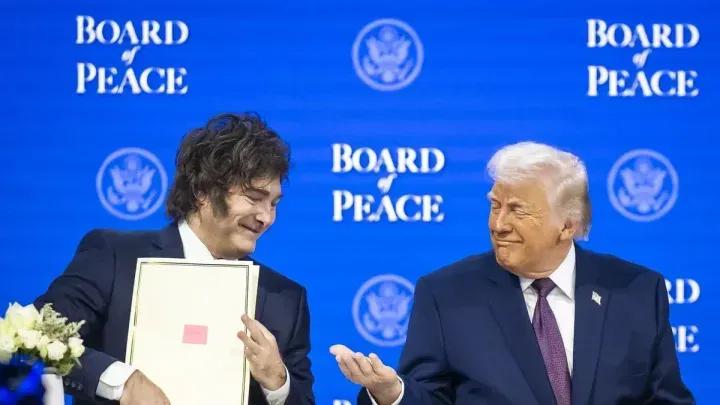
Peace no longer descends from the sky: it is designed in Davos
For decades, peace was a solemn concept, almost liturgical, administered by aging institutions burdened with historical legitimacy. Today, on the other hand, it appears redesigned with the aesthetics of Davos: small tables, powerful leaders, corporate language, and promises of efficiency. The Peace Council promoted by Donald Trump is not just a diplomatic initiative; it is a symptom. And like any symptom, it reveals more than it states.
Born with a limited objective—overseeing the ceasefire in Gaza—the Council quickly mutated into something more ambitious and, at the same time, more disturbing: a space that intends to complement, dispute, or even replace central functions of the United Nations. Trump stated it bluntly, with his usual disruptive candor: there are institutions that no longer serve. The subtext is clear: if traditional multilateralism doesn't work, someone has to hack it.
The multilateralism in crisis and the temptation of shortcuts
The context is not coincidental. The UN is grappling with a profound credibility crisis, trapped between crossed vetoes, endless wars, and a bureaucracy that always seems to lag behind events. In that void arises the temptation of shortcuts: less universality, more decisiveness; less assembly, more boardroom.
The Peace Council thus presents itself as a variable geometry of power. Not everyone is there, nor do they intend to be. The influential are present. Those who matter. Those who—according to Trump—“do their job.” From Western leaders to authoritarian heads of state, passing through tactical allies and regional powers, the composition of the Council does not respond to shared values but to a brutal logic of effectiveness: those who can impose something deserve a seat.
Here appears the first conceptual fracture: Can there be peace without legitimacy? Or is the ability to coerce and finance enough to sustain it?
Gaza as a laboratory and the cost of membership
The formal backing of the UN Security Council for the plan—with a mandate for demilitarization and reconstruction of Gaza—granted the Council a patina of international legality. But the institutional design reveals deep tensions. Members serve for three years; then, if they want to remain, they must pay an astronomical sum. Peace, in this scheme, has an entry cost.
That funds are allocated for reconstruction does not dispel the discomfort: the architecture resembles more an exclusive club than a global governance body. It is not just about who decides, but under what rules. The uncomfortable question hangs in the air: are we facing a pragmatic innovation or the financialization of peace?
Doubting allies, calculating powers
Skepticism is not marginal. France and Norway have distanced themselves; Italy invoked constitutional limits; China reaffirmed its attachment to the UN; Ukraine outright refused to sit next to Russia. Even Washington's traditional allies are moving cautiously, aware that joining implies more than a signature: it means validating a new decision-making order.
Russia, for its part, plays its classic chess: consulting, delaying, observing. Putin understands that these spaces are not evaluated by their speeches, but by their real capacity to redistribute power. Peace, on this board, is a strategic variable, not a moral end.
Argentina and the diplomacy of adherence
The decision of Javier Milei to integrate Argentina into the Council in Davos is not a minor gesture. It marks an explicit alignment with the Trumpist vision of the world: less multilateral ritual, more strong bilateralism; less slow consensus, more direct action. For a country that has historically defended international law and the UN system, this move raises profound questions about its future diplomatic identity.
Is it pragmatism in a harsh world or a silent abandonment of principles that, although imperfect, offered a framework of predictability?
The end of the UN or its uncomfortable mirror?
The Peace Council is not going to “kill” the UN tomorrow. But it does challenge it. It unsettles it. It exposes it. It functions as a brutal mirror reflecting the limitations of the order born 80 years ago. The question is not whether this Council will have immediate success, but what it says about the times: an era where legitimacy is negotiated, peace is managed, and power no longer conceals itself.
Perhaps we are not witnessing the birth of a new order, but something more disturbing: the confirmation that the old one no longer suffices, but the new one still does not know what it wants to be. In that interregnum, peace—that word laden with history—risks being transformed into a premium product, managed by those who can afford and sustain it.
The real discussion, then, is not Trump yes or Trump no. It is something else, more uncomfortable and deeper: what are we willing to sacrifice for peace to work. And whether, in that process, we are losing something essential along the way.

Comments