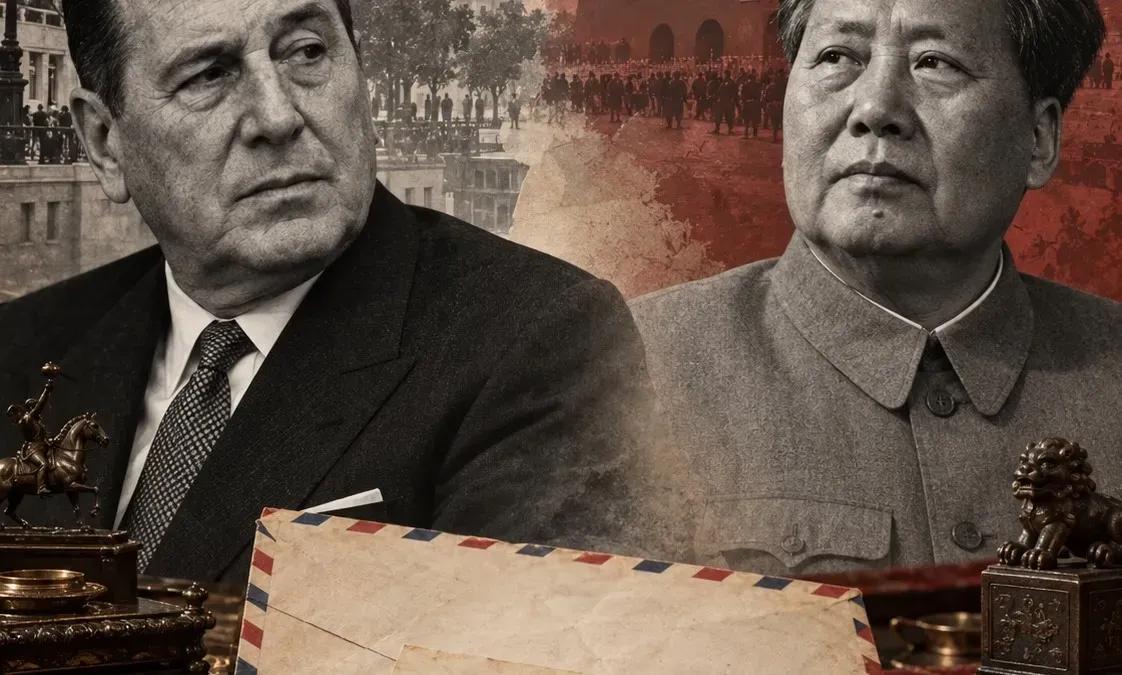
Every October 17, Peronism commemorates Loyalty Day, in memory of the 1945 mobilization that demanded Perón's release. The date invites a review of one of the lesser-known chapters of his trajectory: his relationship with Mao Zedong and the People's Republic of China.
The two leaders never met in person. However, during his exile in Spain, Perón wrote to the Chinese leader. The letter, dated in Madrid on July 15, 1965, was published in facsimile by Infobae in 2017, in an article by journalist Claudia Peiró.
What the letter said
In the text, Perón expressed his admiration for Mao, for his government, and for the Chinese Communist Party, defining China as the "unshakable base of the World Revolution." He also accused American imperialism and the Soviet leadership of the time of opposing the liberation of peoples, and rejected what he called a false peaceful coexistence.
Perón also claimed that the 1955 coup had prevented Argentina from completing a phase of democratic revolution. He acknowledged that the objectives of both countries were common, but that national conditions forced the adaptation of their struggle tactics.
The letter did not emerge from nowhere. In September 1964, in a letter to Delia Parodi cited by Infobae, Perón warned that if his return to the country failed, the path would rather be that of China or Cuba. According to historian Roberto Baschetti, in March 1965, he had already made his first direct reference to the Chinese Revolution.
The travelers and the messenger's mystery
The letter from July 1965 alluded to the trip of young leaders of the Revolutionary Peronist Movement (MRP) to China. According to a study by researcher Brenda Rupar from the Free University of Berlin, published in 2026 in the Iberoamericana magazine, that year seven Argentines led by Carlos Gaitán, from the MRP and the Tacuara Movement, traveled to China for five or six months.
They left from Montevideo, processed their documents in Geneva, and arrived in Shanghai and Beijing via Pakistan. According to Jorge Rulli, one of the youth leaders of the Peronist era, the goal was to receive military training. Gaitán recalled that the group sang the Peronist March in Tiananmen Square on May 1, 1965.
For years, the version circulated that this delegation delivered the letter, but both Gaitán and Rulli denied it. Baschetti claims that it was Bernabé Castellano who delivered it to Prime Minister Zhou Enlai and who distributed copies among European media, including Le Monde.
Was there a response?
Although there is often talk of an epistolary exchange, Rupar's study does not document any written response from Mao to Perón's letter. What did come to light were other gestures. According to Infobae, Perón told Jorge Rulli in Madrid that Mao had offered him a house in China.
The same outlet reports that in 1969, Mao received a delegation of young Argentines from the Communist Party and asked them why they were not Peronists. This is further complemented by a phrase attributed to the Chinese leader, "if I were Argentine, I would be Peronist," which, according to Rupar, circulated among militants since the late sixties, although its authenticity is not verified.
For his part, official biographer Enrique Pavón Pereyra noted in "Yo, Perón" that the general came to define Mao as "almost a Peronist."
The delegation of 1973
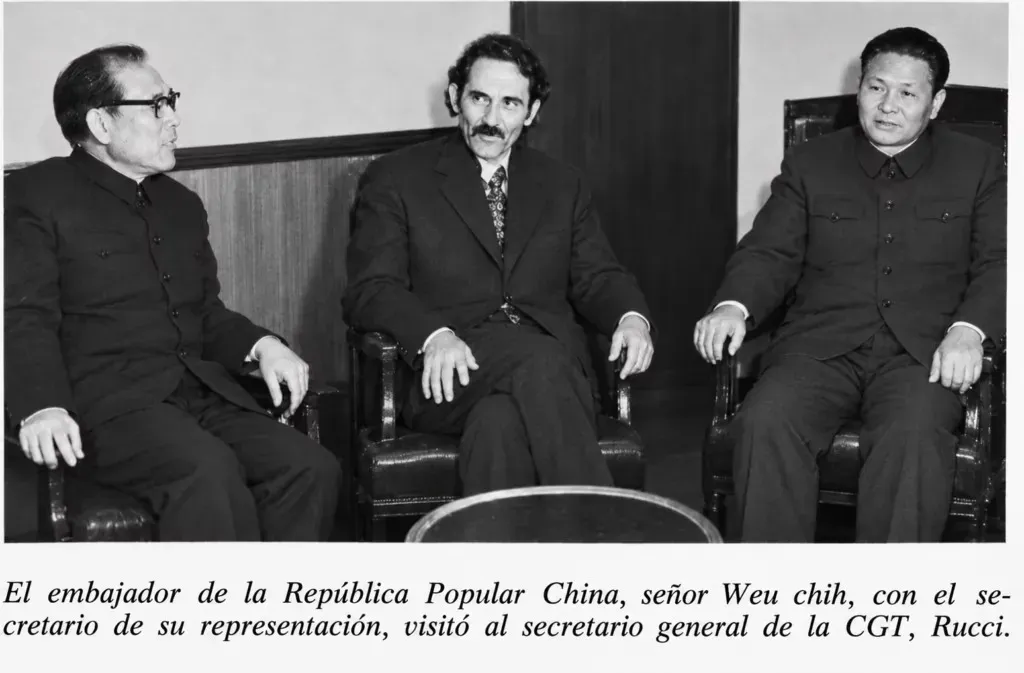
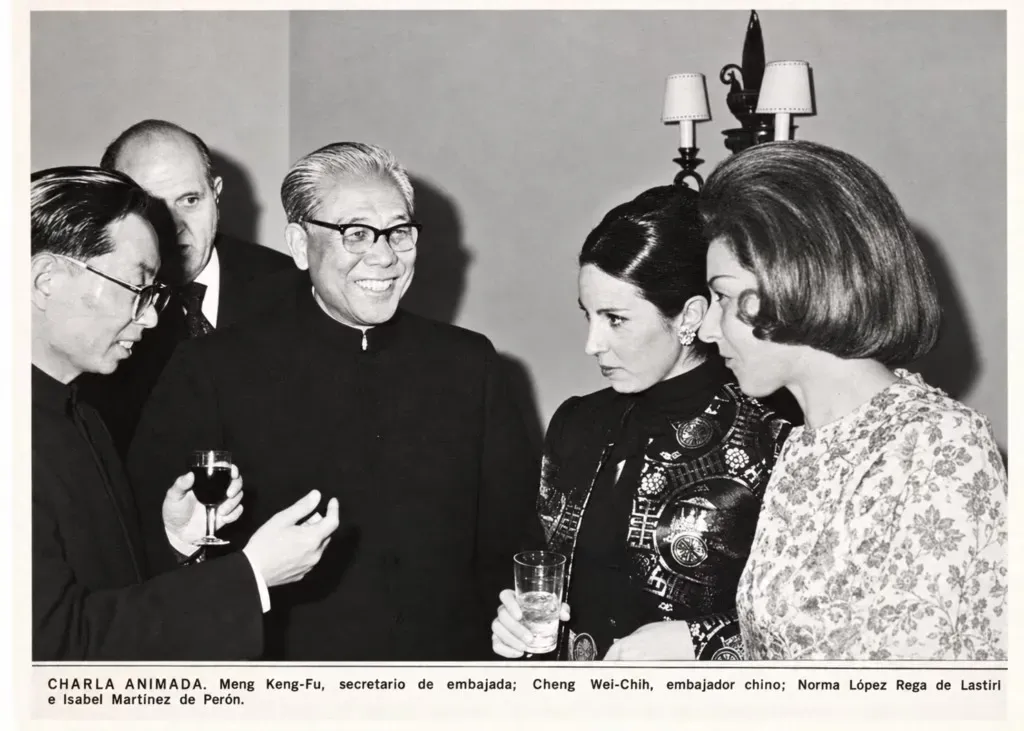
Argentina established diplomatic relations with the People's Republic of China on February 19, 1972. According to Rupar, the first official contact between the Chinese government and Perón occurred in April 1973, following an invitation from an Asian commercial affairs official at the Chinese embassy in Paris.
According to the magazine Noticias, Mao invited Perón to visit China and offered to relocate him to the country.
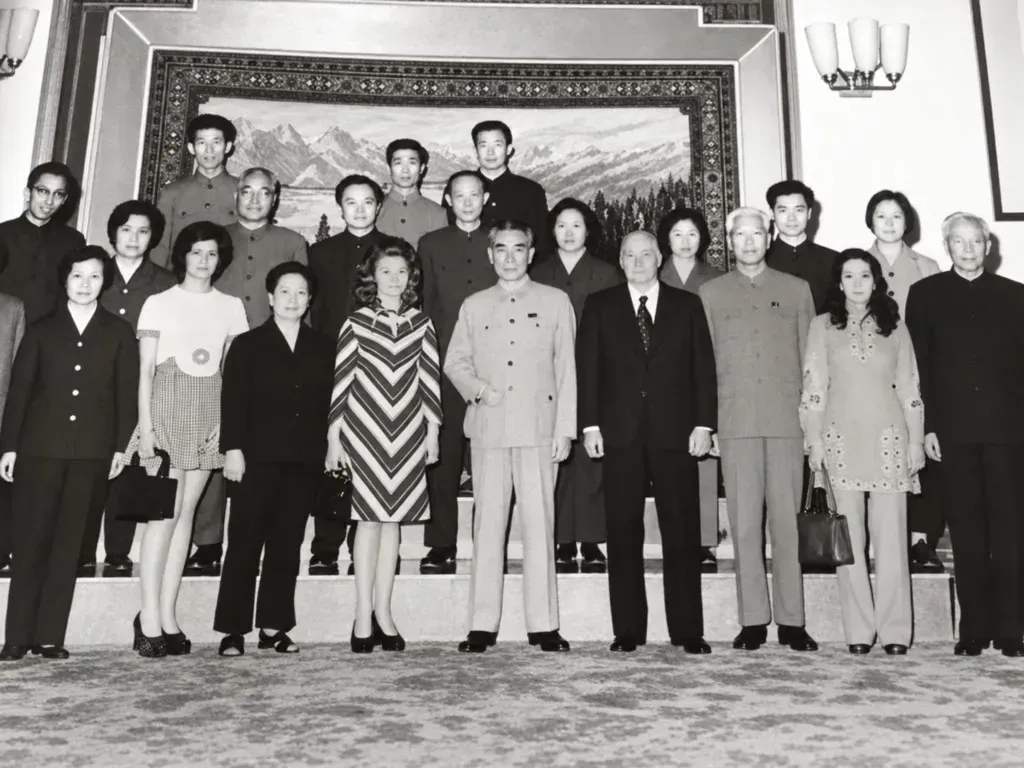
The general, about to return to Argentina, did not travel, but in May 1973 sent a delegation from the National Justicialist Movement led by María Estela Martínez de Perón, along with José López Rega and Gloria Bidegain, among others.
According to Bidegain's testimony to Noticias, the delegation prepared for the trip for a week in Puerta de Hierro and spent ten days in China, where they were received by Zhou Enlai. Jiang Qing, Mao's wife, joined in the farewell toast. The tour included a stop in North Korea, where they were received by Kim Il Sung. A photo of the delegation next to Jiang Qing is displayed today at the Chinese embassy in Buenos Aires.
From exile to government
Upon returning to the country in August 1973, Perón visited the first Chinese trade exhibition in Buenos Aires and, according to El Cronista Comercial, stated: "This is Mao's hour." On January 21, 1974, already in his third presidency, he signed a medical exchange decree between both countries, according to journalist Néstor Restivo.
Perón died on July 1, 1974, without having seen the first Chinese medical mission, which arrived in the country that same month. According to Restivo's account in El Cohete a la Luna, Mao sent a floral offering to the Argentine embassy in Beijing dedicated to "General Juan Domingo Perón, President of the Argentine Republic." Zhou Enlai and Dong Biwu, for their part, sent a letter of condolences to Isabel Perón.
For his part, Mao would pass away on September 9, 1976, two years after Perón, without either having met. What remains of that bond is a letter written from exile, a delegation sent to Beijing, a medical cooperation decree, and a floral offering with the general's name.
These are loose pieces that, from a distance, show how Perón sought in Mao's China a dialogue partner for his Third Position, both in the years of the proscription and during his return to power.
Marcos González Gava is a Co-Founder of Reporte Asia, and a Specialist in Economic and Financial Business and Cultural Affairs with the People's Republic of China.
Comments