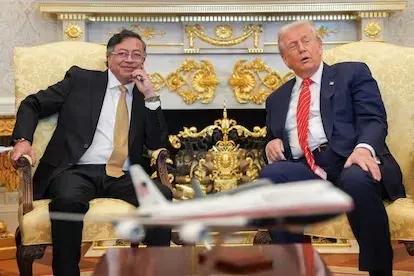
The visit of Colombian President Gustavo Petro to Washington does not represent an ideological shift nor a political reconciliation with the United States. It represents the tacit acceptance that, in this chapter, the one imposing the conditions is Donald Trump, not Petro. The meeting confirms that the Colombian president's margin of maneuver has been reduced and that his narrative of confrontation has yielded to a strategic reality in which Washington retains the initiative, the capacity for pressure, and control of the timing.
Petro has consistently maintained a frontal opposition to the eradication of coca crops. His drug policy has relied on voluntary substitution, rural development, and a structural critique of the traditional strategy driven by the United States for decades. That stance may be coherent from an ideological perspective, but it leaves an operational void in a country that continues to be the world's leading producer of cocaine.
The production of cocaine is not an abstract phenomenon. It is linked to territorial control, armed structures, established logistical corridors, transnational financial networks, and deep levels of institutional corruption. When pressure on any of these components is consistently reduced, the system does not weaken: it reorganizes.
In Washington, no one is deceived by the rhetoric. What matters is whether the flow is halted or not. Whether routes close, shipments fall through, whether organizations feel real pressure. When that pressure eases, the chain does not collapse, but simply rearranges itself. This is the harsh reality.
The visit gains more weight when recalling Gustavo Petro's history of confrontation with the Trump administration. It was not a one-off friction or a diplomatic misunderstanding. On several occasions, Petro referred to the American president as a criminal, accused him of human rights violations, and even publicly called on police and military personnel in the United States to disobey their own commander in chief.
This stance was not improvised. It responded to a deliberate political line, aligned with sectors of the regional left and built on direct confrontation with Washington. Petro took that narrative to various international forums, including climate conferences and his pro tempore presidency of CELAC, where he continued to use the stage to delegitimize and publicly humiliate the Trump administration.
This background explains why the meeting at the White House cannot be interpreted as a natural or friendly rapprochement. It is a tactical retreat. When sanctions, security cooperation, financial control, and international legitimacy come into play, rhetoric loses its utility.
Additionally, there is Petro's position on kinetic lethal operations. The systematic rejection of the use of direct force against criminal structures is particularly problematic in a context where cocaine produced in Colombia fuels a violent, armed, and highly organized market. The supply chain is neither civil nor passive. It is designed to withstand state pressure. Denying the use of force without replacing it with an equally effective mechanism leaves the operational capacity of criminal organizations intact.
The tensions with the United States also extended beyond the drug issue. On the international stage, Petro adopted an openly confrontational stance on the Gaza conflict, aligning against Israel and personalizing his criticism on Prime Minister Benjamin Netanyahu. This position reflected a leadership style willing to subordinate strategic considerations to ideological stances, even when that implied direct diplomatic costs.
In this same framework, other less visible but equally revealing decisions and gestures are inscribed. Petro ordered the suspension of coal shipments and exports to Israel and tried to prevent Colombian governors from traveling and meeting with the White House, even threatening to take actions against those who maintained direct channels with Washington. All of this reinforced the perception of a personalistic, centralized foreign policy defined more by confrontation than by strategic calculation.
In contrast, under President Trump's administration, the United States managed to impose the longest and most impactful pause in the flow of cocaine into its territory since the beginning of the war on drugs. The combination of sustained interdiction, financial pressure, control of maritime and aerial routes, and consistent use of operational intelligence has resulted in a real disruption of the supply chain. All indications are that the levels of cocaine availability in the American market are among the lowest recorded, both in volume and regularity.
This outcome is not incidental. It depends on continuity. Any strategic concession — in particular, a negotiation that reduces lethal interdiction as a bargaining chip to improve political relations with Colombia — would have immediate effects on the chain. Experience shows that when the pressure decreases, even selectively, the criminal system responds rapidly, reconstitutes routes, reduces costs, and regains momentum. The advances made can dissolve in months.
The visit also has a personal dimension. Petro reaches the final leg of his presidency with a weakened coalition, questioned results in security, and an increasingly narrow international margin. His inclusion on U.S. Treasury lists conditions his external projection and any scenario post his mandate. In this context, Washington is not just an uncomfortable partner, but the determining actor.
The key question is not what was said in the meeting, but what happens next. If the meeting translates into sustained operational cooperation — applied intelligence, maritime and aerial interdiction, continuous financial pressure, and persistent actions against critical nodes — the impact on the supply chain will be measurable. If it remains a matter of diplomatic gestures, the criminal system will absorb the adjustment without structural consequences.
Historical experience is clear, pressure vacuums do not reduce violence nor strengthen governance. They do the opposite. They allow illicit economies to consolidate territorial control, increase revenues, and deepen institutional capture.
Petro may maintain his ideological opposition to eradication. The United States may accept tactical adjustments. But without a comprehensive strategy that raises real costs to the criminal chain, the flow of cocaine to the United States will continue.
That will be the true parameter to evaluate this visit.
About the author:
Jesús Daniel Romero is a former naval intelligence officer and an intelligence operations specialist of the United States Army, with over 37 years of experience in regional security and transnational threats. He is a regular analyst in international media such as Sánchez Grass en América, Fox Noticias, Voz Media's news spaces, and Newsmax. He has been quoted and interviewed by The Wall Street Journal. He is a bestselling author of El Vuelo Final: La Reina del Aire and Silencio Letal: El Mundo Oculto de los Narcosubmarinos.
Comments