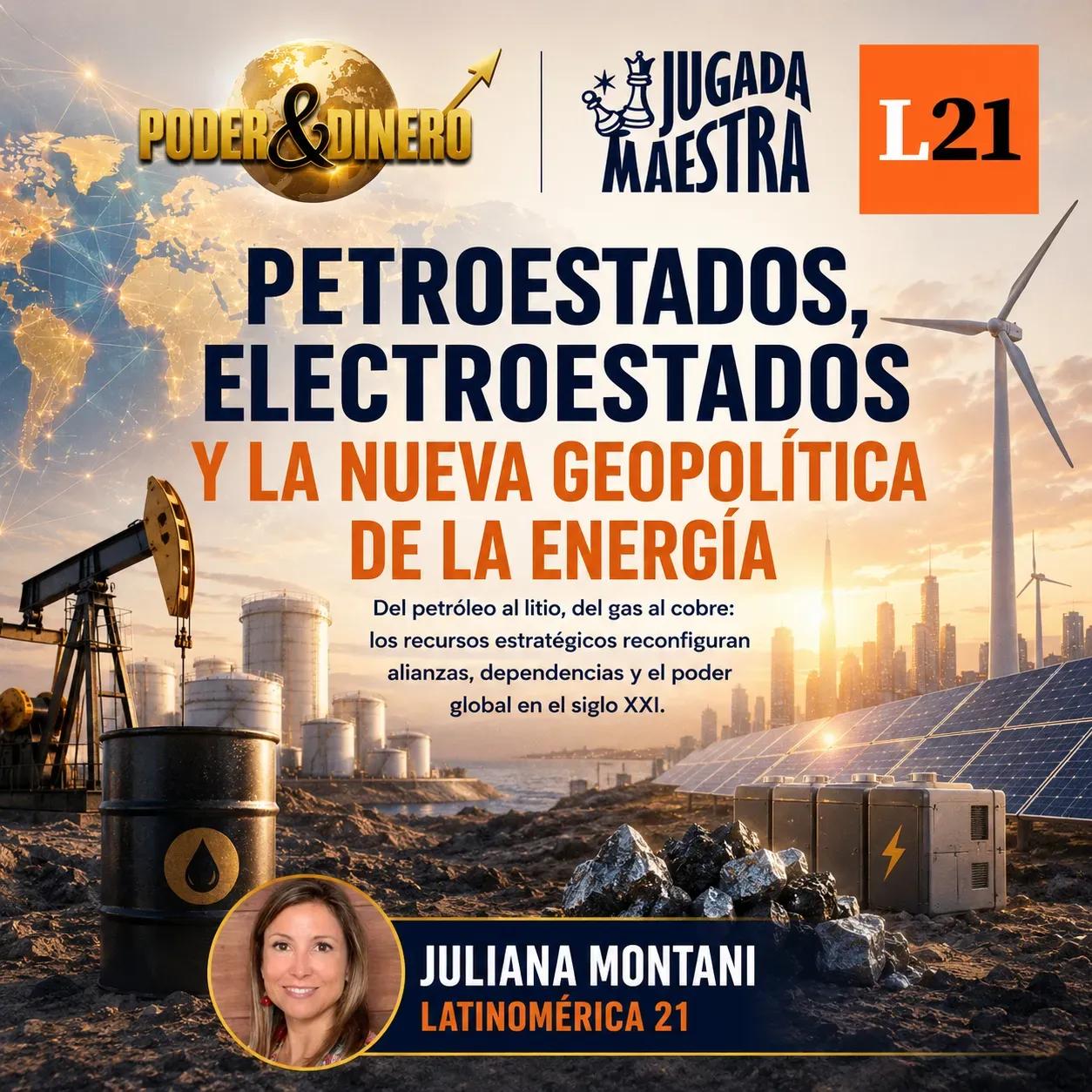
Every time a geopolitical tension threatens fuel supply, energy returns to the center of the strategic debate. This happened during the oil crisis of 1973 and after the Russian invasion of Ukraine with gas. Today, blockades in the Strait of Hormuz remind us of how much energy remains a matter of national security at its highest and, at its minimum, of political survival, as Bolivia is an example.
From oil to electricity
For decades, energy supply was dominated by petrostates. The power of Saudi Arabia, Russia, or Iran rested on scarce and geographically concentrated fossil resources. Whoever controlled wells, pipelines, or maritime straits controlled a large part of the global economy. The rules of the game are changing: Saudi Arabia is investing in renewables through Vision 2030, and Russia exports nuclear technology. The main fossil fuel producers are looking to maintain influence in a world where energy power no longer solely depends on oil.
The expert and consultant from the International Atomic Energy Agency, Alfredo García, states that “fossil fuels have taken us to the highest levels of human development.” Oil will not disappear tomorrow: beyond fuels, it constitutes an essential raw material for agriculture, the chemical industry, and pharmaceutical production. What is changing is its relative weight within an increasingly diversified energy matrix, and the strategic axis shifts from controlling the fuel itself to the ability to produce, store, manage, and distribute electricity.
Energy storage specialist for Latin America, Luciano Silva, offers a reading that reframes the discussion: the real change consists of moving “from a reality where energy was scarce to a reality where non-conventional renewable energy - solar and wind - abounds. What is scarce today is the management of that variable renewable energy.”
This observation is particularly relevant for Latin America. In Europe, the challenge consists of replacing fossil sources with low-carbon sources. According to Silva, many countries never had abundant fossil fuels of their own. For these, it is not a transition, but rather building energy autonomy from resources such as the sun, wind, or water. To achieve this, large-scale batteries are the technology that needs to be developed.
A dependence for another
If the 20th century depended on oil from the Middle East, the 21st century increasingly depends on smart electrical grids, semiconductors, storage, and strategic minerals. Here lies a paradox: in the new energy era, dependence may not be disappearing, but rather being replaced by another. Most of the lithium extracted from the triangle of Argentina, Chile, and Bolivia is refined in Asia. China not only dominates the manufacturing of solar panels, batteries, and electric vehicles: it has long been controlling the entire supply chain of LFP (lithium iron phosphate), the current standard for electromobility and industrial storage, through state-subsidized innovation and development, long-term planning, and economies of scale that are hard to replicate, although recently Chinese companies have been investing to diversify their production.
While Latin America tries to insert itself into that chain, China is already migrating technology to sodium-ion batteries, a widely available material that frees it from dependence on lithium imports.
New energy actors
The geopolitical struggle for energy is not only occurring between states. Large technology companies are starting to act like energy players. The expansion of artificial intelligence is driving the demand for electricity. Amazon, Google, and other hyperscalers are looking for long-term supply contracts, funding energy infrastructure, and investing in small modular nuclear reactors.
Microsoft signed a historic twenty-year agreement to buy all the production from the Three Mile Island nuclear power plant. Electricity is becoming a strategic input as important as oil was for the industrial economy, and nuclear energy is experiencing renewed global interest.
Kronos and Kairós
The new geopolitics of energy is not exhausted in access to electricity or the bet on different technologies; it is also materialized in different capabilities to plan for the future. This is what I call "political dumping": the difficulty of sustaining long-term strategic investments in systems where political costs are immediate but the benefits will be reaped by future governments.
Ancient Greece distinguished between Kronos, chronological time, and Kairós, the opportune time to act. Nuclear reactors, electrical grids, or storage systems require finding the ideal political opening to be planned. The electoral calendar, on the other hand, operates under very short-term incentives that often result in patches and little planning for the future.
China resolved that tension through long-term state planning - at the cost of a single-party system that controls dissent. Some democracies have also managed it: Finland is building Onkalo, a nuclear waste encapsulation designed to last 100,000 years: no politician will see its end (nor perhaps any other type of human). In France, the nuclear program has survived as a state policy. South Korea has made energy and technology pillars of an industrial strategy sustained over decades.
The key to energy security lies in the existence of political and institutional agreements capable of surviving the short term.
The Latin American opportunity
Latin America has some of the largest global reserves of lithium, copper, and uranium, in addition to abundant hydroelectric, solar, and wind resources. The region, however, is a recurring victim of the well-known "paradox of abundance" or "resource curse," according to which countries rich in raw materials do not translate their benefits into sustained development.
Escaping that self-closing cycle requires more than just extracting what is in the subsoil. The plot twist to escape the paradox of abundance involves, in the energy sector, strengthening those segments with higher added value, from mineral processing and storage to nuclear technology, smart grids, and energy software. This must be complemented by the creation of human capital and innovation capacities that are sustained over time.
Currently, institutional stability becomes as strategic as lithium, copper, or gas. While some countries turn energy into industrial policy, technological innovation, and capacity for influence, the region risks returning to the role it knows best: that of supplying the inputs that others will transform into power.
Juliana Montani
Graduated in Political Science from the University of Buenos Aires (UBA), specializing in International Relations, diploma from the INCAP School of Government. Analyst at the Institute of International Security and Strategic Affairs (ISIAE/CARI).

Comments