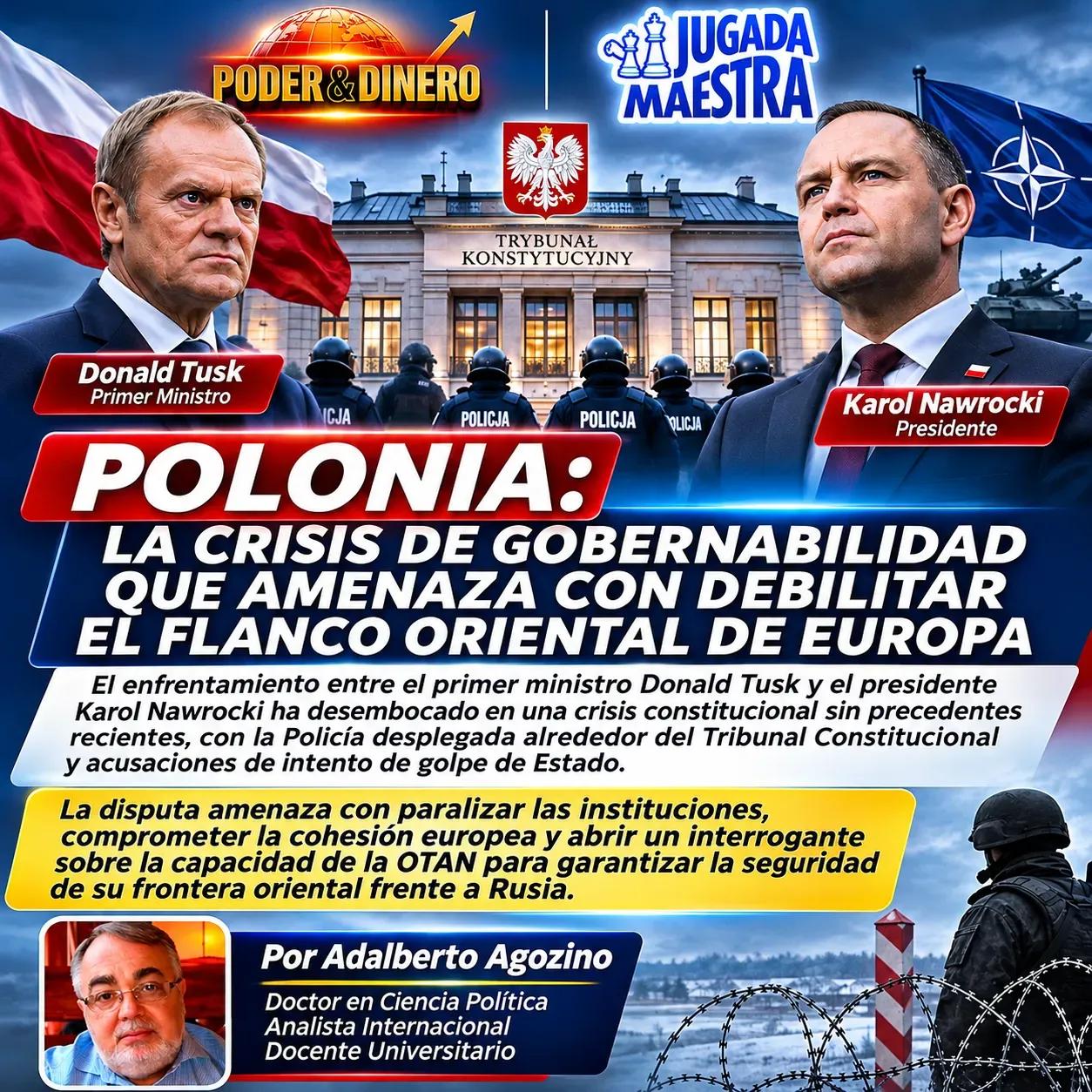
Poland is going through one of the most serious institutional crises since the recovery of democracy after the collapse of the communist system. The confrontation between the government of Prime Minister Donald Tusk, who is pro-European, and President Karol Nawrocki, backed by the national-conservative Law and Justice party (PiS), has taken on a dimension that far exceeds the political differences between the two leaders. The dispute over control of the Constitutional Court has led to a clash between state authorities, street mobilizations, police intervention, and allegations of a supposed breach of constitutional order.
The most recent episode occurred on Friday, October 30, when Judge Anna Korwin-Piotrowska announced the temporary suspension of the President of the Constitutional Court, Bogdan Święczkowski, and his Vice President, Bartłomiej Sochański. The judge provisionally assumed the direction of the body, arguing that its previous authorities were preventing the regular functioning of the institution and hindering the incorporation of judges elected by the current parliamentary majority.
The reaction was immediate. The Constitutional Court denounced a supposed illegal takeover of its facilities and described the events as a "coup d'état." Leaders of the PiS supported this interpretation and called on their supporters to demonstrate outside the building. The riot police established a security perimeter and detained three people after incidents occurred with protesters trying to breach the protective barriers.
The seriousness of the situation was reflected in President Nawrocki's decision to interrupt his official trip to Senegal and urgently return to Warsaw. Once in the capital, he headed to the headquarters of the Constitutional Court, where he managed to gain access amidst controversial circumstances. Subsequently, he accused the government of violating constitutional order and called for urgent consultations with representatives of parliamentary forces to try to restore institutional normality. Reuters+2
The crisis, however, did not begin this week. Its roots lie in the profound transformation of the judicial system undertaken by the PiS during its eight years in power, from 2015 to 2023.
A long-standing dispute
During that period, the party led by Jarosław Kaczyński pushed for reforms that substantially changed the organization of Polish justice. The Constitutional Court, responsible for determining the compatibility of laws with the Constitution, gained decisive importance in that political confrontation.
The problem arose when the conservative government promoted appointments of judges that were questioned by sectors of the opposition, legal experts, and European bodies. The conflict was related, among other aspects, to the appointment of judges to positions that had already been legally filled by the previous Parliament. European judicial institutions considered that these actions compromised the independence and impartiality of the court.
The Court of Justice of the European Union and the European Court of Human Rights raised objections to various aspects of the Polish judicial reform. The controversies led to European proceedings against Warsaw and the withholding of community funds linked to compliance with the principles of the rule of law.
When Donald Tusk came to power in December 2023, he promised to reverse those reforms, restore judicial independence, and normalize relations with Brussels. His coalition, composed of various liberal, centrist, and leftist formations, had a parliamentary majority but lacked the political capacity to execute all its initiatives.
The main difficulty lay in the presidency of the Republic. Andrzej Duda, closely linked to the PiS, had used his constitutional powers to veto government initiatives. His successor, Karol Nawrocki, elected in 2025 with the support of the same political space continued that strategy of institutional resistance.
The new president refused to swear in several judges elected by Parliament, five according to reports describing the current controversy. The Constitutional Court, under Święczkowski's presidency, also did not allow those judges to fully participate in its deliberations.
The government considers that such a situation represents a continuation of the political capture of justice inherited from the PiS. The opposition, on the other hand, argues that Tusk seeks to change the composition of a constitutional body whose independence should be protected from circumstantial majorities through administrative procedures.
The decision by Korwin-Piotrowska to suspend the court's leadership thus represents a qualitative escalation. The issue is no longer merely about determining who has the right to occupy certain judicial positions, but about establishing which authority can legitimately lead a fundamental institution of the state.
The Minister of Justice, Waldemar Żurek, announced that he had requested the lifting of the immunity of Święczkowski and Sochański to push for criminal actions against them for alleged irregularities and obstruction of judicial functioning.
However, the legality of the suspension is also being questioned. Jurist Marcin Matczak, a critic of the PiS judicial reforms, warned that the police intervention and the legal interpretation used to remove the court's authorities could cause lasting harm to the rule of law. His position is particularly significant because it does not come from a defender of the previous conservative judicial policy, but from an academic who has repeatedly questioned its foundations.
The controversy has even extended to the diplomatic sphere. Jakub Kumoch, Polish ambassador to China and former foreign policy advisor to former president Duda, announced his resignation amid the events. The Minister of Foreign Affairs, Radosław Sikorski, responded by questioning how he had abandoned his responsibilities. Le Monde.fr+2
The protagonists and the battle for the state
The confrontation expresses two political projects that have profoundly polarized Polish society.
Donald Tusk represents a pro-European integration orientation, favoring the strengthening of community institutions and greater coordination with Germany, France, and the main Western governments. His political trajectory includes his previous term as prime minister and his later presidency of the European Council. His return to power was interpreted in Brussels as an opportunity to normalize institutional relations with Poland.
Karol Nawrocki, on the other hand, expresses the continuity of a national-conservative current that prioritizes national sovereignty, the defense of traditional values, and a more restrictive interpretation of the competencies of European institutions. Although formally independent, his presidential candidacy was supported by the PiS, and his electoral victory in 2025 constituted a significant setback for Tusk.
The third protagonist is Jarosław Kaczyński, founder and main leader of the PiS, who maintains a decisive influence over the conservative space. His strategy consists of presenting the government's actions as a threat to institutional sovereignty and the continuity of constitutional order.
The dispute also has an electoral dimension. The next parliamentary elections are scheduled for the autumn of 2027. Tusk needs to demonstrate to his voters that he can fulfill the promise of dismantling the PiS's institutional legacy. His opponents aim to present his procedures as an abusive concentration of power.
However, the prime minister faces a considerable political contradiction: restoring judicial independence through procedures whose legality is contentious may end up undermining the principle he seeks to recover.
Even among sectors opposed to the PiS reforms, there are doubts about the advisability of using administrative decisions and police deployments to resolve a conflict of constitutional nature.
The U.S. ambassador in Warsaw, Tom Rose, expressed on October 30 his concern over what he termed an unprecedented confrontation regarding the exercise of state power and the independence of a constitutional institution. Washington urged avoiding any action that could lead to violence and emphasized that Polish democratic stability is a strategic interest for the United States.
A robust economy, but subjected to increasing demands
The political crisis is unfolding in a country whose economic importance has increased significantly since its accession to the European Union in 2004.
Poland is currently one of the main economies of Central and Eastern Europe. Its growth has been supported by industrial expansion, integration into European production chains, domestic consumption, foreign investments, and the use of community funds.
The European Commission's forecasts for 2026 estimate a gross domestic product growth of 3.5%, following a 3.6% expansion during 2025. Inflation would be around 3.6%, while unemployment would remain close to 3.1%, one of the lowest rates in the European Union.
However, there are significant fiscal imbalances. The public deficit reached 7.3% of GDP in 2025, and the European Commission estimates that it will be 6.5% in 2026. A considerable portion of this imbalance is due to increased military spending, social benefits, and public sector wages.
The continuity of economic growth will depend on the government's ability to maintain investments, leverage European resources, and control indebtedness. A prolonged confrontation between the Executive and the Presidency could affect regulatory predictability, delay budgetary decisions, and hinder the execution of strategic projects. European Commission+1
The military and geopolitical importance of Poland
The conflict takes on an even more delicate dimension when considering Poland's geographic position. Located between Germany and Belarus, with borders close to Ukraine and the Russian enclave of Kaliningrad, it constitutes one of the main points of articulation for European security.
Its territory represents a fundamental space for the defense of NATO's eastern flank. It is also indispensable for land communications between Western Europe and the Baltic states. The Suwalki Corridor, situated between Poland and Lithuania, constitutes a particularly sensitive area because it connects Estonia, Latvia, and Lithuania with the rest of the allied territory and lies between Kaliningrad and Belarus.
A potential military crisis in that region would have immediate consequences for the security of the entire Atlantic Alliance. For that reason, the multinational military presence deployed in Polish territory constitutes one of the essential components of the deterrence strategy against Russia.
Poland has made an extraordinary effort in military modernization. According to estimates from the International Monetary Fund, its defense spending rose from 2.2% of GDP in 2021 to approximately 4.5% in 2025. By 2026, the defense budget, including the corresponding off-budget funds, exceeds 200 billion zlotys, equivalent to about 4.8% of GDP.
The country has a military force of over 220,000 personnel, according to data released by its military authorities in 2026. This dimension makes its armed forces the most numerous in the European Union in terms of permanent military personnel.
The modernization includes acquisitions of tanks, artillery systems, aircraft, helicopters, missiles, and air defense capabilities. The United States and South Korea have become fundamental suppliers of weapons and technology.
The Polish effort is not solely a consequence of a desire for regional power. It is a direct response to the perceived threat represented by Russian foreign and military policy since the annexation of Crimea in 2014 and, particularly, since the invasion of Ukraine in February 2022. International Monetary Fund+3
Ukraine and the security of Europe at the center of the controversy
Poland has played a decisive role in sustaining Ukrainian resistance. Since the beginning of the Russian invasion, it has provided heavy weaponry, munitions, armored vehicles, air defense systems, and combat aircraft. It has also organized training programs for Ukrainian soldiers and facilitated the transit of Western equipment into Ukrainian territory.
Rzeszów-Jasionka Airport became one of the main international logistics centers for the transfer of military and humanitarian assistance.
According to figures released by the Polish Ministry of Defense in July 2026, military donations made to Ukraine since the beginning of the war amounted to approximately 16.45 billion zlotys. More than 30,000 Ukrainian soldiers have received training in facilities and programs linked to Poland.
The coop
The operation continues through joint arms production initiatives and participation in international assistance mechanisms. In September 2026, Tusk announced Poland's incorporation into the Anti-Ballistic Coalition and reiterated that the Russian threat affects all of Europe, not just Ukraine. Portal Gov.pl+2However, the institutional crisis introduces additional uncertainty. A politically paralyzed Poland would have greater difficulties in coordinating defense decisions, approving budgets, maintaining international commitments, and exercising its influence in NATO deliberations.
This does not mean that the country will abandon its commitment to Ukraine. The Russian threat constitutes a structural factor of its security policy, shared by a large part of the political spectrum political. Even the differences between Tusk and Nawrocki do not eliminate the perception that a strategic victory for Moscow would deeply alter the regional balance.
But political fragmentation could weaken the continuity of decisions and offer opportunities for disinformation operations, influence, and hybrid pressure that Moscow develops against European countries.
For the Kremlin, a Poland absorbed by its internal disputes would be a less predictable interlocutor and potentially more vulnerable within the western defensive architecture. A possible Russian invasion of allied territory does not constitute an automatic consequence of the Polish crisis, but the political cohesion and responsiveness of Warsaw are essential factors for deterrence.
NATO has multinational military structures, planning mechanisms, and collective commitments that do not depend solely on the political situation of a government. However, the effectiveness of those guarantees requires national authorities capable of making timely decisions and sustaining a coherent strategy.
The European Union in the face of a new rule of law crisis
For Brussels, the events represent a particularly uncomfortable situation. The European Union supported the demands for judicial independence recovery during PiS governments and considered that the reforms promoted by Tusk would allow overcoming that confrontation.
Now it must face a more complex circumstance: a Europhile government that justifies extraordinary measures in the name of the rule of law but whose procedures also raise legal questions.
The European Commission and the community judicial institutions will have to determine whether recent actions comply with the constitutional principles that Poland is obliged to respect as a member state.
The issue is particularly delicate because the conflict could feed Eurosceptic positions. Kaczyński has recently argued that Poland should begin discussing the conditions for a possible exit from the European Union. Tusk, for his part, believes that the country’s European future is directly at stake in this confrontation.
A possible escalation could reopen divisions among member states regarding Brussels' competencies, national sovereignty, and the limits of community intervention in national judicial systems.
The situation also affects European foreign policy. Poland is one of the main advocates for a firm response to Russia and a key player in building a continental defense strategy. Its political weakening would impact the ability of France, Germany, and the Baltic countries to articulate a common position.
An uncertain outcome
The immediate evolution will depend on the possibility of reaching an institutional agreement that allows for the restoration of the Constitutional Tribunal’s functioning without imposing a unilateral solution. The consultations called by Nawrocki and the judicial actions announced by the Ministry of Justice will constitute decisive tests.
The meeting of judges scheduled for the first days of November could become a new focal point of confrontation if the parties question the composition of the body or the validity of its decisions.
There are at least three possible scenarios. The first would be a negotiated de-escalation, with mutual guarantees regarding the functioning of the tribunal and the recognition of verifiable legal procedures. The second would involve an extension of the institutional blockade, with contradictory decisions and an increasing judicialization of the political confrontation. The third, more concerning, would imply a radicalization of mobilizations and an open confrontation between authorities simultaneously claiming constitutional legitimacy.
The parliamentary elections of 2027 add an electoral component that complicates any compromise. Both the government and the opposition have incentives to present the conflict as an existential dispute over Poland's future.
The Polish crisis, therefore, exceeds a controversy over judicial appointments. What is at stake is the ability of a European democracy to resolve its power conflicts without compromising the independence of its institutions.
Poland represents a fundamental piece of the western security architecture. Its economy, armed forces, geographical position, and commitment to defending Ukraine make it an irreplaceable actor for the stability of Eastern Europe.
Therefore, the confrontation between Tusk and Nawrocki cannot be interpreted as an exclusively domestic issue. In a continent that has once again considered conventional war as a real threat, the strength of Polish institutions is also an element of collective security.
The paradox is evident: while Warsaw increases its military capabilities to deter possible external aggression, its political leadership is engaged in a confrontation that threatens to weaken the internal cohesion necessary to effectively utilize that power.
The real challenge now is to prevent the struggle for control of the state from compromising the state itself. For Poland, and for its European and Atlantic allies, that is the strategic dimension of a crisis whose outcome remains open.
Adalberto Agozino is a Doctor in Political Science, International Analyst, and Lecturer at the University of Buenos Aires

Comments