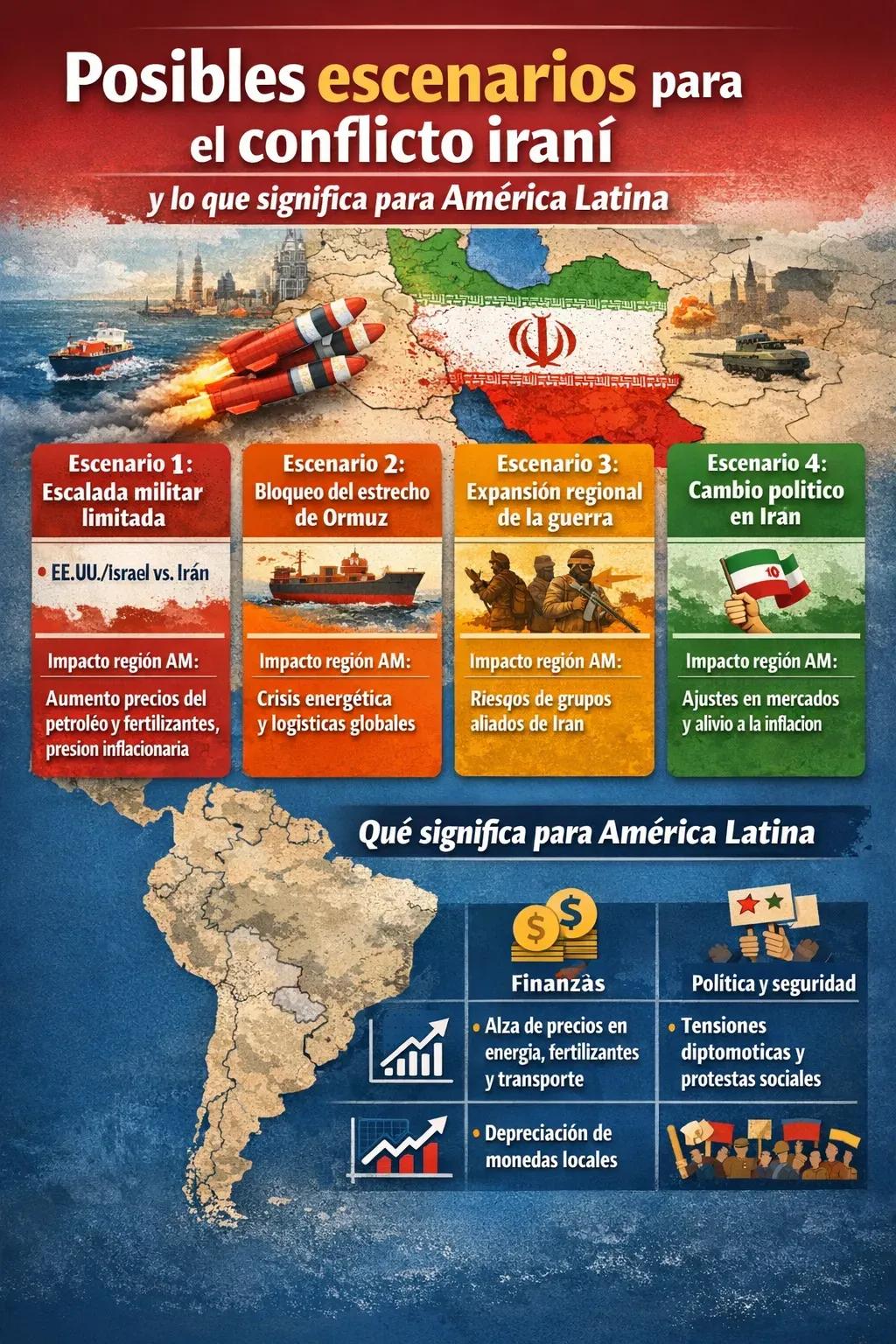
The Joint U.S.-Israel Operation in Iran is in its early phases. It has already overshadowed U.S. operations in the Caribbean as the most significant military action of the second Trump Administration. President Trump has indicated that military action could continue for several weeks. The Iranian regime's response, launching massive attacks both against Israel and regional countries hosting U.S. forces or perceived as supporting the military campaign against it, suggests a serious risk that the conflict could escalate, impacting international trade and the global economic and financial system. This article offers a first look at the potential strategic impacts of the conflict on Latin America. It is based on the excellent analysis on this topic conducted by Latin American analyst James Bosworth.
In the short term, the impacts of the conflict will likely be primarily economic. Oil prices are already rising and could increase significantly if Iran closes the Strait of Hormuz, creating difficulties for oil-dependent countries in the Caribbean and Central America. Disruptions in international logistical flows between the region and Asia could become more substantial, with impacts on prices and inventories, if an escalating conflict jeopardizes transits through the Red Sea, the Suez Canal, and other key international maritime routes.
The Iranian proxy Hezbollah has a long-standing presence in Latin America, which it has used to fund the organization's activities in the Middle East and, occasionally, for terrorism, including attacks on the Israeli embassy in Buenos Aires in 1992 and the AMIA Jewish Community Center in 1994. However, Israeli actions against the group in Lebanon and Iran in 2024-2025 have severely weakened the organization. Additionally, the political defeat of the MAS government in Bolivia and U.S. military action capturing Nicolás Maduro in Venezuela in January 2026 have eliminated allies whose negligence or facilitation provided Hezbollah with leverage in Latin America. Pro-Israeli governments in Paraguay and Ecuador that closely cooperate with the United States have also reduced options for Hezbollah in those countries. Thus, while terrorist actions by Hezbollah and other Iranian proxy groups in Latin America are possible, the likelihood of a successful large-scale terrorist attack as part of Iran's recommendations for the military campaign between the U.S. and Israel is limited. However, this does not eliminate the likelihood of protests against the war in the region, as also occurred during Israel's campaign against the terrorist organization Hamas in Gaza.
From a broader political perspective, the current regime led by Delcy Rodríguez in Venezuela, along with its authoritarian counterparts in Cuba and Nicaragua, may perceive a decrease in attention and pressure on them from the Trump Administration. They may feel tempted to consolidate their positions and explore how their options have changed in the new environment. While some U.S. military assets, such as the Ford Carrier Strike Group (Cvbg), may have been withdrawn from the region, U.S. attention toward the region will likely be maintained by a State Department team with deep experience in Latin America at high levels, and President Trump's demonstrated ability to shift attention between regions as needed. The summit scheduled for March 7 at Mar-a-Lago with key U.S. partners from the Americas will be a key indicator of the Administration's continued focus on the Americas; it will likely be fueled by events in the Middle East rather than distracted by them. Even so, progress on the U.S. agenda with individual countries, which generally requires White House approval, may be less developed than it would be without a major and absorbing conflict elsewhere.
Paradoxically, the current phase of the war in the Middle East is likely to be limited in scope and duration. It will dramatically change the dynamics of the region, with high risks of secondary political violence and a new authoritarian government, instead of democracy in Iran. In anticipation of the attack against it, Iran undoubtedly had an initial plan for both leadership succession and regional retaliation against known targets in the region, which was activated when that attack began and is now unfolding. However, the apparent successes of the massive and ongoing joint military campaign between the U.S. and Israel mean that the missiles and drones that Iran and its representatives must launch against their opponents will likely soon decrease, and the effectiveness of their decapitated leadership, forced into hiding with diminished command and control capabilities, will become less effective in planning and executing the later phases of the response. To the extent that it continues, the conflict is likely to degenerate into a lower-level terrorist retaliation campaign.
While a significant portion of the Iranian populace despises the corrupt clerical regime of the country and longs for political change, it is unclear whether they have the means or organization to "take control" of the country. The Iranian Revolutionary Guard Corps (IRGC) and its Basij militia have a decentralized presence throughout the country. Although the ongoing military campaign may advance in decapitating the IRGC and undermining its response capabilities, it is unclear if this highly ideological force will dissolve in the face of a military campaign led by its two main adversaries, the United States and Israel, especially in the name of Western democracy. While it is difficult to predict the course of events, the most likely outcome of the current campaign is, possibly, the replacement of the current theocratic regime with another authoritarian one capable of controlling sufficient repressive forces to restore stability, but willing to make a deal with the Trump Administration, committing to cease support for radical Islamic terrorism and to do business with Western oil companies, giving the United States a significant symbolic victory.
Such an outcome would likely signify a tremendous economic and political boom for the moderate Arab states of the Gulf aligned with the Trump Administration, as well as for Israeli security, and pave the way for a new ‘Abraham Accord’ between those states and Israel. It would be a dramatic strategic loss for the PRC, which would see a period of high oil prices followed by the loss of Iran as a key supplier and customer of Chinese commercial products, military goods, services, and infrastructure.
For Latin America, the chain of events mentioned would likely be a political roller coaster.
Initially, a group of leftist governments led by Brazil, Colombia, Mexico, and some small Caribbean states would express regret over the human cost of the war, the failure to achieve a ‘democratic’ outcome, and the impact of high oil prices and other disruptions on their economies. Meanwhile, the regimes in Nicaragua, Cuba, and possibly Venezuela would seem to ‘challenge’ the Trump Administration. However, within months, the situation could be very different, with a triumphant Trump Administration redirecting its attention to authoritarian actors in the Western Hemisphere that challenged it, elevating the political and economic fortunes of governments that supported it, such as Argentina, Paraguay, Ecuador, and Chile, likely pro-U.S. governments in Colombia and Peru, and a leftist regime in Brazil facing elections in October 2026 under unfavorable conditions, including the loss of the Brics ally, Iran.
Within the United States, the economic impacts of the war, debates over casualties and legal issues, and the perception of whether it was a triumph or failure in foreign policy for the administration will likely also define the midterm elections, subsequent control of Congress by Republicans versus Democrats, and the public discourse emerging from Washington, as well as its freedom to pursue its agenda in Latin America in the last two years of the Trump Administration.
These dynamics will not alleviate the economic pain of those Latin American states sensitive to oil prices, nor the political pressures from marginalized sectors affected by high food costs. As noted earlier, the coming months are also likely to see a significant increase in protests. Ironically, Latin America could enter the second half of the year under deep economic and social stress, with profound divisions regarding the United States, but with a number of governments willing to cooperate with the U.S. that has never been so large, and a U.S. position on the global stage that has never seemed so strong.
Evan Ellis is a non-resident senior associate at the Center for Strategic and International Studies (CSIS). His latest book, ‘China Engages Latin America: Distorting Development and Democracy’, is published by Palgrave Macmillan.

Comments