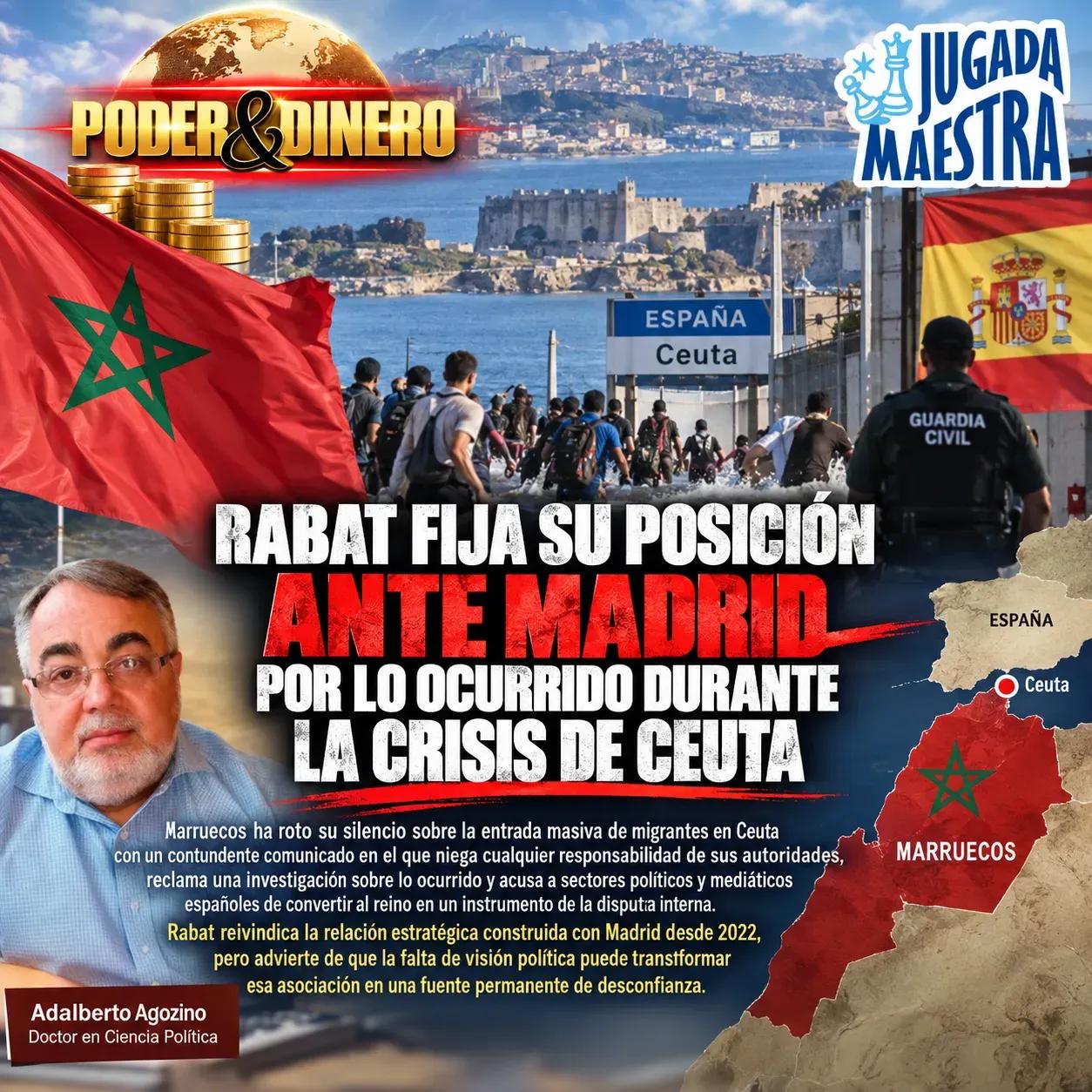
The crisis in Ceuta has opened an unexpected crack in a relationship that Madrid and Rabat had presented over the last few years as one of the strongest strategic partnerships in the western Mediterranean. The Ministry of Foreign Affairs, African Cooperation, and Moroccan Residents Abroad of Morocco has decided to intervene publicly to clarify its position after weeks of accusations, parliamentary debates, and political controversies in Spain. Its message is unequivocal: Morocco denies having organized, facilitated, or instigated the massive entry of migrants that occurred at the end of July and rejects becoming the external responsible party for a crisis that, it claims, also has deep dimensions of Spanish internal politics.
The statement released by Rabat on September 10 constitutes the first official comprehensive response from the Moroccan authorities since the outbreak of the crisis. Its tone is significantly more political than defensive. Morocco does not merely deny the accusations: it openly questions the behavior of certain Spanish parties, media outlets, and institutions, warning that the instrumentalization of the bilateral relationship could ultimately harm both countries.
The Moroccan Foreign Ministry reminds that the kingdom sovereignly chose to build a relationship with Spain based on good geographical neighborliness, political understanding, economic partnership, and cooperation in security. That policy, Rabat asserts, found its most complete expression in the Joint Declaration of April 7, 2022, after the meeting between King Mohammed VI and the President of the Spanish Government, Pedro Sánchez. That agreement opened, according to the Moroccan interpretation, a new phase based on mutual respect, trust, ongoing dialogue, and the willingness to construct a beneficial partnership for both parties.
This is not merely a diplomatic reference. The mention of 2022 recalls that the current relationship was born after one of the most serious crises between Madrid and Rabat in recent decades. Since then, Spain has substantially changed its position regarding the Sahara conflict and supported Morocco's proposal for autonomy, while Morocco has consolidated its cooperation with Spain on migration, policing, counter-terrorism, and economic matters.
The material interests that underpin this rapprochement are considerable. Morocco highlights that Spain is its main economic partner and that the Alaouite kingdom has become one of Spain's main trading partners outside the European Union. Moroccan diplomacy further emphasizes that the two countries have achieved significant results in combating criminal and terrorist networks and in preventing migratory flows.
The data provided by Spanish diplomacy shows just how much this interdependence has grown. Bilateral trade reached approximately 22 billion euros in 2024, according to data released by the Spanish Ministry of Foreign Affairs, and more than 5,000 Spanish companies maintain regular exporting activity in Morocco. The Maghreb country is also one of the main destinations for Spanish investment in Africa.
Precisely for this reason, the migratory question acquires a dimension that far exceeds the management of a border. What occurred on July 30 and 31 transformed that border into the epicenter of an unprecedented humanitarian and political crisis.
Tens of thousands of people, mostly from Morocco, attempted to access Ceuta by sea and through the border. Official estimates place the volume of entries and attempts at between 70,000 and 80,000 people. The episode resulted in deaths, missing persons, extraordinary pressure on the city's services, and a political crisis that quickly reached Pedro Sánchez's central government.
The issue took on a new dimension this week when the Spanish government declassified 40 reports and communications corresponding to July. The documents show that the National Intelligence Center had detected calls disseminated via Facebook and WhatsApp and that on July 29, it communicated to Moroccan intelligence services that preparations were underway for entries to Ceuta, both by swimming and by climbing the fence. The groups used to mobilize migrants amassed tens of thousands of people.
The content of this documentation has precisely fueled the controversy that Rabat is trying to contain. Some reports drawn up after the massive entry described a passive or negligent performance by the Moroccan forces. One of them even raised, among the hypotheses analyzed, the possibility that there was some degree of collusion in response to recent political events. But those documents do not prove that the Moroccan authorities organized the operation. In fact, the Spanish government itself has insisted that it does not have solid evidence to attribute the planning of the avalanche to Rabat.
This nuance is the core of the Moroccan argument. Rabat maintains that no data, fact, or report establishes the implication of its authorities. It transforms the issue into a series of questions directed at Madrid: why are the accusations maintained if there is no conclusive evidence, why are irregular migrants not returned when Morocco claims to have officially accepted their readmission, and why do unaccompanied minors continue to remain in Spain whose returns, it asserts, Rabat has repeatedly requested.
The harshness of the statement increases when addressing Spanish politics. The Moroccan Ministry denounces that certain political and media sectors use the kingdom as part of an internal agenda and accuses parties with government experience of having replaced rational analysis with what it characterizes as populist rhetoric. Although it does not explicitly mention the People's Party, the allusion has been interpreted in Spain as an unequivocal reference to the main opposition force.
The People's Party maintains that the relationship with Rabat must be based on mutual respect and the defense of Spain's borders.
From other political sectors, interpretations are different. Former President Felipe González has questioned Sánchez's government's management and has deemed the response to the crisis to be manifestly improvable. The President of Castilla-La Mancha, Emiliano García-Page, has also referred to disastrous management and warned of the risk of the controversy ultimately benefiting the extreme right.
Among security analysts, there is also no unanimous reading. Intelligence analyst Fernando Cocho has argued that Morocco has historically used migratory flows as a strategic pressure instrument and has interpreted the Spanish documents as indications of a greater Moroccan responsibility than Rabat acknowledges. However, his reading contrasts with the official position of the Spanish government, which does not consider it proven that Morocco organized the operation.
The issue has also been presented in journalistic circles as a test of resilience for the bilateral relationship. Analyses published in recent days agree that the declassified documents show that there were prior signals and coordination failures, but they do not definitively resolve the fundamental question about the intentions of the Moroccan authorities. The very newspaper El País has highlighted that the CNI informed Morocco of the existence of calls to cross the border and that subsequent Spanish reports detected a lack of proactive response from the Moroccan authorities.
Therefore, Rabat's position is not simply about denying an accusation. It is also a diplomatic warning. Morocco states that migratory cooperation has historically been effective and that the July episode must be the subject of a thorough investigation to determine its circumstances, identify possible interferences, and prevent it from occurring again.
The final warning is perhaps the most significant. Rabat states that it will not accept becoming an electoral “bargaining chip” or a “scapegoat” for Spanish political disputes. The Moroccan Foreign Ministry asserts that geographical neighborliness is immutable, but it is up to political leaders to transform it into a strategic asset. If what it calls “strategic blindness” is imposed instead, the capital accumulated over recent years could become a permanent source of distrust and recurring tensions.
That is, ultimately, the underlying issue. Ceuta has tested not only the control mechanisms of a particularly sensitive border but also the relationship model built between Madrid and Rabat since 2022. Spain needs Moroccan cooperation to control migratory flows, combat terrorism, and protect its economic interests in North Africa. Morocco, for its part, needs to preserve its partnership with Spain, one of its main European interlocutors and one of the countries most deeply involved in its new diplomatic strategy.
The crisis has shown that this partnership is solid but not immune. The accusations, the declassification of intelligence information, and the political utilization of immigration have introduced an element of distrust that may prove difficult to manage. Moroccan diplomacy has chosen to respond firmly while keeping the door open to dialogue. By recalling the architecture built since 2022, Rabat seems to be sending Madrid a double message: it does not accept bearing a responsibility it considers unproven, but it also does not wish for a border crisis to destroy a relationship it deems strategic.
The Ceuta border will continue to be, by its very nature, a point of friction. But Rabat's statement makes it clear that the future of the Spanish-Moroccan relationship will not be decided solely at that border. It will also be decided in Madrid, in Rabat, and in the ability of both governments to prevent a migratory crisis from ultimately becoming a strategic crisis.
Adalberto Agozino is a Doctor in Political Science, International Analyst, and Professor at the University of Buenos Aires.

Comments