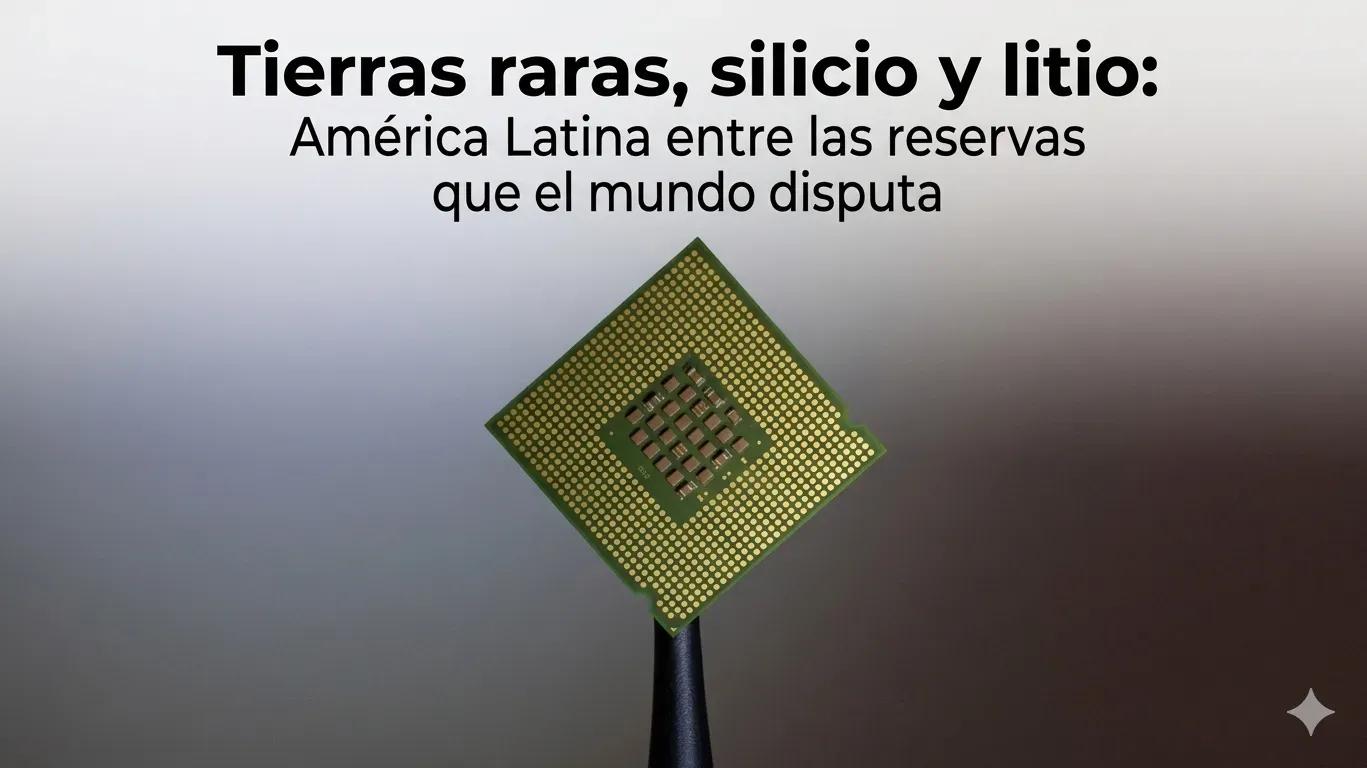
Rare earths are a set of 17 metallic elements that include the 15 lanthanides of the periodic table—from lanthanum to lutetium—plus scandium and yttrium. Their name is a historical anachronism: when they were discovered in the 18th and 19th centuries, they were difficult to isolate due to the technical limitations of the time, which were not precisely scarce. Cerium, for example, is more abundant in the Earth's crust than copper. The problem is not the quantity, but rather the geographical concentration and the complexity of their processing. Since 2011, the European Commission has included them in its official list of critical raw materials, a recognition that reflects both their strategic importance and the vulnerability of the supply chains that sustain them.
What makes these elements strategically vital are their unique magnetic, optical, and electronic properties. Neodymium and dysprosium are essential components of permanent magnets that drive the motors of electric vehicles and wind turbines. Without them, the energy transition that G7 governments promise would be technically unfeasible. Lanthanum, cerium, and praseodymium are used as stabilizers in all kinds of batteries, from mobile devices to large energy storage systems.
Yttrium and europium bring LED screens to life. Gadolinium is key in magnetic resonance imaging equipment. Erbium enables data transmission through fiber optics. Even solar panels benefit from these earths: several elements from the group enhance silicon efficiency in photovoltaic cells, allowing thinner and more flexible panels to be manufactured.
Rare earths and critical minerals
China controls approximately 60% of the world's rare earth reserves and about 90% of its global production. This concentration makes these minerals a premier geopolitical lever. In 2010, Beijing restricted exports to Japan during a territorial dispute in the East China Sea, and the impact on the Japanese electronics industry was immediate. In recent years, China has again limited its exports, accelerating the search for alternatives by the United States, the European Union, and other players.
The problem is structural: according to specialists, from the discovery of a viable deposit to production up to 30 years can pass. An additional solution that is gaining ground, though still marginal, is recycling: currently, the recovery rates of rare earths do not exceed 1% of the global total.
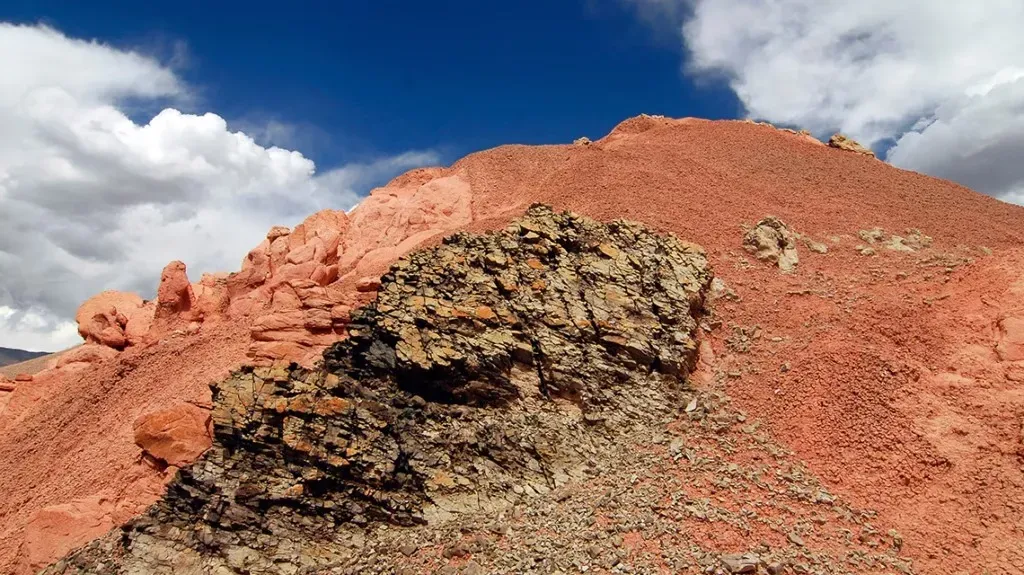
Rare earths are, however, not the only materials that define the strategic landscape of the 21st century. There is a broader category of critical minerals and elements that, while not belonging to that group, are equally indispensable for the digital economy and the energy transition. Lithium, mostly extracted in the South American triangle—Argentina, Bolivia, and Chile—is at the heart of the ion batteries that power everything from phones to cars. Cobalt, largely sourced from the Democratic Republic of the Congo, is another critical component of those same cells. Copper, whose projected demand for 2035 will double current production, is essential for any electrical infrastructure.
In that same category of strategic minerals—though with a different nature—lies silicon. Unlike rare earths, silicon is not a scarce or exotic metal: it is the second most abundant element in the Earth's crust and is obtained from quartz sand. Its critical value does not lie in its rarity but in what is done with it: silicon-based semiconductors are the physical substrate of artificial intelligence, digital communications, and modern defense systems. Control over the chip manufacturing chain—from design to cutting-edge lithography—has become the central axis of the rivalry between Washington and Beijing, prompting the technological restrictions imposed by the United States starting in 2022.
Ormuz and Taiwan: two bottlenecks that worry the world
What these materials have in common is that their value chain is global, fragile, and highly concentrated. And today, that fragility is being tested on two simultaneous fronts.
The Strait of Hormuz, where nearly 20% of the world's oil and a significant proportion of container traffic between Asia and Europe transits, is experiencing one of its highest tension periods in recent years. An eventual closure or disruption of that waterway would not only drive up oil prices but would also increase costs and delay the transport of electronic components, processed raw materials, and intermediate goods circulating between the world's main industrial nodes.
The other scenario that keeps economic security analysts on alert is Taiwan. The island concentrates more than 60% of the world's advanced semiconductor production and around 90% of next-generation chips, manufactured by TSMC. Any military escalation in the Taiwan Strait—even if limited—would disrupt a supply chain on which the automotive industry, defense, artificial intelligence, and virtually all global consumer electronics depend. Currently, there is no large-scale substitute available in the short or medium term.
Latin America: huge reserves, pending added value
Latin America emerges, in this context, as a region with a growing weight in the map of critical minerals, although with a still limited capacity for value addition. Brazil is the most advanced case: it has the largest rare earth reserves in the region—estimated at around 21 million tons according to the United States Geological Survey—and already has active production and export. The Serra Verde project, in the state of Goiás, represents the region's most notable asset: it is currently the only rare earth deposit in production and export outside of China that operates at a significant commercial scale in the southern hemisphere, with regular shipments to Europe and Asia. Its ion leaching extraction model, similar to that employed in mines in southern China, gives it a considerable technical and cost advantage.
Peru and Chile concentrate strategic reserves of copper and indium, the latter crucial for touch screens and solar cells. Mexico houses deposits of beryllium and graphite in Sonora and Oaxaca, although its development remains in exploratory stages. Venezuela has documented reserves of platinum group elements and rare earths in the Orinoco Mining Arc, but institutional instability has halted any serious development. Argentina, better known for its lithium in the Puna region, also records the presence of rare earths in the provinces of Córdoba and San Luis, with no projects in advanced stages to date.
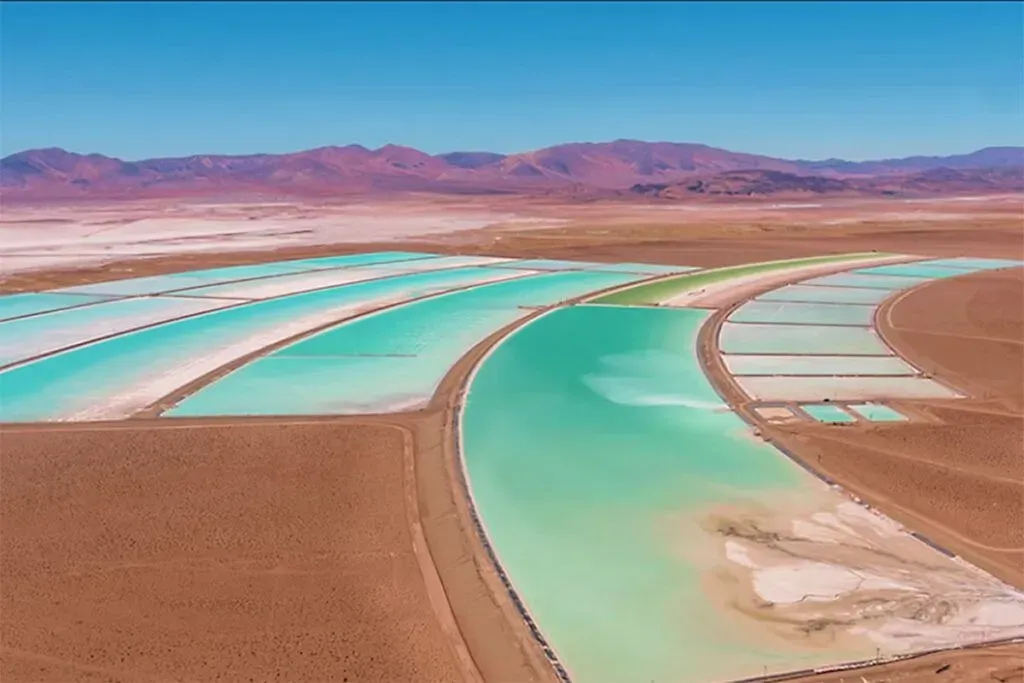
The region faces a structural dilemma that is not new but has acquired unprecedented urgency: it has the reserves that the world increasingly needs but largely lacks the processing infrastructure to capture the added value that those reserves could generate. Exporting mineral concentrates instead of separated oxides, alloys, or purified metals implies conceding the most profitable—and strategic—part of the production chain to countries that do have that installed capacity, primarily China and, to a lesser extent, some European players.
A warning for integral development
The history of lithium is, in this sense, a warning. Latin America holds more than 60% of the world's lithium reserves, but most of the economic value is generated outside the region: in East Asian cell and battery plants, in applied chemistry laboratories in Germany or Japan, in electric vehicle assembly lines in China and the United States. The region provides the raw material and receives a marginal fraction of the final product's value.
Brazil, with Serra Verde, is trying to break that pattern. But a single exporting project is not enough to reposition an entire region. What Latin America needs—and what some governments are beginning to discuss more seriously, though with few concrete results—is a coordinated regional policy on critical minerals that includes investment in refining, technological transfer, stable regulatory frameworks, and market access negotiations that go beyond mere concentrate sales.
The moment is propitious and, at the same time, narrow. Global demand for critical minerals will steadily grow over the next two decades driven by electrification, artificial intelligence, and the technological arms race among powers. The tensions in Ormuz and the latent risk concerning Taiwan remind us that supply chains can break quickly. In that scenario, countries with their own reserves, processing capacity, and solid bilateral agreements will be in a radically different position than those that only depend on the open market.
Latin America meets the first condition. The other two remain, for the most part, a pending debt with itself.
Marcos González Gava is Co-Founder of Reporte Asia and a specialist in Commercial and Financial Business Management with the People's Republic of China

Comments