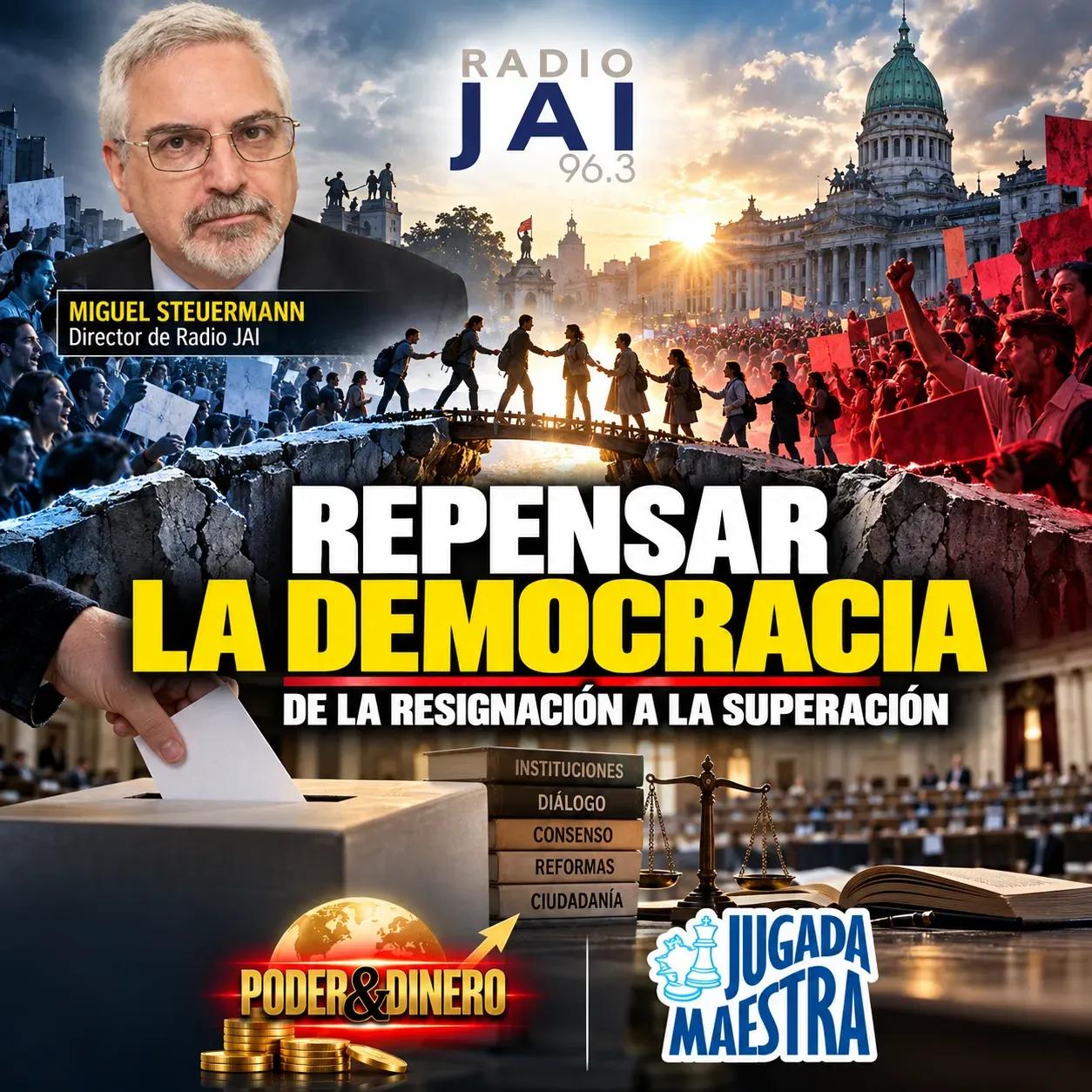
We were taught to repeat that democracy is imperfect, but it is the best system we have invented. And it's true. It is. It is the best system we have invented. No other has managed to combine freedom, alternation, and human dignity like it.
Today, democracies are in a deep crisis.
And precisely because it is the best system, we cannot settle for its imperfection. Saying it is the best cannot be an excuse for not improving it. It has to be the reason to take care of it and enhance it. Imperfections are not for being tolerated. They are to be overcome.
When a system shows flaws, it is wise to seek out the mistakes and find paths for repair. It is not about looking for an easy way out, a revolution that breaks everything and brings another imperfect model.
Politics should be the tool that improves the reality of countries for all its citizens. A country has no owners. It has temporary administrators who must serve all its members and not just a particular group.
The discredit
The discredit of politicians is increasingly greater. It is a global fact, not just from one country. Surveys are damning across all continents.
Societies, for the most part, do not feel represented. They feel that politics speaks of itself, that it discusses its positions, its internal issues, its privileges, while real life goes on elsewhere.
And in that vacuum of representation, the dangerous expectation in supermen grows. Leaders who sell themselves as enlightened, promising magical, instantaneous solutions, without effort or cost. Who do not present a plan, but rather a vendetta.
Their central tool is not the idea. It is the disqualification of the opponent. The opponent is no longer an opponent. They become an enemy. A traitor. Someone to be destroyed, not someone to work with and collaborate with.
The spectacle of the self
I write these lines while watching the pathetic spectacle of the election in Brazil, where the show seems like a football match to see who scores the winning goal. Fans, jerseys, insults. There is no debate. There is a stage. (Note: I write this regardless of the outcome. No matter who wins in Brazil, the problem I describe is the same. The show of the divide is identical on both sides).
Among the imperfections that have intensified in recent decades, especially with the emergence of online communication, the excess of messages, and social networks, there is a cruel paradox.
We have never had such access to so much information, depth, and analysis. And politics has never been such a poor, superficial spectacle.
An actor, generally from a one-man show, is sold over the script of ideas. Ideas or teams are not voted for. Characters are voted for.
A brief history of an idea that never stopped changing
We forget that democracy did not fall from the sky. It was a construction. And it has always been under reform.
Humanity has tried everything: monarchy by divine right, empire, theocracy, oligarchy, feudalism, absolutism. All presented themselves as eternal. All fell.
Modern democracy was born as a limited experiment. Classical Athens was direct but only for free men. The Roman Republic had consuls and a senate. The revolutions of 1688, 1776, and 1789 established popular sovereignty and the separation of powers.
But it was a democracy for a few. Censitary vote. Then universal male suffrage. Only in the 20th century did the deepest revolution arrive: female suffrage. New Zealand in 1893, Finland in 1906, the wave after the World Wars. Then we lowered the voting age from 21 to 18 and now there are discussions about 16.
And models emerged. The American presidentialism: the winner takes all. And parliamentarism with its negotiations.
Democracy has never been a finished model. It was a model that dared to correct itself. Why does it scare us now to correct it again?
The proposal: from 50% + 1 to shared government
It would be time to seek overcoming ways where the vast majority participates in the destiny and responsibility of a nation.
The majority plus one model does not work, even with a 5% difference. That will always make half the population feel like the government does not represent them.
A possible example: when an election does not have a margin where the winning proposal obtains a minimum of 75% of the voters, the future government should not be able to govern alone. The second force should assume responsibility in fundamental ministries: Security, Social Development, and others. In reality, all ministries should have mixed teams.
A kind of co-governments that integrate the different. Where it is a practice to work, live, and collaborate with the other and listen to their proposals. If the opponent stops being an enemy and becomes co-responsible for the government, the business of winners and losers ends. We will all be responsible.
Unchangeable rules of coexistence
But for this to work, there is a prior and non-negotiable condition: unchangeable rules of coexistence.
There cannot be an overcoming model if the rules of the game can be changed by the players for their benefit.
Just as in sports, the rules are not changed by the winning team, in democracy, institutional rules cannot be infringed or rewritten by politicians to perpetuate themselves, to dominate justice, to silence the press, to change the way votes are counted, or to turn the state into a booty.
There must be a hard core, unyielding, unamendable by circumstantial majorities: real judicial independence, freedom of the press, transparency in financing. (Note: this applies to everyone. For the right and for the left. For governments and oppositions. No political space can claim the right to touch these rules for its benefit).
The end of the dead end
Because when there are no overcoming projects that hold the entire citizenry accountable for their destiny, when frustration accumulates and people feel that no matter how they vote, nothing changes, the worst appears.
Frustration mutates into violence. The lack of horizon mutates into anarchy. And democracy, that best system we have invented, begins to be seen not as the solution, but as the problem.
The history is clear: no society eternally tolerates feeling outside its own destiny. If democracy does not integrate, it disintegrates.
We need to think of reforms that perfect the system. When something stops working or starts showing severe flaws, it is time to look for the reasons. And it is wise to find new paths.
Democracy is poor if the only act is to vote. Being a citizen should imply participation that does not simply delegate in a circumstantial vote the destiny of all. Being a citizen is being a part, not just being a fan.
It is not about knowing who scores the goal in the last minute or which horse wins by a head. It is about working, living, and collaborating so that we all win the race.
It would be unforgivable to let the best system we have invented fall, just because we do not dare to improve it.
Miguel Steuermann is the Director of Radio JAI, the Jewish radio of Latin America

Comments