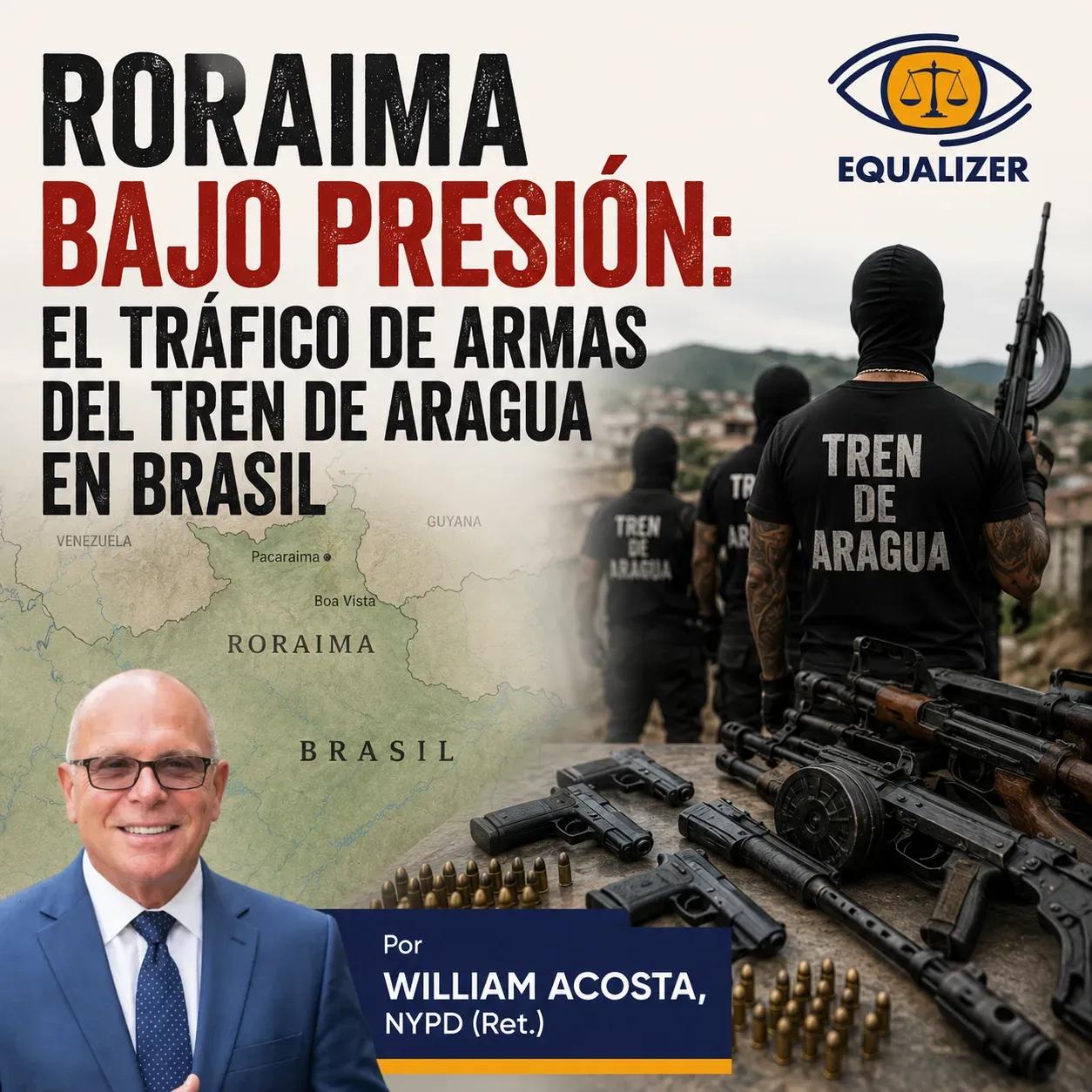
The border between Brazil and Venezuela has become a high-interest area for regional security. It is a convergence point for migration, legal trade, illegal mining, smuggling, drug trafficking, and the clandestine movement of weapons. In June 2026, Operation Rota do Norte investigated a network allegedly linked to the Tren de Aragua for arms trafficking, drugs, and money laundering.
The case is not limited to Roraima. The proceedings extended to Amazonas, São Paulo, Rio de Janeiro, Minas Gerais, and Paraná, indicating that Brazilian authorities were investigating a structure with national, financial, and cross-border connections (“Polícia deflagra operação”).
This report is based on information published by Brazilian authorities and specialized media. The individuals mentioned as detained or investigated maintain the presumption of innocence until a final judicial decision exists.
The border and the criminal model
Roraima shares a border with Venezuela and maintains a direct connection to the Venezuelan state of Bolívar. The region combines jungle, secondary roads, isolated rural areas, and difficult-to-monitor crossings. This geography can be exploited to transport weapons, cocaine, gold, fuel, cash, and other illicit goods.
For the Tren de Aragua, Roraima would represent more than a gateway to Brazil. It could serve as a logistical base for establishing contacts, moving goods, and relating to already consolidated criminal organizations within the country. InSight Crime asserts that the group's presence in Brazil began to grow in 2018 and that the organization exploited the routes opened by Venezuelan migration to expand its mobility and support networks (Cavalari and Venezuela Investigative Unit).
This reality demands a clear distinction. Venezuelan migration cannot be equated with criminal activity. Thousands of people have arrived in Brazil seeking employment, stability, or family reunification. The lack of documents, formal work, or support networks can make them victims of extortion, human trafficking, and exploitation, but it does not make them responsible for the activities of a criminal organization.
The importance of Roraima is also understood by what happens on the other side of the border. Bolívar is an area affected by illegal mining, smuggling, and the presence of armed groups competing for resources and routes. InSight Crime links Las Claritas, in the municipality of Sifontes, with illegal mining networks and with Yohan José Romero, known as "Johan Petrica," one of the founders of the Tren de Aragua (Cavalari and Venezuela Investigative Unit).
Las Claritas gained relevance after the state intervention in Tocorón, the prison in the state of Aragua that for years was the main power center of the organization. After the takeover of Tocorón in 2023, Las Claritas served as a refuge and reorganization point for members of the Venezuelan structure (Cavalari and Venezuela Investigative Unit).
Weapons, cocaine, and Operation Rota do Norte
The Brazilian investigation focused on an alleged high-powered arms trafficking scheme. The Civil Police of Roraima reported that the investigated network supplied war weapons, including .50 caliber machine guns and grenade launchers, to Brazilian criminal organizations (“Polícia deflagra operação”).
According to police investigations, the weapons were allegedly acquired in the United States, Colombia, and Venezuela. The material would enter Brazil through Roraima and be sent to members of the Comando Vermelho active in Amazonas and Rio de Janeiro (“Tren de Aragua usa Roraima”; “Polícia de Roraima prende 11 pessoas”).
The traceability of some rifles is not yet fully clarified. The case gained momentum in November 2024, when Operation Kapok seized rifles of American origin in the village of Samaúma, in the municipality of Mucajaí, within Roraima. This find allowed the Civil Police to initiate an investigation into a possible international arms route and its connections within Brazil (“Tren de Aragua usa Roraima”).
Public sources do not disclose the exact number of rifles seized, their brands, models, calibers, serial numbers, or each stage of their journey before arriving in Mucajaí. Therefore, it would not be correct to present a unique route or specific models as established facts. What is confirmed by authorities is the American origin of the rifles and their value as a starting point for the investigation (“Tren de Aragua usa Roraima”).
Money was not the only form of payment. InSight Crime reported that part of the weaponry may have been exchanged for cocaine. Under this scheme, the Tren de Aragua would deliver arms and receive drugs, which could then be sold in Roraima or other clandestine markets (Cavalari and Venezuela Investigative Unit).
The mechanics are simple, although their consequences are severe. Weapons strengthen a faction; the faction delivers cocaine or cash; the drug produces profits; and that money can finance vehicles, communications, transporters, and new shipments. They are not isolated activities but parts of the same criminal economy.
The Civil Police of Roraima launched Operation Rota do Norte on June 16, 2026. The proceedings were carried out simultaneously in Roraima, Amazonas, São Paulo, Rio de Janeiro, Minas Gerais, and Paraná (“Polícia deflagra operação”).
Authorities issued 25 preventive arrest warrants and more than 30 search and seizure warrants, for a total of 55 judicial measures. The investigation encompasses alleged crimes of drug trafficking, money laundering, and illegal trade of war weapons (“Polícia deflagra operação”).
G1 reported that arrest warrants were carried out against 13 targets and that two additional people were detained in the act. During the operation, vehicles, cash in reais and dollars, drugs, ammunition, electronics, and high-value goods were confiscated (“Polícia de Roraima prende 11 pessoas”).
The number of judicial orders does not equate to the number of arrests made. Some orders may remain pending, be executed at a later stage, or pertain to individuals who were not located during the first deployment. Likewise, an arrest does not constitute a conviction.
Companies, accounts, and criminal alliances
The Judiciary of Roraima blocked approximately 429 million Brazilian reais, about 82 million dollars, in bank accounts and assets associated with individuals under investigation identified as part of the network's financial structure (“Justiça bloqueia R$ 429 milhões”).
The investigation has not publicly disclosed the names of the banks, companies, or the 34 natural and legal persons suspected of being part of the financial arm of the scheme. Authorities did report that companies, bank accounts, high-value vehicles, and crypto assets were allegedly used to conceal assets and disguise the source of funds supposedly derived from arms and drug trafficking (“Justiça bloqueia R$ 429 milhões”).
Among the individuals publicly identified is Gustavo Vieira Rufino, a Brazilian businessman indicated by the Civil Police as one of the main financial operators of the Tren de Aragua in Brazil. He was arrested at the Galeão International Airport in Rio de Janeiro. According to the investigation, he had mobilized over R$300 million in crypto assets in the previous year and had also laundered money for other factions, including the Comando Vermelho (“Tren de Aragua: Suspeito de lavar R$ 300 milhões”).
The lack of a public list of banks and companies requires caution. The existence of blocked accounts or investigated companies does not authorize attributing responsibility to specific entities until authorities disclose their names or there is a judicial decision establishing their involvement.
The possible relationship between the Tren de Aragua and the Comando Vermelho is one of the central elements of the investigation. The logic behind this alliance would be functional: the Venezuelan group would provide weapons, routes, and border contacts; the Brazilian faction would offer drug markets, financial capacity, and operational presence in different states (“Polícia de Roraima prende 11 pessoas”; Cavalari and Venezuela Investigative Unit).
This does not mean that the two organizations have merged. In organized crime, alliances are often convenience agreements. One group can supply arms while another facilitates transport, protection, cocaine distribution, or money laundering. Pacts change when routes alter, competitors emerge, or police pressure increases.
The investigated relationship would also have a penitentiary dimension. According to statements collected by InSight Crime, Roraima authorities described a “symbiosis” between the Tren de Aragua and the Comando Vermelho. Some members of the Venezuelan group allegedly requested to remain in the same prison wings as members of the Brazilian faction, a situation that may facilitate protection, communication, and operational contacts (Cavalari and Venezuela Investigative Unit).
The PCC should be understood as part of the criminal context of Roraima, not as an identified recipient of arms in this investigation. Its presence, along with that of Comando Vermelho, limits the possibility of a foreign organization imposing direct territorial control. In that scenario, the Tren de Aragua would have greater incentives to act as a supplier of criminal services rather than as an occupying force (Cavalari and Venezuela Investigative Unit).
Regional implications and for Venezuela
What happens in Roraima has consequences that extend beyond the Brazil-Venezuela border. A network that can acquire weapons in different countries, move them across border corridors, exchange them for cocaine, and conceal money through companies and crypto assets represents a regional security problem.
For Brazil, the main risk is the strengthening of already established factions. Access to high-powered weapons can increase the intimidation and violence capacity of criminal organizations in the Amazon and urban centers. The alleged cooperation between the Tren de Aragua and the Comando Vermelho shows how groups from different countries can expand their reach without needing to form a single command structure.
For the United States, the case presents a challenge of traceability and prevention. Brazilian authorities identified American-origin rifles in Mucajaí and noted that some of the investigated weaponry may have been purchased in that country. However, public sources have not established each stage of their transport to Brazil nor attribute involvement to the U.S. government (“Tren de Aragua usa Roraima”).
The impact for the United States is primarily hemispheric. American-origin weapons ending up in the hands of transnational criminal networks can strengthen violent factions and worsen insecurity in allied countries. The response requires ballistic information exchange, judicial cooperation, financial investigation, and control of mechanisms for illicit arms purchase and diversion (“Gobiernos latinoamericanos”).
The case also has implications for a potential democratization of Venezuela. A political change would not automatically eliminate the smuggling networks, illegal mining, arms trafficking, and money laundering that have consolidated over the years. These organizations can adapt, move assets, seek new allies, or resort to violence to protect their routes and sources of income.
A democratic transition would have to regain effective control of prisons, borders, and mining areas, without creating power vacuums. It would also require professionalizing security agencies, strengthening civilian oversight, investigating corruption links, and protecting judges, journalists, social leaders, and communities affected by violence.
The penitentiary system would be a priority challenge. Tocorón demonstrated that a prison can become a center for recruitment, coordination, and criminal power. Regaining control of prisons does not solely depend on forceful interventions: it requires controlling illicit communications, purging corrupt personnel, separating violent leaders, and implementing real reintegration programs.
Regional cooperation would be essential. Brazil, Colombia, Guyana, the United States, and a transitioning Venezuela would have an interest in tracking arms, freezing assets, sharing financial information, and preventing political uncertainty from being exploited by criminal groups. The objective should not be solely to seize shipments but to dismantle the chain connecting suppliers, transporters, buyers, financial operators, and drug markets.
Conclusion
Operation Rota do Norte exposes a network that, according to Brazilian authorities, would connect weapons, cocaine, money, and criminal alliances on both sides of the border. The alleged arms trafficking attributed to the Tren de Aragua should not be analyzed as an isolated fact, but as an activity integrated into drug routes, financial operators, and established criminal markets in Brazil.
Roraima occupies a decisive position within that dynamic. Its proximity to Venezuela, illegal activities in southern Venezuela, and the presence of Brazilian factions make the state a strategic point for transnational organized crime.
The challenge for Brazil, Venezuela, and their regional partners is not only to capture those transporting weapons. It also requires identifying those financing operations, laundering resources, facilitating logistics, and receiving the armament. Only a response that reaches the entire chain can prevent the border from becoming a permanent corridor for weapons, drugs, and illicit money.
William L. Acos
ta is a graduate of PWU and the Alliance University. He is aretired police officer from the New York Police Department, a former military member of the United States Army, as well as the founder and CEO of Equalizer Private Investigations &
Security Services Inc., a licensed agency in New York and Florida, with
international reach. Since 1999, he has led investigations in cases of
narcotics, homicides, and missing persons, in addition to participating in
criminal defense at both state and federal levels. Specialized in international
and multijurisdictional cases, he has coordinated operations in North America, Europe, and America

Comments