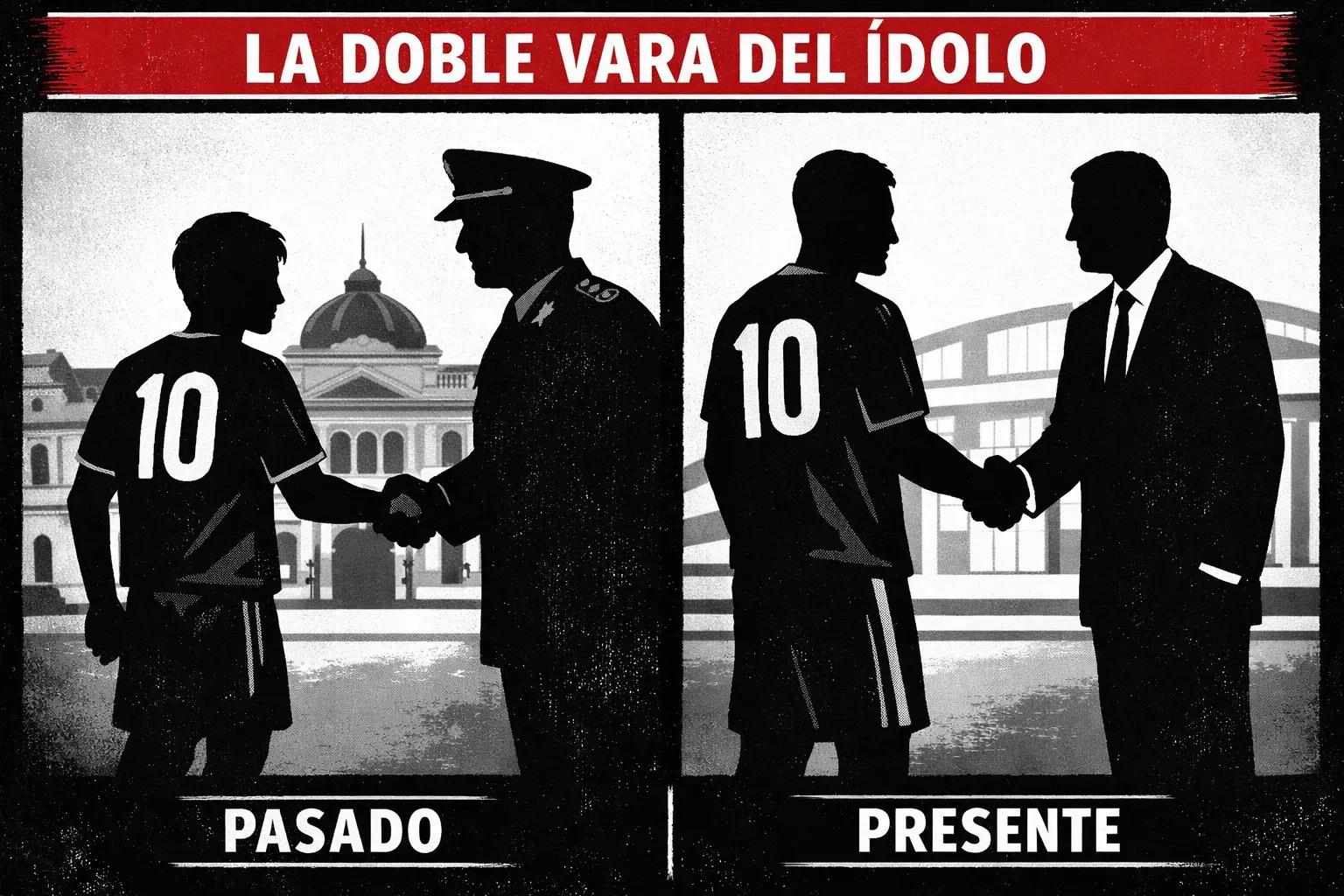
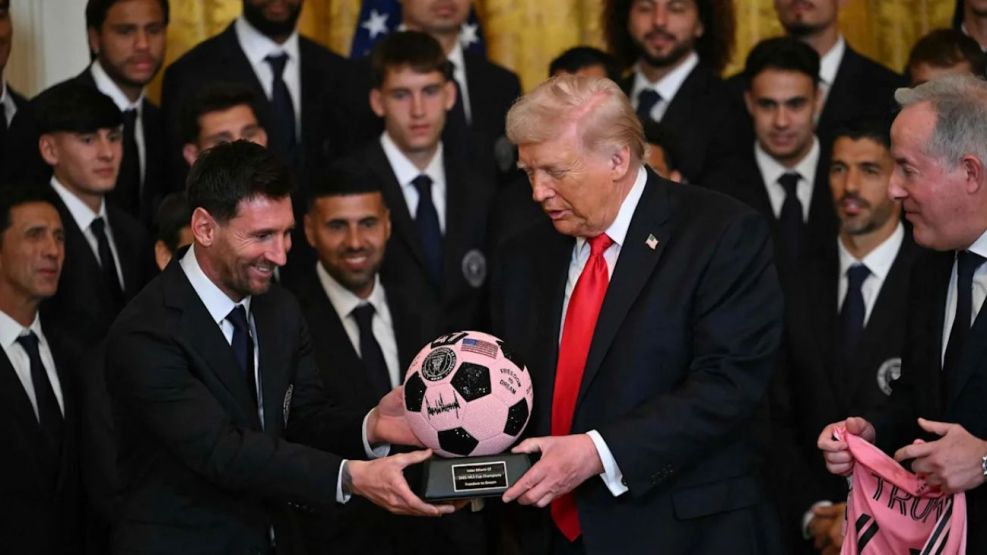
In social analysis in Argentina, objectivity seems to be a rare thing, almost disappeared. It has been replaced by intense passion that confuses understanding and alters facts according to the narrative one wants to tell. What we witness today —a coordinated media lynching against Lionel Messi for a protocol handshake with Donald Trump— is not a genuine ethical debate, but a shameless display of hemiplegic and biased memory.
The captain of the national team is accused of supposed ideological complicity or an unforgivable "softness," while Diego Armando Maradona is placed on the altar of political morality under the precept of a rebelliousness that, when contrasted with the rigor of the archives, is revealed to be as porous as it is self-interested.
At what moment did we decide that the institutional courtesy of an athlete is a capital sin, but collusion with horror is a mere justifiable "detail of the times"?
To understand the magnitude of this discursive injustice, it is imperative to go back to 1979 and observe the photograph that time has been unable to erase, although many attempt to cover it with the mantle of nostalgia. Maradona, at just 18 years old and the glory of the Youth World Cup in Japan still fresh in his boots, shook hands with Jorge Rafael Videla at the Casa Rosada. It was not an accidental encounter or a scheduling error; it was the symbolic validation, necessary for the power in office, of a regime that executed a systematic extermination plan.

It is here where journalistic rigor must be raw: Videla was not just another political actor; he was the face of a dictatorship that, according to the historic Trials of the Juntas in 1985, was responsible for state terrorism that resulted in a life imprisonment sentence for committing 469 crimes against humanity, including 66 homicides, 306 kidnappings, and 97 proven cases of torture. Faced with this factual data, an uncomfortable question arises: Why does contemporary society grant the benefit of "immaturity" or "ignorance of context" to a young Maradona in front of a genocidal, but denies the right to neutrality to a 38-year-old Messi in front of a democratically elected president?
If the argument is that Maradona "had no choice" because at that time the military power was absolute, why does the same conditioning logic not apply to Messi?
Messi is, in this context, an employee of a private corporation, Inter Miami, whose hierarchical structure and commercial commitments in the United States impose an institutional agenda of which he is neither the owner nor architect.
Is Messi really a free man to slight the president of the country where he resides and works without jeopardizing the stability of his club, his contracts, and his own legal security? Or do we demand that the idol sacrifice himself on the altar of our personal ideology so that we, from the comfort of the keyboard, can feel morally superior?
The myth of "Maradonian coherence" stands on a scaffold of mud that crumbles when analyzed during his adult stage. He is exalted for his closeness to leaders like Fidel Castro or Hugo Chávez, presenting him as a guerrilla of social justice, but it is deliberately omitted that these figures represented power structures that also faced international allegations of political persecution and violations of individual freedoms. Maradona, already a successful adult, multimillionaire, and with unlimited access to information, actively chose to forge ties with regimes that deprived their people of basic rights while he received benefits far removed from revolutionary austerity.
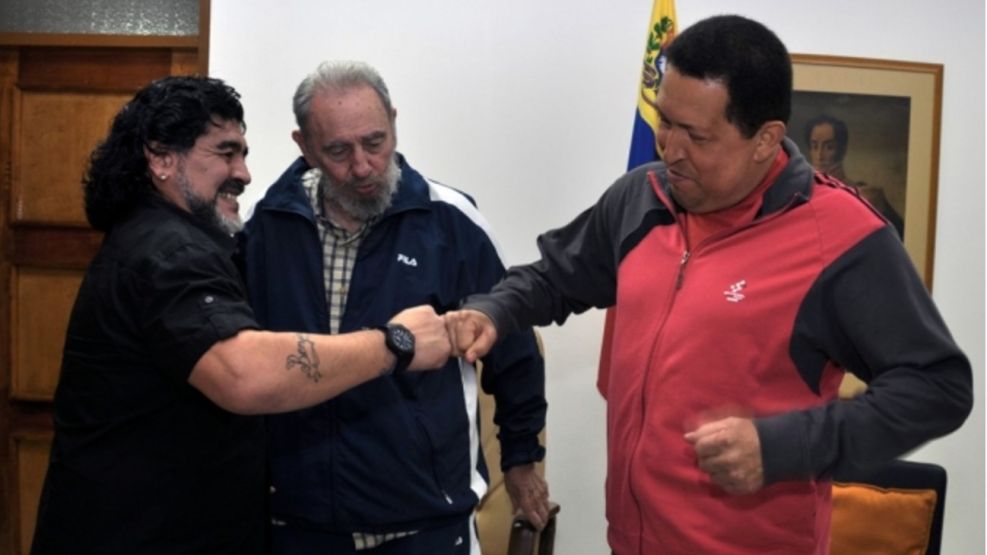
Was that an unselfish rebellion or a strategic alignment?
Why is Maradona's closeness to figures who received questionable flows of capital read as "commitment," while Messi's greeting is interpreted as "betrayal"?
The answer is bitter: we have decided that the explosiveness of one is a free pass for contradiction, but the discretion of the other is a symptom of hypocrisy.
It has become a common place, almost a dogmatic demand, to ask football players to be moral beacons and geopolitical reference points. "He has a responsibility, he is an example for the kids," repeat those who today lynch Messi.
But is it legitimate to demand that an athlete resolve the ideological tensions that we as citizens are incapable of managing at the polls?
Why do we burden a man who just wants to kick a ball with the responsibility to denounce Trump for what happened in Venezuela or at the Capitol?
This demand to "take charge" is, in reality, a form of discursive violence and emotional extortion that tells the idol: "If you are not the echo of my hatred, you are my enemy."
Messi has been consistent with his neutrality throughout his career; he chose not to go to the Casa Rosada in 2022 to avoid being used by the local government, in an act of institutional sobriety that should have been applauded. However, that same neutrality is what is today savagely punished.
Isn't the right to silence a fundamental form of freedom of expression?
Or is freedom only valid when the one speaking says exactly what we want to hear?
The Argentine society is on a path of increasing aggressiveness where there is no room for nuances. If you are not a loud militant, you are a "fake." This dichotomy prevents us from seeing the depth of the facts: while Maradona shook hands with a dictator condemned for atrocious crimes, Messi simply complied with a work protocol in front of an elected leader.
The savagery against Messi is a projection of our own frustrations; we ask him to be the hero we do not dare to be in our daily lives. We label him as "unpleasant" because he does not shout, because he does not insult, because he does not wrap himself in flags that do not belong to him to feed the media circus.
Who is more dangerous to the democratic health of a nation: the athlete who greets and remains silent, or the pack that judges and condemns without looking at its own past?
I am ashamed to see how we have become a digital inquisition that allows no dissent nor plurality. Maintaining journalistic rigor today means swimming against the current of popular sentiment and denouncing the double standard.
Messi's neutrality is not lack of character; it is the most genuine act of resistance in a world that wants to force him to choose a side at any cost.
If we are unable to respect the freedom of the individual to not be part of our political mire, then we are not facing a free society, but rather a pack hungry for myths that justify their own inability to dialogue.
It is time to stop demanding that football players resolve the moral contradictions that we, as a society, have yet to heal, and start demanding from ourselves the intellectual honesty to look at the full picture.

Comments