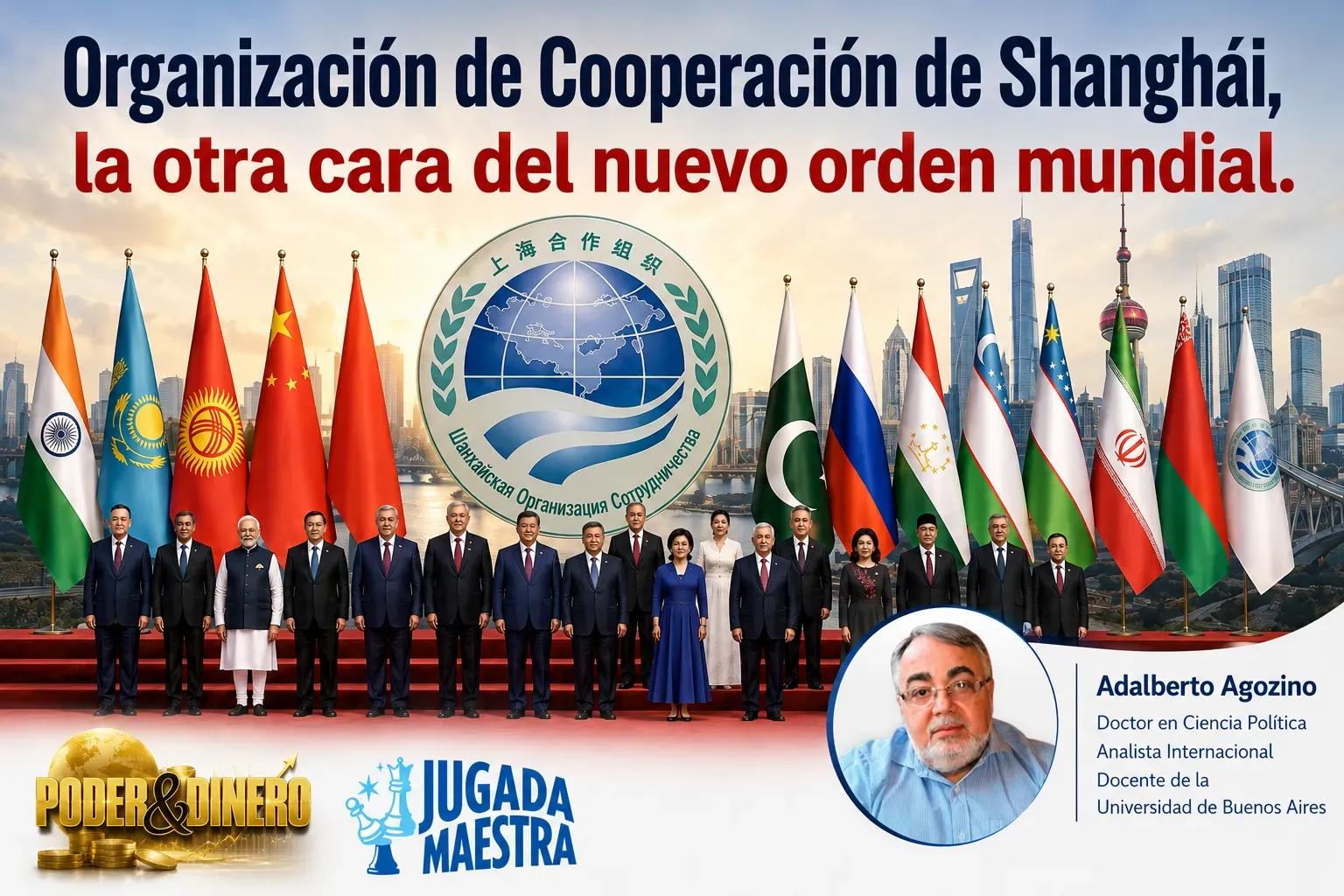
There are photographs that explain an era better than many treaties. The one of Xi Jinping, Vladimir Putin, and Narendra Modi sharing a stage in Bishkek belongs to that category. The Chinese president, the Russian leader, and the Indian prime minister represent profoundly different interests and maintain rivalries between them that are sometimes difficult to disguise. However, the three have found in the Shanghai Cooperation Organization a common space broad enough to defend an idea that until a few years ago seemed more of an aspiration than a reality: global power can no longer be organized around a single center.
The summit held on September 1 in the capital of Kyrgyzstan, coinciding with the twenty-fifth anniversary of the organization, has served to confirm that transformation. The SCO, created in 2001 from the former Shanghai Five, was essentially born as a mechanism to resolve border disputes and combat terrorism, separatism, and extremism. Today it groups ten countries and has become a forum for security, trade, energy, technology, connectivity, and international diplomacy.
Its dimension is difficult to ignore. China, India, and Russia are among the largest economies on the planet; Iran is a top energy power; Pakistan possesses nuclear weapons; and the Central Asian republics occupy a strategic position between China, Russia, the Middle East, and Europe. Together, SCO members represent around 43% of the world’s population and approximately a quarter of global GDP.
But demographic and economic statistics tell only part of the story. The true importance of the organization lies in the accumulation of strategic resources. Its members collectively hold about one-fifth of the world's oil reserves and nearly half of the proven natural gas reserves. In rare earths, whose importance for the electronics, energy, aerospace, and military industries is growing rapidly, China, India, and Russia jointly hold around 60% of known reserves. This data is particularly significant because China not only has large reserves: it also dominates much of the processing and refining stages of these minerals.
Thus, it is an organization based on a formidable material foundation. Territory, population, energy, critical minerals, trade corridors, and internal markets combine in a space that extends from Eastern Europe to the Far East and from the Arctic to the Indian Ocean.
The question that begins to arise in Western capitals is inevitable: is an alternative block to the West being born?
The answer requires some caution. The SCO is not an Asian NATO. Its members are not obliged to defend each other, nor is there an integrated military structure. They also do not have a common foreign policy. The rivalry between India and Pakistan remains deep; India and China maintain strategic competition; Russia and China have divergent interests in Central Asia; and the small Central Asian states seek to avoid becoming mere pawns of any of the great powers.
Precisely for this reason, it is more interesting to observe what the SCO is indeed building.
The Bishkek Declaration and the documents approved during the summit significantly expanded the field of cooperation. Agreements were adopted on security and drug trafficking, artificial intelligence, data centers, environmental protection, energy, transport, and logistics. The organization also made progress in the creation of financial mechanisms and the use of national currencies for trade among its members.
This is not an immediate financial revolution. The dollar remains the primary reserve currency and international transaction currency, and Western financial institutions maintain extraordinary influence. But the direction of the movement is significant. Russia, subjected to broad Western sanctions, has a clear interest in reducing its dependence on the US-dominated financial system. China is closely watching this experience. India, although it maintains close economic and technological ties with Washington, also does not wish for its strategic options to be conditioned by decisions made in another capital.
Vladimir Putin expressed it clearly during the summit. According to the Russian president, more than 98% of Russia's trade operations with SCO members are already conducted in national currencies. Moscow also aspires for the eventual Development Bank of the organization to be independent of Western financial structures.
China, however, seems to pursue a more sophisticated goal than merely constructing an anti-American block. Xi Jinping has spoken of a world "multipolar, equal, and orderly", of a reform of international governance, and of the need to preserve the central role of the United Nations. At the same time, Beijing is promoting infrastructure projects, renewable energy, artificial intelligence, data centers, and trade corridors capable of providing Eurasia greater autonomy.
The Chinese message is less about destroying the existing international system than about modifying the distribution of power within it.
This nuance is important. Carnegie Endowment specialist Evan A. Feigenbaum warned during the summit against the simplistic interpretation of the SCO as an organization where Russia would be losing its "backyard" to China. In his view, the organization was fundamentally born as a Chinese instrument, and Beijing’s economic presence in Central Asia has been decisive for decades.
Recent academic research also invites avoiding hasty conclusions. James MacHaffie, in Asia & the Pacific Policy Studies, believes the SCO has the potential to become an important balancing mechanism against Western security structures, but warns that rivalries among its main members could severely limit that possibility. Susanne Weigelin-Schwiedrzik, a specialist in China and Russia, reaches a similar conclusion from another perspective: the limitations of the SCO are unlikely to disappear while China, Russia, and India do not reach some understanding about the distribution of power within the organization itself.
India may perhaps be the best example of this ambivalence. Narendra Modi did not attend Bishkek to join a crusade against the United States. New Delhi maintains a strategic relationship with Washington and participates in the Quad alongside the U.S., Japan, and Australia. But India also buys Russian energy, develops links with Iran, and participates in the SCO because it understands that the emerging world cannot be managed exclusively from institutions created under Western dominance.
Modi even used his meeting with Putin to again call for an end to the war in Ukraine. The scene perfectly encapsulates the nature of the SCO: cooperation without subordination and convergence without alliance.
Also significant is what happened with Iran. The summit backed Iranian sovereignty and condemned attacks against its territory, while calling for respect for its right to peaceful nuclear development. In contrast, the war in Ukraine was virtually left out of the collective declaration, precisely because there is no consensus among members on the conflict.
This difference reveals the true logic of Bishkek. Members may agree that they do not wish for an international system excessively dependent on Washington without necessarily sharing the foreign policies of Moscow, Beijing, or Tehran.
The expansion of the SCO also does not stop at its ten members. Turkey, which has held dialogue partner status since 2012, has again expressed its aspiration to join fully. President Recep Tayyip Erdogan, however, was quick to clarify after the summit that the rapprochement with China and Russia does not mean abandoning Western alliances. This statement is further proof that the new international system resembles less a division into two blocks than a complex network of overlapping partnerships.
There lies, perhaps, the greatest significance of the SCO.
During the Cold War, international logic tended to organize itself around relatively defined blocks. Today, the great powers cooperate in one realm, compete in another, and maintain cross-cutting alliances in a third. India can simultaneously belong to the SCO and the Quad. Turkey can be a NATO member and aspire to a closer relationship with the SCO. Saudi Arabia and the United Arab Emirates can maintain close ties with Washington while deepening their relationships with Beijing and Moscow.
The SCO does not need to become a military alliance to modify the world balance. It is enough to contribute to its members having more alternatives. Energy alternatives. Financial alternatives. Technological alternatives. Logistical alternatives. Diplomatic alternatives.
In that sense, the organization represents one of the most visible responses to the growing use of sanctions, trade restrictions, technological controls, and financial measures as instruments of international power. The greater the perception that access to markets, credit, technology, or the payment system can be used as a mechanism of pressure, the greater the incentive for emerging powers to develop alternative networks.
Bishkek has not proclaimed the birth of a new empire nor the disappearance of the Western order. It has shown something more important and likely more lasting: that the monopoly on the capacity to define international rules is being challenged.
The SCO still has too many contradictions to become a compact block. But perhaps that is not its purpose. Its true strength may lie precisely in being a flexible platform where powers that do not fully trust each other find sufficient reasons to cooperate.
The photo from Bishkek, therefore, does not herald a new Cold War. It heralds something more uncertain: a world in which it will no longer be possible to assume that all major decisions will be made in Washington, Brussels, or Western capitals.
And that transformation, quieter than spectacular, may be the most important geopolitical event of the summit.
Adalberto Agozino holds a PhD in Political Science, is an International Analyst, and a Professor at the University of Buenos Aires.
Comments