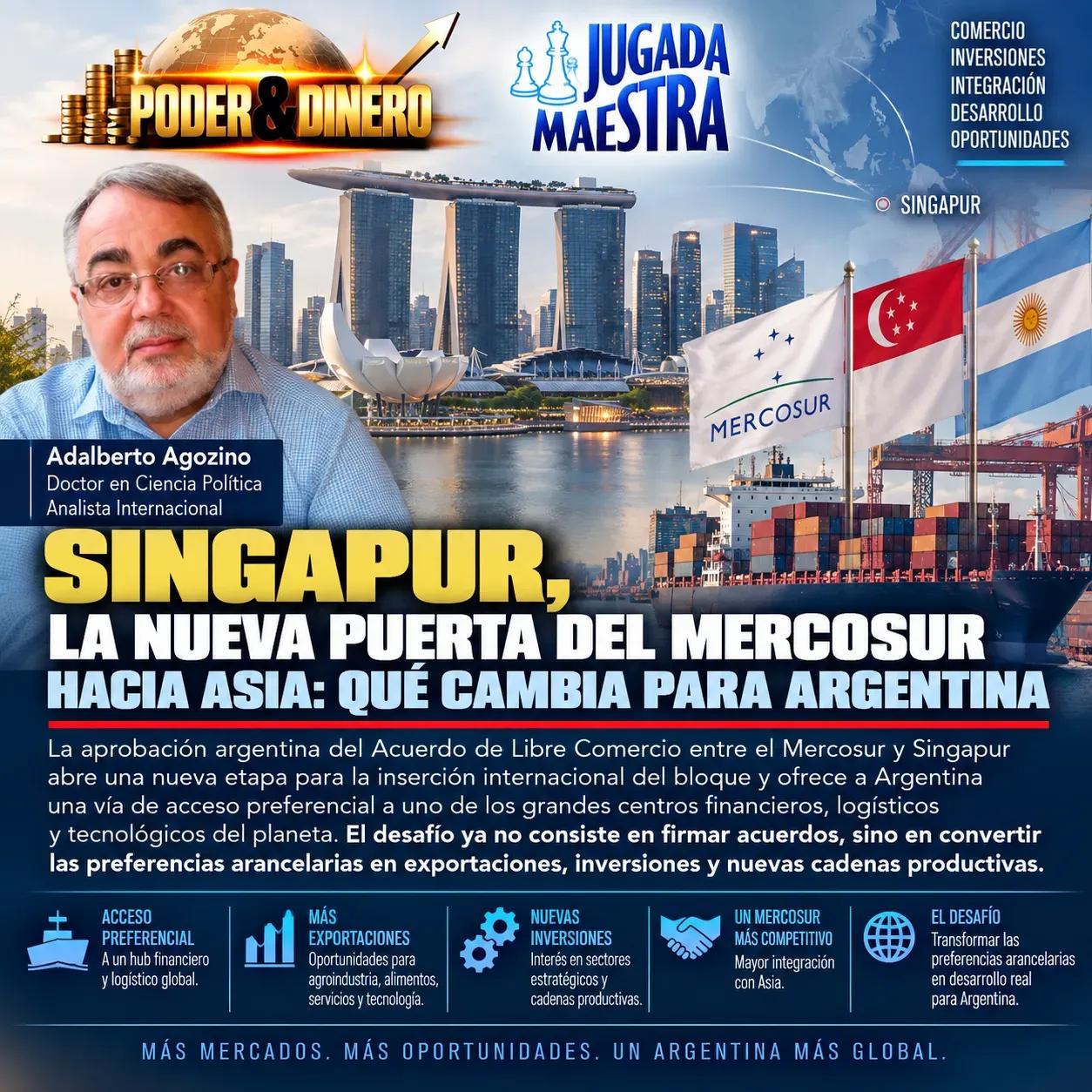
The scene has a dimension that far exceeds trade between two markets separated by more than 15,000 kilometers. With the enactment of Law 27,819 and Decree 1010/2026, published this Tuesday in the Official Gazette, Argentina completed its internal procedure to approve the Free Trade Agreement between Mercosur and Singapore, signed in Rio de Janeiro on December 7, 2023. Congress had converted the project into law on August 26, with 234 votes in favor and only four against. The treaty consists of 19 chapters and covers goods, services, investments, public procurement, electronic commerce, intellectual property, rules of origin, and small and medium-sized enterprises.
The Argentine approval completes the internal process of the four founding members of Mercosur. The agreement began to be applied bilaterally between Singapore and Paraguay, Uruguay, and Brazil during 2026. For Argentina, however, it is still necessary to distinguish between legislative approval and full international entry into force: after promulgation, the deposit of the ratification instrument must be completed according to the mechanism provided by the treaty.
The importance of the pact is not so much in the current size of bilateral trade as in the position that Singapore occupies in the global economy. The city-state has only about 6 million inhabitants, but in 2025 it registered a gross domestic product of approximately 789.5 billion Singapore dollars at current prices, with more than 70% of its added value coming from services. It is one of the major financial, port, technological, logistical, and commercial hubs in Asia. Its economy grew by 4.8% in 2025, according to official statistics from Singapore.
Therefore, viewing Singapore solely as a final destination would misinterpret the scope of the treaty. The true appeal lies in using it as a gateway to Southeast Asia, a region integrated by ASEAN economies and increasingly connected to the productive chains of China, Japan, South Korea, India, Australia, and New Zealand. Additionally, Singapore has an extensive network of trade agreements and is deeply integrated into the economic architecture of the Indo-Pacific.
The contrast with Mercosur is significant. Argentina, Brazil, Paraguay, and Uruguay have a population and a base of natural resources considerably larger and possess an export offer based on food, energy, minerals, agro-industrial products, and manufactured goods. Brazil provides a large-scale industrial and agricultural structure, as well as significant mineral and energy reserves. Argentina combines one of the world's major agri-food platforms with Vaca Muerta, strategic mineral resources, and growing capabilities in knowledge-based services. Paraguay has a powerful agro-export base and an enormous availability of hydroelectric energy, while Uruguay has developed advantages in food, services, and logistics.
The agreement aims to connect these capabilities with an economy that functions as a hinge between the West and Asia. Singapore imports more than 90% of the food it consumes, and in 2025 it sourced food from more than 180 countries and regions. For Argentina, whose export structure has large agricultural and agro-industrial surpluses, there is an evident opportunity here. Meats, grains, oils, processed foods, fishery products, and other agro-based goods may find better access conditions and, above all, a distribution platform towards Asian markets.
Liberalization is extensive. Singapore will eliminate tariffs for 100% of the products originating from Mercosur, while the South American bloc will liberalize around 95.8% of its tariff lines corresponding to Singaporean products. The opening will not be simultaneous for all goods: there are products with immediate elimination and others subject to phasing periods of up to 15 years. The treaty also includes specific rules of origin and regional accumulation mechanisms, intended to prevent goods from third countries from being artificially presented as originating from either party.
This last point is particularly important given the magnitude of Singapore's exchanges with China and other Asian economies. The agreement establishes origin requirements aimed at avoiding triangulation. For Mercosur industries, the rules are both a guarantee and a challenge: a guarantee because they protect preferences against potential abusive use of Singapore as a re-exportation platform; a challenge because they require companies to precisely demonstrate the origin of their products and components.
The opening will have different effects within Mercosur. Brazil has a more diversified industrial structure and companies with greater financial, technological, and logistical capacity. It could take advantage of the new conditions to expand its exports of processed food, chemical products, machinery, and manufactured goods. Argentina presents a different profile. Its most visible opportunities concentrate in agro-industry, food, energy, mining, and professional and technological services.
In terms of energy, the treaty comes at a particularly significant moment. The development of Vaca Muerta is changing Argentina's outlook for oil and gas, while the country seeks to expand its export capacity and move towards liquefied natural gas projects. Singapore, due to its role as a financial, commercial, and maritime center, can play a relevant role as a business and capital-raising hub, although the agreement does not, by itself, guarantee that it will become a major buyer of Argentine hydrocarbons.
Mining offers another possibility. Lithium and copper have made Argentina an area of interest for international supply chains related to electrification, energy storage, and technological transition. Singapore has large institutional investors and international companies capable of participating in infrastructure, energy, logistics, technology, and natural resources projects. GIC, one of the major managers of Singapore's reserves, has reported that it has doubled its exposure to Latin America in recent years and that the region currently represents around 4% of its global portfolio, with investments in infrastructure, technology, financial services, health, education, and energy transition.
The investment appeal is not limited to Singapore. ASEAN received $243.9 billion in foreign direct investment in 2025, according to data released by the organization itself based on the UNCTAD report. Singapore captured $150.9 billion, once again becoming the main recipient of foreign investment in the association. This financial capacity constitutes an additional element of the agreement: Argentina and its partners not only seek to sell in Asia but also to attract Asian capital to South America.
The opportunity may extend to other Southeast Asian partners. Indonesia, Vietnam, Malaysia, and Thailand are markets of much larger dimensions than Singapore and have large-scale industrial and demographic economies. Moreover, Vietnam already constitutes an explicit target for Argentina: Mercosur launched negotiations in December 2025 for a preferential trade agreement. Therefore, the pact with Singapore can function as a first stop in a broader strategy for approaching ASEAN.
Digital commerce is another area where Argentina could find a less evident advantage than in agri-food. The agreement incorporates provisions on electronic commerce, services, movement of people, and investments. Argentina has competitive companies in software, fintech, professional services, engineering, design, and knowledge economy. Singapore, for its part, is among the leading digital and financial centers in Asia. Geographical distance loses significance when the exported product is an algorithm, a professional service, a technological platform, or specialized knowledge.
However, the opening also has potential costs. Argentine industries accustomed to high levels of tariff protection may face more intense competition from products coming from an economy highly integrated into Asian supply chains. The very design of the treaty acknowledges that sensitivity by maintaining protection for part of Mercosur's trade and establishing prolonged phasing schedules.
Here, the political and economic discussion that accompanied the legislative process arises. Foreign Minister Pablo Quirno defined the agreement as "key for Argentina's integration with the world" and stated that it is now up to the private sector to take advantage of the conditions created. In the same direction, Senator Francisco Paoltroni defended during the debate the commercial opening as a tool to reduce Argentina's external lag. On the other hand, during the parliamentary debate, there were also warnings about the need to strengthen technical and sanitary controls. Former governor and opposition legislator Jorge Capitanich emphasized the role that organizations such as INTA and INTI should play to preserve standards and productive capacities.
Both perspectives point to a fundamental issue. A trade treaty does not create competitiveness by itself. It reduces barriers, establishes rules, and generates opportunities. The result depends on the capacity of companies to produce at international costs, obtain certifications, ensure volumes, develop brands, comply with sanitary standards, and build distribution networks.
For Argentina, this issue is especially relevant because commercial opening can simultaneously produce export expansion and pressure on certain industrial segments. Export-capable agri-food, mining, and energy producers start from a different position than small industries that depend on the domestic market. The final effect will also depend on the evolution of the exchange rate, logistical costs, credit, infrastructure, and regulatory stability.
For Mercosur, the agreement has an institutional dimension that may even be more important than its immediate commercial effects. For years, the bloc has been criticized for its difficulty in concluding agreements with extra-regional economies. Singapore represents Mercosur's first formal foray into Southeast Asia and demonstrates that the bloc can build trade instruments beyond its traditional relationships with Europe, the United States, and China.
The demonstration effect can be relevant. A Mercosur capable of negotiating with Singapore has a precedent to deepen ties with Indonesia, Vietnam, Malaysia, and Thailand, and potentially with other economies in the Indo-Pacific. The recent conclusion of negotiations with EFTA and talks with other countries show that the bloc's external agenda is in a stage of greater dynamism.
The Argentine challenge now is to transform the treaty into a concrete trade policy. The Foreign Ministry is already preparing a business mission to Singapore for September, with companies in food, beverages, and software, precisely to take advantage of the opportunities opened by the new framework. This step is revealing: the success of the agreement will depend less on the ceremony of its signing than on the ability to build permanent trade links.
The experience of other Latin American countries also shows that Asian investment seeks concrete assets. UNCTAD recorded a foreign direct investment inflow of $188 billion in Latin America and the Caribbean in 2025, a 14% increase. Brazil received $77 billion, becoming once again the leading regional recipient. The competition for these capitals will be intense, and the projects capable of attracting them must offer legal security, infrastructure, profitability, and stable rules.
The Mercosur-Singapore Agreement is therefore not a simple reduction of tariffs. It is a bet to integrate South America into a region that concentrates a growing share of trade, investments, technology, and global production chains. For Argentina, it represents a particularly significant opportunity in food, energy, mining, professional services, and the digital economy.
But it also poses a demand. The opening does not replace competitiveness. Tariff preference has value only if there are products capable of utilizing it and companies prepared to reach the market. Singapore can become a relevant trade destination, but its greatest strategic value lies in its role as a platform towards the Indo-Pacific and in its ability to connect capital, technology, logistics, and markets.
The Argentine approval thus marks the end of one stage and the beginning of another. For years, the debate has focused on whether Mercosur should open up to the world. The agreement with Singapore shifts the question to a much more concrete realm: what will Argentina do with the door that has just opened? The treaty offers preferences, predictability, and access. Turning them into exports, investments, jobs, and new production chains will be a task for companies, governments, and technical organizations. The result will depend on that capacity. Singapore can be for Mercosur a small market of six million inhabitants or, if the strategy is right, one of the main South American entry points to the vast economic space of the Indo-Pacific.
Adalberto Agozino holds a PhD in Political Science, is an International Analyst, and teaches at the University of Buenos Aires.
Comments