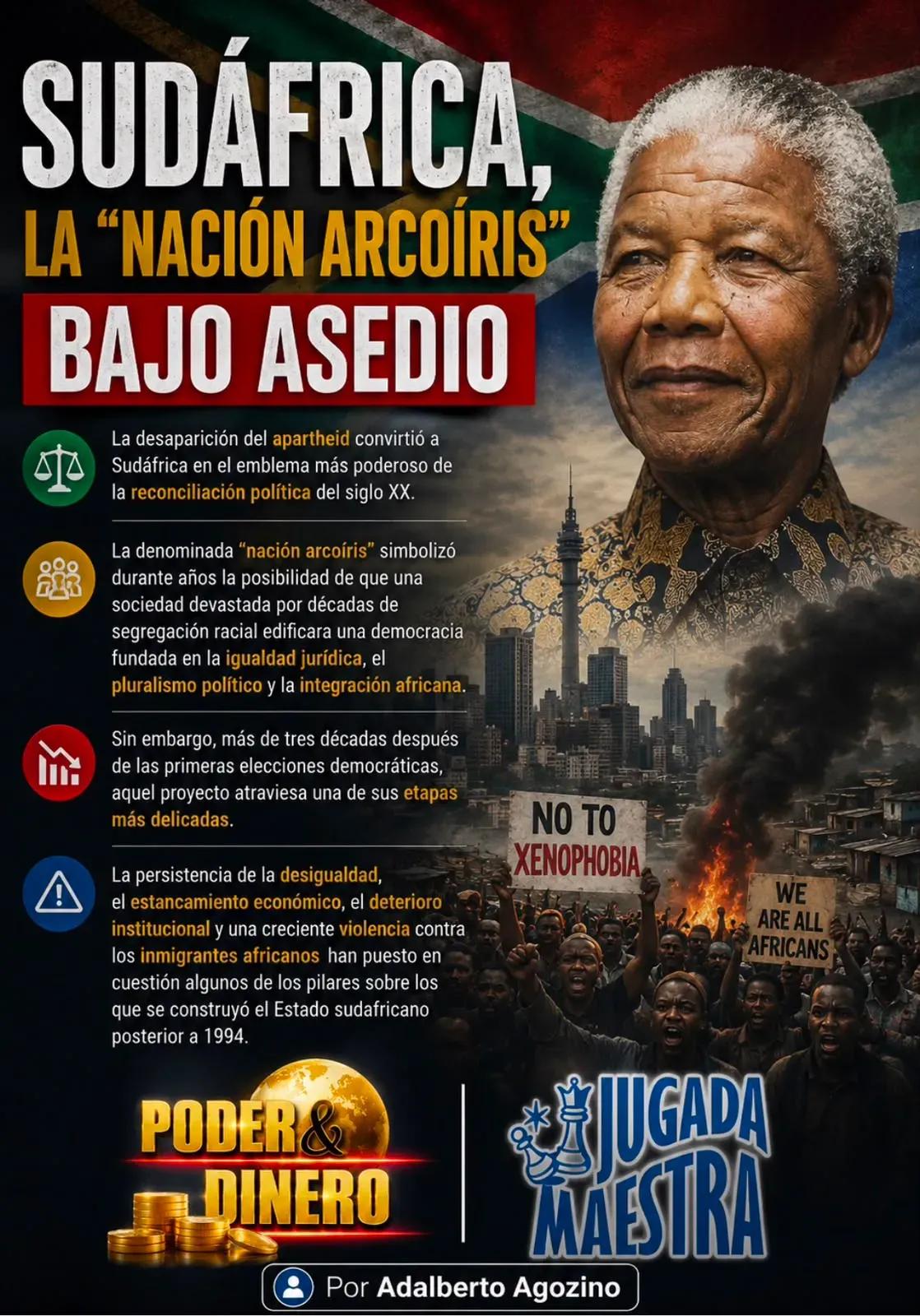
The paradox is evident. No other African country has sparked such high expectations regarding the possibility of peacefully overcoming an institutionalized regime of discrimination. Nevertheless, contemporary South Africa faces a social crisis that many consider the most severe since the end of apartheid. Recent demonstrations in Johannesburg, Durban, Pretoria, and other major urban centers, accompanied by attacks on immigrant communities, looting of businesses, and the forced displacement of thousands of people, reflect a deterioration that transcends episodes of violence and reveals tensions accumulated over the years.
These expressions of hostility are not an isolated phenomenon, but rather the visible manifestation of a profound social malaise fueled by unemployment, persistent poverty, corruption, the degradation of public services, and the growing perception that the democratic transition has failed to transform the economic structures inherited from the segregationist regime.
Although South Africa remains the continent's most developed economy, it also ranks among the societies with the highest levels of inequality in the world. A substantial portion of wealth remains concentrated in a small segment of the population, while broad sectors, especially among the black majority, continue to suffer from conditions of exclusion that remind us of the deep fractures of the past.
This contrast is particularly visible in large metropolitan areas, where modern financial districts coexist with extensive townships characterized by unemployment, precarious basic services, and deteriorating infrastructure. While the first democratic governments expanded access to housing, education, and electricity, these advances did not decisively modify the productive structure or significantly reduce the unequal distribution of wealth.
The macroeconomic stability achieved after the economic liberalization of the late 1990s favored the emergence of a new black middle class and stimulated internal consumption, but its benefits have been distributed unevenly. The high concentration of wealth has remained practically untouched, and social mobility continues to be limited for large segments of the population.
Unemployment is the main destabilizing factor. Official rates exceed thirty percent, and various specialists argue that considering those who have given up searching for work, the effective unemployment rate is considerably higher. Among young people, labor exclusion reaches particularly concerning dimensions and limits the development prospects of an entire generation.
To these economic difficulties is added a prolonged institutional deterioration. In recent years, South Africa has faced repeated corruption scandals, a loss of administrative capacity, and a profound crisis of strategic public enterprises. The troubles of the state power company Eskom, responsible for frequent power supply interruptions, are one of the most visible examples of an administration unable to respond effectively to the needs of the population.
Insecurity exacerbates this scenario even further. The country maintains some of the highest crime rates in the world, with high rates of homicide, violent robbery, and organized crime. In numerous impoverished neighborhoods, the perception of abandonment by the state has favored the emergence of community organizations that, under the pretext of guaranteeing security, have ended up exercising surveillance functions outside the legal frameworks.
The combination of mass unemployment, corruption, deterioration of public services, and insecurity has progressively eroded the legitimacy of the political system that emerged after apartheid. The historical prestige of the African National Congress, built during decades of struggle against racial segregation, is no longer enough to contain a social discontent that manifests itself in recurrent protests and sustained electoral fatigue.
The economic difficulties are also not solely due to cyclical factors. The South African economy continues to rely heavily on traditional sectors, especially mining, whose evolution remains closely tied to the international cycles of raw materials. The slowdown in global growth, energy constraints, and insufficient investment have reduced the country's capacity to absorb a constantly expanding workforce.
Paradoxically, that same economy continues to exert a powerful attraction for millions of citizens from Sub-Saharan Africa. For more than a century, mining, agriculture, construction, and numerous urban activities have depended on the labor of migrants from neighboring countries such as Mozambique, Lesotho, Zimbabwe, Malawi, Botswana, and Eswatini. Regional migration is therefore a historical component of South Africa's economic development and not a recent phenomenon.
After the establishment of democracy, these migratory flows intensified. The relative institutional stability of South Africa contrasted with the economic and political crises recorded in various neighboring states, making the country the primary destination for millions of Africans seeking job opportunities. It is estimated that around three million foreigners currently reside in South African territory.
For years, this reality was interpreted as a natural consequence of the regional integration promoted after the end of apartheid. However, the weakening of economic growth gradually altered public perception. A growing part of society began to blame immigrants for unemployment, the saturation of hospitals and schools, the increase in crime, and the deterioration of public services.
Most academic research rejects that interpretation. Various specialists argue that there is no empirical evidence to attribute the fundamental causes of the South African crisis to immigration. From this perspective, foreigners have become a convenient scapegoat onto which frustrations originating from structural problems, explained by the inability of the economic system to generate sufficient employment and the accumulated limitations of public policies, are projected.
Nonetheless, the weight of these explanations has yielded ground to increasingly emotional and nationalist discourses that present immigration as the main threat to the country’s economic and social stability. On this perception has been built the current rise of xenophobia and anti-immigrant discourse, whose consolidation is one of the most significant political phenomena of contemporary South Africa.
Immigration as a scapegoat: the rise of xenophobia
Periodic explosions of violence against immigrants are not a new phenomenon in South Africa. Since the end of apartheid, successive waves of xenophobic attacks have been recorded, especially in 2008, 2015, 2019, and, with particular intensity, in 2026. What is new about the current situation lies less in the violence itself than in the progressive institutionalization of anti-immigrant discourse and the emergence of organizations capable of converting social discontent into a permanent political project.
What had remained confined to sporadic episodes in the townships has evolved into a narrative that attributes the responsibility for the national economic decline to African immigrants. Unemployment, the pressure on public services, the scarcity of housing, and the rise in crime are synthesized in one argument: foreigners are displacing South African citizens from the labor market and access to increasingly limited resources.
This discourse has found wide acceptance in the provinces hardest hit by poverty and unemployment, where the competition for informal jobs and state assistance intensifies the search for visible scapegoats for problems whose nature actually responds to structural factors.
Research developed by the Xenowatch project at the University of Witwatersrand shows that xenophobia is a persistent phenomenon. Since 1994, more than a thousand violent incidents have been documented, hundreds of fatalities, tens of thousands displaced, and thousands of businesses destroyed or looted. These figures indicate that these are not spontaneous outbursts, but a deeply rooted issue.
Communities from Somalia, Ethiopia, the Democratic Republic of the Congo, and especially Zimbabwe are among the most vulnerable. Their small businesses have been the subject of recurring intimidation campaigns, while many immigrants live under the constant threat of aggression, extortion, and forced expulsions.
The crisis reached a new turning point during 2026 when various anti-immigration groups publicly demanded that irregular foreigners leave the country by June 30. Although that ultimatum lacked legal basis, it created a climate of fear that precipitated evictions, business closures, and mass displacements even before the deadline was reached.
Scenes recorded in cities like Durban illustrated the seriousness of the situation. Numerous families were expelled from their homes, merchants abandoned their establishments for fear of new lootings, and thousands of people sought refuge in temporary centers organized by authorities or the diplomatic representations of their countries of origin.
In the face of escalating violence, several African governments coordinated extraordinary operations to facilitate the voluntary return of their nationals. Nigeria, Ghana, Malawi, Mozambique, and Zimbabwe organized special flights and land convoys, while other states recommended that their citizens temporarily leave South Africa or heighten security measures.
Behind much of this mobilization are organizations whose political influence has increased in recent years.
The most well-known is Operation Dudula, which emerged in Soweto in 2021 as an initiative claiming to combat crime, but quickly shifted its activities towards identifying immigrants, inspecting businesses, and pressuring hospitals, schools, and other public services to restrict access for foreign citizens. Various human rights organizations have repeatedly denounced their intimidation methods, including neighborhood patrols, illegal searches, and acts of violence.
One of the cases that generated significant attention was the death of the child of a worker from Malawi, whose access to medical care had reportedly been hindered by the atmosphere of intimidation surrounding public hospitals. For many humanitarian organizations, this episode symbolizes the extreme consequences of the growing dehumanization of anti-immigrant discourse.
Far from limiting itself to street activism, Operation Dudula decided to enter the electoral competition. Although its results have been modest, many analysts consider that its main success has been moving much of its agenda into the national political debate.
In 2026, the movement March and March, led by Jacinta Ngobese-Zuma and Nkosikhona Ndabandaba, also gained notoriety. Their campaigns advocating for mass deportations, stricter border controls, and a rigorous enforcement of immigration law coincided with new episodes of violence against foreign communities. Although their leaders reject being labeled as xenophobic, slogans like “South Africa for South Africans” or Abahambe (“they must go”) reinforced a narrative that identifies nationality with the exclusive right to public resources.
The immigration issue has ceased to be the exclusive domain of these movements. Various parties have progressively hardened their positions. ActionSA, led by Herman Mashaba, has made immigration control one of its primary programmatic axes; the Patriotic Alliance, led by Gayton McKenzie, has maintained for years a particularly severe discourse towards immigration; and sectors of the uMkhonto we Sizwe (MK), founded by former president Jacob Zuma, also advocate for considerably more restrictive policies.
Particularly significant is the evolution of the African National Congress itself. Historically identified with pan-Africanism and benefiting from the political and material support of numerous African states during the struggle against apartheid, the ruling party has gradually hardened its rhetoric on irregular immigration. Various Executive members have advocated for stricter border controls, large-scale police operations, and biometric systems designed to reinforce immigration management.
For many specialists, this convergence has contributed to shifting into the center of the debate positions that were previously confined to marginal sectors. The greatest risk lies not only in the violence exercised by radical groups but in the growing social acceptance of the idea that immigrants are the main cause of the country's economic and social problems. When that perception begins to be shared by political actors and public institutions, the distance between the legitimate debate on immigration policy and the indirect legitimization of collective violence becomes increasingly tenuous.
Thirty-two years after Nelson Mandela proclaimed the return of South Africa “to the bosom of humanity”, the continent's leading economy faces a momentous decision. It can rebuild the inclusive democratic and pan-African project that inspired the birth of the rainbow nation or allow economic frustration, exclusionary nationalism, and institutional weakening to turn the promise of post-apartheid into a politics of confrontation between
the most vulnerable sectors. How it resolves this dilemma will depend not only on the political and social future of South Africa but also on the credibility of the pan-African ideal in a continent undergoing profound demographic, economic, and geopolitical transformations.Adalberto Agozino has a PhD in Political Science, is an International Analyst, and is a Lecturer at the University of Buenos Aires

Comments