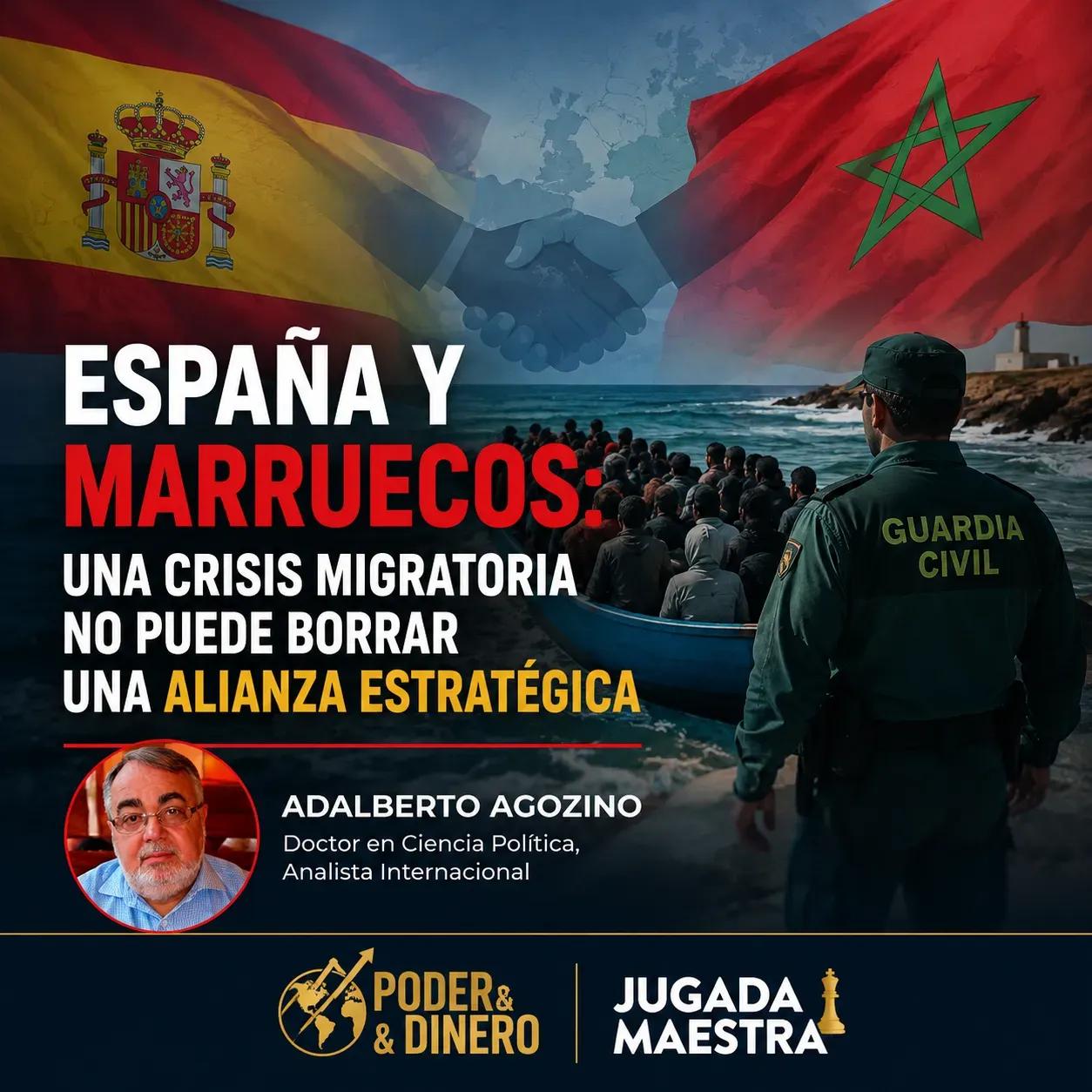
The news was brief, but its potential impact was considerable. A program from Spanish public broadcasting, Mañaneros 360, reported on the existence of a supposed "contingency plan" developed by the Pedro Sánchez government to respond to a potential new migration crisis triggered from Morocco. The information suggested that Madrid was studying mechanisms aimed at raising the cost for Rabat of any eventual use of migratory flows as a pressure instrument on Spain, particularly at the borders of Ceuta and Melilla. The Spanish government later categorically denied that such a plan existed and labeled the information false. RTVE subsequently removed the publication from its social media.
The accuracy is not minor. The version initially disseminated did not simply speak of preventive measures to protect Spanish borders, something perfectly compatible with the obligations of any State. Rather, it presented the possibility that Morocco might be willing to deliberately provoke a migration crisis and attributed to Madrid the intention to prepare a deterrent response. The Spanish government specifically rejected that interpretation.
The controversy arises, moreover, at a particularly sensitive moment. During the summer of 2026, Ceuta again experienced strong migratory pressure. At the end of July, there was a massive arrival of migrants by land and sea, while in the following days, Spanish and Moroccan authorities reinforced their security measures in response to new calls disseminated via social media. Reuters reported on August 14 that Moroccan authorities had detained over a hundred people attempting to reach Ceuta, while Spain significantly increased its police presence in the enclave.
The episode confirms that there is a real migration problem and that Spain needs to have prevention and response mechanisms in place. However, this does not necessarily imply the existence of a Spanish strategy directed against Morocco. The difference is substantial. A border protection policy can coexist with a cooperative bilateral relationship; a plan explicitly conceived to penalize or pressure the neighboring country would imply, on the other hand, a much deeper modification of the strategic relationship.
A relationship too important to be subordinated to the migration issue
The reality of Spanish-Moroccan relations hardly fits the image of two States heading towards new confrontation. Since the adoption of the roadmap in April 2022, Madrid and Rabat have sought to build a broader and more stable framework for cooperation. The XIII High-Level Meeting, held in December 2025, reaffirmed the willingness of both governments to deepen a relationship officially defined as modern, global, and transversal.
The material basis of this relationship is particularly solid. Spain has been Morocco's main trading partner for years. In 2024, bilateral trade reached €22,693 million, a historical record, with a growth rate exceeding 7%. More than 6,000 Spanish companies regularly export to the Moroccan market, and over 900 have subsidiaries or significant stakes in companies in the country. Morocco has also become the main destination for Spanish investment in Africa.
The figures reveal an interdependence that transcends conventional trade. Spanish companies participate in Moroccan infrastructure, transport, water, and energy projects, while Morocco occupies an increasingly important position within the productive chains that connect Europe with Africa. For Spain, geographical proximity makes the Alaouite kingdom a natural platform to the African continent; for Morocco, the linkage with the Spanish economy facilitates its connection to the European market.
This economic dimension explains why a diplomatic crisis would have costs for both countries. Madrid has no interest in deteriorating a relationship that offers growing commercial, energy, and business opportunities. Rabat also seems disinclined to risk a partnership that provides it privileged access to one of the main European markets.
The same logic applies to security matters. Spain and Morocco maintain close cooperation against terrorism, violent radicalization, organized crime, and networks dedicated to human trafficking. In February 2025, the interior ministers of both countries described bilateral police cooperation as extraordinary and reaffirmed their intention to deepen it. Madrid then highlighted Morocco's role in fighting human trafficking mafias and defined Morocco as a loyal and reliable partner for Spain and the European Union.
Migration cooperation, therefore, is not a marginal element of the bilateral relationship. It is one of its pillars. Madrid needs Moroccan collaboration to contain human trafficking networks and reduce departures towards Spanish territory, while Rabat gains political recognition, European assistance, and a privileged interlocutor within the European Union from that cooperation.
Ceuta and Melilla: the most vulnerable point
The migration issue, however, is the area where the bilateral relationship presents the greatest risks. Ceuta and Melilla are particularly sensitive spaces because they involve sovereignty, border security, human mobility, and the complex neighborhood relations between Spain and Morocco.
The 2021 crisis demonstrated how much an alteration in cooperation can lead to immediate consequences. But it also highlighted the high cost of a rupture. Since then, Madrid and Rabat have worked to prevent the migration issue from becoming a mechanism for general confrontation again.
Even during the recent crisis, communication between both governments remained open. President Pedro Sánchez stated during his visit to Ceuta at the end of July that cooperation with Morocco had been constant and fluid and emphasized that communication with Moroccan authorities had been very different from that recorded in 2021.
This fact is particularly significant. If there were a political decision in Madrid to view Morocco as a strategic adversary, it would be difficult to reconcile this with the continuity of cooperation channels that function precisely during episodes of greater tension.
The risk of a crisis manufactured by third parties
It is at this point that the hypothesis that there are actors interested in deteriorating relations between Spain and Morocco becomes relevant. There are, at least based on the available information, insufficient elements to attribute the dissemination of the supposed plan to a specific organization or State. It would therefore be unwise to turn that possibility into an accusation.
However, the existence of interests that could benefit from a Spanish-Moroccan confrontation constitutes a politically reasonable hypothesis. The relationship between both countries affects much broader equilibria than strictly bilateral ones. It impacts European migration policy, the security of the western Mediterranean, trade routes, investment, counter-terrorism cooperation, and Morocco's position within Europe's and Africa's strategic architecture.
Therefore, any information presenting Rabat as a threat to Spain can be used to foster perceptions of distrust and promote political positions against cooperation. The dissemination of information later denied, especially when it comes from a public medium and quickly gains traction in Spanish and Moroccan media, can generate consequences even after having been retracted. The very document provided indicates that the publication ended up circulating in both countries and transferred to the bilateral arena a version that lacked official backing.
The fundamental question, therefore, is not only who disseminated the information but whom a perception of growing hostility between Madrid and Rabat could benefit.
The need to separate the crisis from the strategic relationship
Spain has the right and the obligation to protect its borders and to prepare responses to potential migration crises. Morocco, for its part, has the responsibility to control its borders and combat the criminal networks that exploit migrants. Neither of these obligations requires turning the other country into an adversary.
Bilateral cooperation has already demonstrated that it can produce results. In 2024, Madrid highlighted the reduction in irregular arrivals and the effectiveness of cooperation against human trafficking mafias. At the same time, the opening of commercial customs in Ceuta and Melilla, the expansion of circular migration, and police coordination show that the relationship is based on concrete interests and not solely on diplomatic statements.
Additionally, a horizon that hardly aligns with a strategy of confrontation has emerged: Spain, Morocco, and Portugal will be host countries for the 2030 World Cup. Both governments view the event as an opportunity to deepen economic, social, and human ties between the two societies.
The Spanish government's denial thus assumes a dimension that surpasses the media episode. Madrid has sent a clear message: the existence of migratory problems in Ceuta and Melilla does not mean that Spain has decided to change its strategy towards Morocco. Border security will continue to be a priority, but within a framework of cooperation.
The most reasonable conclusion is that Spanish-Moroccan relations are going through a phase of localized tension, not a new strategic crisis. Migratory pressure can provoke serious episodes and demand strong responses, but the economic, security, and geopolitical interests that link both countries are too deep to be subordinated to each border shock.
In this context, it is particularly important to prevent unverified information from turning a concrete difficulty into a general diplomatic crisis. Spain and Morocco have numerous shared interests, and both governments seem to understand that the stability of the western Mediterranean largely depends on preserving that partnership. Precisely for this reason, any actor attempting to turn the migration issue into a permanent source of distrust would be acting against one of the most relevant strategic relations in the political and economic architecture between Europe and North Africa.
Adalberto Agozino is a Doctor in Political Science, International Analyst, and Lecturer at the University of Buenos Aires.

Comments