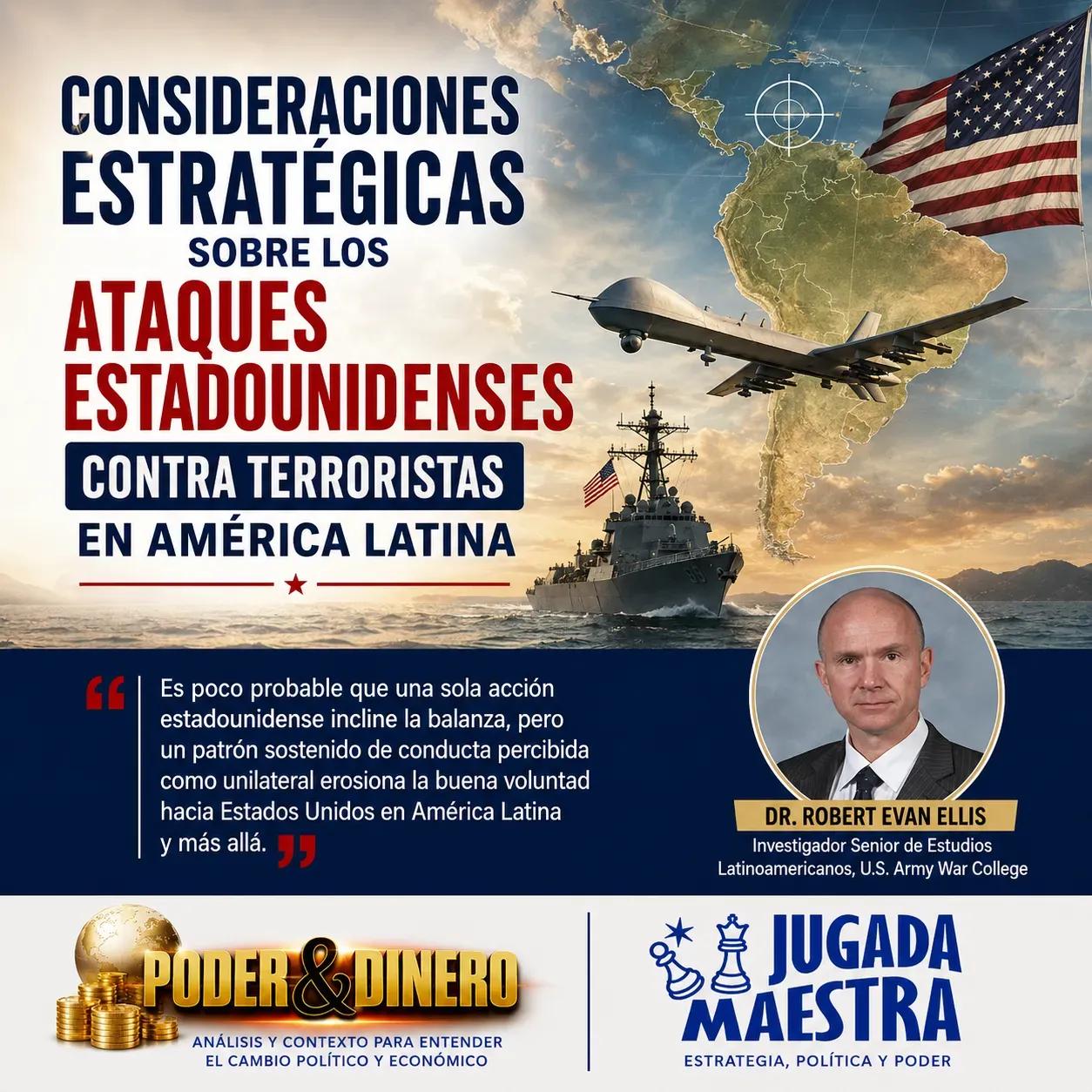
June 19. The U.S. attack last week that killed the founder of the Tren de Aragua, Héctor ‘Niño’ Guerrero Salazar, in the state of Bolívar, Venezuela, along with the subsequent public comments from Secretary of War Pete Hegseth, have focused regional attention on the use of lethal force by the United States as a tool against organizations designated as terrorists.
Such attacks superficially resemble the tactics employed against key figures of extremist groups during the global war on terrorism post-September 11, both in style and in their reliance on, at least, a nominal concurrence from the host government. Then, as now, in the name of Americans killed by the threat posed by a group, the attacks were presented as an expedited alternative to judicial processes, which are often impractical in practice. If this approach proved problematic in the context of the global war on terrorism, the strategic risks of applying it today against narco-terrorist organizations are even greater and deserve serious consideration by policymakers in the United States.
The focus of this article is not the legality or morality of such operations, topics that warrant separate examination. This article centers on how the United States can pursue its security objectives most effectively in a complex environment.
In managing the threats of narco-terrorism and unauthorized flows of people, money, and materials into the United States, as well as the activities of extra-hemispheric adversaries operating in the region, the U.S. national interest is best served by cooperative, institutionally capable, and resilient neighbors to both state and non-state threats operating from their territory: partners who collaborate voluntarily and creatively out of perceived self-interest, not simply out of fear or obligation.
Kinesthetic lethal attacks, while tactically effective and sometimes necessary, increase the risk of adverse consequences in five areas: adversary adaptation that reduces U.S. visibility or effectiveness; fragmentation and violence that degrade partner governments' capability; increased distrust that diminishes future cooperation; political shifts toward less cooperative governments more open to U.S. adversaries; and the erosion of goodwill and U.S. strategic position in the broader global competition. When policymakers determine that the need to act outweighs these risks, the consequences should, at a minimum, be anticipated and mitigated where possible.
Adversary Adaptation
Lethal attacks have a planned deterrent effect that goes beyond simply eliminating a leader, financier, or technical asset. As demonstrated by drug traffickers in response to U.S. lethal operations in the Caribbean—shifting from speedboats to commercial cargo containers and more southern routes—these actions can push adversaries toward less observable and less vulnerable behaviors to interdiction. When the partner's capacity or the coordination between the United States and that partner is imperfect, an attack may degrade the partner’s knowledge about the criminal network more than the network itself.
Fragmentation and Violence
Historically, decapitation attacks have accelerated fragmentation within adversary networks, often accompanied by increased violence as less experienced subordinates and rival organizations vie for control under conditions of uncertainty. This pattern has frequently repeated itself following the elimination of leadership in major cartel organizations. The consequences of targeted attacks or arrests against the Sinaloa, Gulf, and Los Zetas cartels in Mexico, and more recently against the CJNG, illustrate this. So too do the dismantling of the Mendoza and Lorenzana criminal families in Guatemala, as well as the Cachiros and Valle Valle networks in Honduras.
Partner Trust
When U.S. actions are carried out without the partner's consent or with effectively coerced consent, the trust essential for effective cooperation is eroded. As occurred with Dutch and British partners following U.S. lethal attacks in the Caribbean, allies may restrict intelligence sharing for legal, political, or principled reasons, reducing overall effectiveness far beyond the immediate operational context.
Adverse Political Reaction
Even when U.S. actions are conducted with the genuine consent of the host country and in support of shared security goals, they may fuel opposing narratives about sovereignty violations. That political damage is magnified by collateral damage or target identification errors. The sustained refusal of Sheinbaum's government to allow U.S. attacks on Mexican territory, and the quick denial by Arévalo's government that such attacks were being considered in Guatemala, illustrate the depth of these sensitivities.
While political repercussions can be managed through effective communication and a tangible demonstration of shared benefits, a too-frequent series of attacks causing disproportionate collateral damage, combined with a U.S. posture perceived as disrespectful of sovereignty, risks triggering the political downfall of a cooperative partner and its replacement with a government actively hostile to Washington. Such a government could expand, rather than restrict, narco-terrorist organizations' access to its territory, reduce security cooperation, and deepen its ties with U.S. adversaries, creating a strategic detriment that far outweighs any tactical gains achieved with the original attack.
Strategic Positioning
A single U.S. action is unlikely to tilt the balance, but a sustained pattern of behavior perceived as unilateral erodes goodwill toward the United States in Latin America and beyond.
China is already exploiting perceptions of U.S. coercion in its public statements and diplomatic efforts, building consensus around alternative governance structures that favor Beijing and weaken Washington.
These include the Global Development Initiative, the Global Security Initiative, the Global Civilization Initiative, and the Global Governance Initiative.
Soft power rarely overcomes a gap in military capabilities or a superior trade offer, but it often influences partners' decisions at the margins, precisely in cases where China's material offer is competitive. The United States cedes such advantages at its own strategic risk.
In its commitment to putting America first and responding to real security threats, Washington sometimes underestimates the strategic consequences that can arise from the application of its considerable military, technical, and intelligence capabilities. The five risks described here do not constitute arguments against action; they are arguments in favor of fully accounting for all consequences and costs before acting. When the use of force is necessary, careful planning and proper communication, combined with respectful consultations with partners, can substantially reduce the associated risks. That prudence is neither weakness nor naivety. It is the strategic wisdom needed to manage the nation’s affairs in an environment where every action carries consequences that extend far beyond the immediate objective.
*R. Evan Ellis is a senior non-resident associate at the Center for Strategic and International Studies. His most recent book, China in Latin America: Distorting Development and Democracy, was published by Palgrave Macmillan. The opinions expressed are solely those of the author.
Robert Evan Ellis is a senior non-resident associate at the Center for Strategic and International Studies (CSIS).

Comments