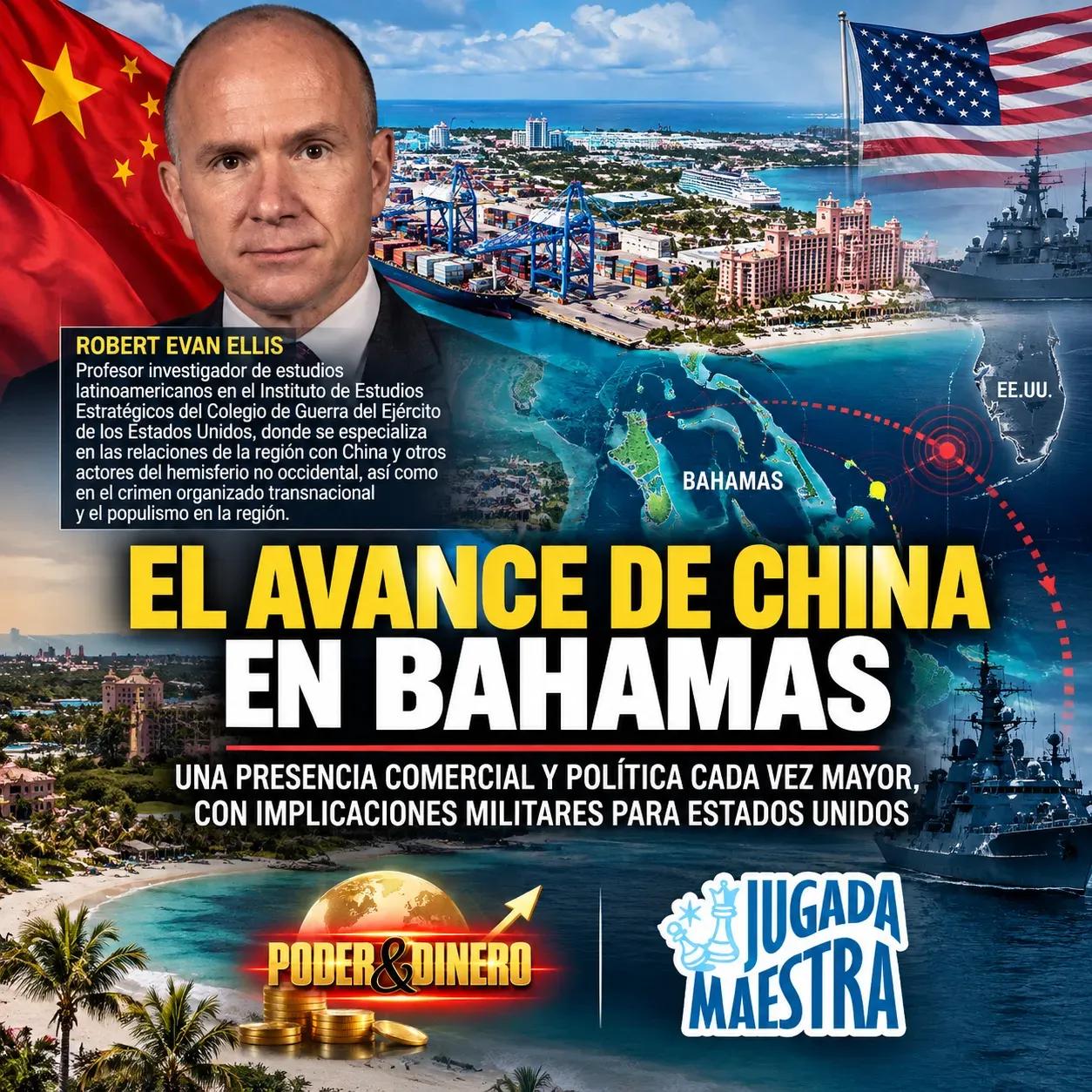
Introduction: a strategic presence at the gates of the United States
The U.S. National Security Strategy of December 2025 established Washington's commitment to resist the influence of extra-regional actors in the Western Hemisphere, especially when it involves control over strategic assets and maritime corridors.
China has developed a commercial presence and a network of influence relationships in the Bahamas that pose strategic difficulties for the United States. The archipelago is located just 80 kilometers from U.S. territory at its closest point, even closer than Cuba. Additionally, the military maritime routes used by Washington to deploy and supply its forces pass through the islands. For this reason, the State Department has described them as the "third border" of the United States.
China's influence in the Bahamas receives less attention than its activities in Cuba, the Panama Canal, the port of Chancay in Peru, or the space radar installation in Neuquén, Argentina. However, the author argues that its strategic importance is comparable.
Although the Chinese presence is primarily commercial and political in nature, the combination of companies under Chinese control and ties with political, military, and business figures could offer Beijing opportunities to observe the movements of U.S. forces and even threaten them.
1. Chinese business projects
Chinese commercial investments reinforce Beijing's influence and, in the worst-case scenario, could provide cover for operatives from the People's Liberation Army or the Ministry of State Security of China.
Activities span port operations, hotels, resorts, construction, telecommunications, and energy.
The port of Freeport
The Hong Kong-based company Hutchison operates the main port and container terminal in the Bahamas, in Freeport, as well as its cruise terminal.
The company is developing a $100 million modernization program that includes cranes and other equipment that have previously raised concerns related to data security.
Baha Mar and other hotel complexes
One of the main Chinese commercial projects is the Baha Mar resort, valued at $4.2 billion and owned by Chow Tai Fook Enterprises, based in Macau.
The construction company China Construction America (CCA), responsible for the works, was convicted by U.S. courts for causing $845 million in damages through fraud and breach of contract against the original developer, Sarkis Ismirlian.
CCA and its parent company, China State Construction and Engineering Company, are also involved in other major projects, such as The Pointe, the complex associated with Margaritaville Resort, and the British Colonial Nassau hotel.
The article notes several conflicts between Chinese companies and Bahamian authorities regarding labor and immigration issues.
Among the mentioned examples is the detention of 65 Chinese citizens who were working on renovations at the British Colonial Hotel without the appropriate work permits and allegations about hiring foreign workers at The Pointe, despite the agreement with the Government stipulating that 70% of the workforce should be local.
Hospitals, infrastructure, and agriculture
The Chinese presence also extends to a hospital funded by a loan, renovations of the national stadium—previously built by Chinese companies—and a demonstration farm donated to the country.
These projects expand opportunities for regular contact between Chinese personnel and Bahamian institutions.
Telecommunications and digital surveillance
In telecommunications, Huawei is a major supplier for national operators ALIV and BTC.
In 2013, Huawei Marine Systems was selected to modernize BTC's BDSNi fiber optic network, including underwater cables.
The author believes these infrastructures present potential risks for government, commercial, and personal information.
In terms of video surveillance, the Chinese company Hikvision supplied over 2,000 cameras for the Baha Mar casino, among other works carried out in the country.
Energy and storage
Chinese companies are also involved in the Bahamian energy sector, particularly in solar projects and storage systems.
The article mentions Sungrow, which supplied an energy storage system for Sampson Cay, as well as Kehua and GSL, providers of solar energy-related products and services.
Huawei, for its part, promotes its capabilities in integrating solar solutions in the country.
2. Personal ties and influence diplomacy
In addition to investments, China has developed an extensive network of relationships with members of the security forces, political leaders, journalists, businessmen, and representatives of Bahamian society.
Training for security forces
According to information published by the institutions themselves, the Royal Bahamas Defence Force and the Royal Bahamas Police Force regularly send personnel to China for training courses.
In 2025, six members of the Bahamian defence force participated in programs conducted by Chinese military, naval, and air institutions.
The courses included training in maritime law enforcement and in the Chinese language.
For his part, Police Deputy Commissioner Leamond Deleveaux is said to have participated in a course in China on peaceful conflict resolution.
The author emphasizes that these personal contacts are complemented by donations of equipment.
Among them are two Tiger armored vehicles delivered in August 2017, equipment for the military band in November 2024, advanced sports equipment, jet skis, and patrol boat material donated by the Baha Mar Foundation, linked to the Chinese-owned complex.
Contacts with political and professional leaders
Chinese diplomacy is not limited to security forces.
According to the article, the Chinese government took approximately 100 Bahamians to China over the last year, including parliamentarians, high-ranking security officials, doctors, nurses, students, and business representatives.
In July 2026, representatives from the two main political parties in the country—the Progressive Liberal Party and the Free National Movement—traveled to Beijing for consultations among party organizations.
Bilaterals meetings were also organized regarding dialogue between civilizations and economic and commercial cooperation.
By October 2026, 23 Bahamian doctors and nurses were scheduled to travel to China to participate in a health-related activity.
The relationship with the media
The author pays special attention to the ties between China and Bahamian journalists.
Among recent examples is Leandra Rolle from the newspaper The Tribune, who participated in a seminar in China in July 2026 on media cooperation and political parties.
Genea Noel from Eyewitness News, and Alicia Wallace participated in a three-week Caribbean media exchange funded by China, from June to July 2026.
Jade Russell, also from The Tribune, spent three weeks in Shanghai in April 2025 in a training program for young international talents from countries linked to the Belt and Road Initiative.
The article also recalls previous trips by Ricardo Wells and Rashad Rolle from The Tribune, and Eric Rose from the Bahamas Information Services.
According to Ellis, many of these trips resulted in opinion pieces favorable to China and the lessons that, according to their authors, the country might offer to the Bahamas.
The Confucius Institute
Cultural influence is another component of the Chinese strategy.
The Confucius Institute at the University of the Bahamas, funded and staffed by Chinese personnel, has played a significant role in spreading the Chinese language and culture among young Bahamians.
The institution started as a Confucius classroom in 2009 and became a full institute in October 2012.
By 2019, it had trained more than 1,000 students and taken over 100 Bahamian teachers and students to China.
The author interprets these initiatives as part of a strategy to build lasting ties with the country's future generations.
3. Conclusion: a strategic concern for Washington
Ellis acknowledges that most of China's activity in the Bahamas does not have a direct military nature.
However, he believes that the breadth of that presence and the network of relationships that accompany it gain special importance due to the proximity of the archipelago to the United States and its location over essential maritime routes for the deployment of U.S. forces.
In a conflict scenario between Washington and Beijing in the Indo-Pacific, those routes could be crucial for mobilizing and supplying troops and military assets.
The presence of Chinese companies, their technological infrastructures, and their relationships with political, military, and economic actors could provide Beijing with opportunities to gather intelligence or exert pressure.
The author concludes that Washington should pay more attention to this situation. He believes that given the readiness of the U.S. Administration to apply the priorities set out in its National Security Strategy, Chinese influence in the Bahamas should also be a concern for the Bahamian government itself.
The central thesis of the article
Ellis's argument is that China's strategic influence does not solely depend on establishing military bases or deploying weaponry. It can also be built through ports, telecommunications, investments, training for security forces, political exchanges, cultural programs, and relationships with journalists.
In the Bahamas, the geographical closeness to the United States and the importance of maritime routes turn this economic and diplomatic presence into a national security issue for Washington.
An important clarification: the text presents the situation from the perspective of U.S. security. The possibilities of espionage, support for military operations, or threat to U.S. forces are risks posed by the author; they should not be automatically confused with demonstrated Chinese military activities in the Bahamas.
Dr. Evan Ellis is a research professor of Latin American studies at the U.S. Army War College's Strategic Studies Institute, specializing in the region's relationships with China and other non-Western Hemisphere actors, as well as transnational organized crime and populism in the region.

Comments